
Quick Take
- SpaceX’s 1.3 billion-share Oct. 22 unlock expands tradable supply, but eligibility does not mean shares will sell.
- Aave’s proposed 55% collateral factor reflects SpaceX volatility and a modeled 41% off-hours decline.
- Aave’s $5.47 million SPCXc cap is tiny beside the $194.3 billion unlock, but thin onchain liquidity remains the test.


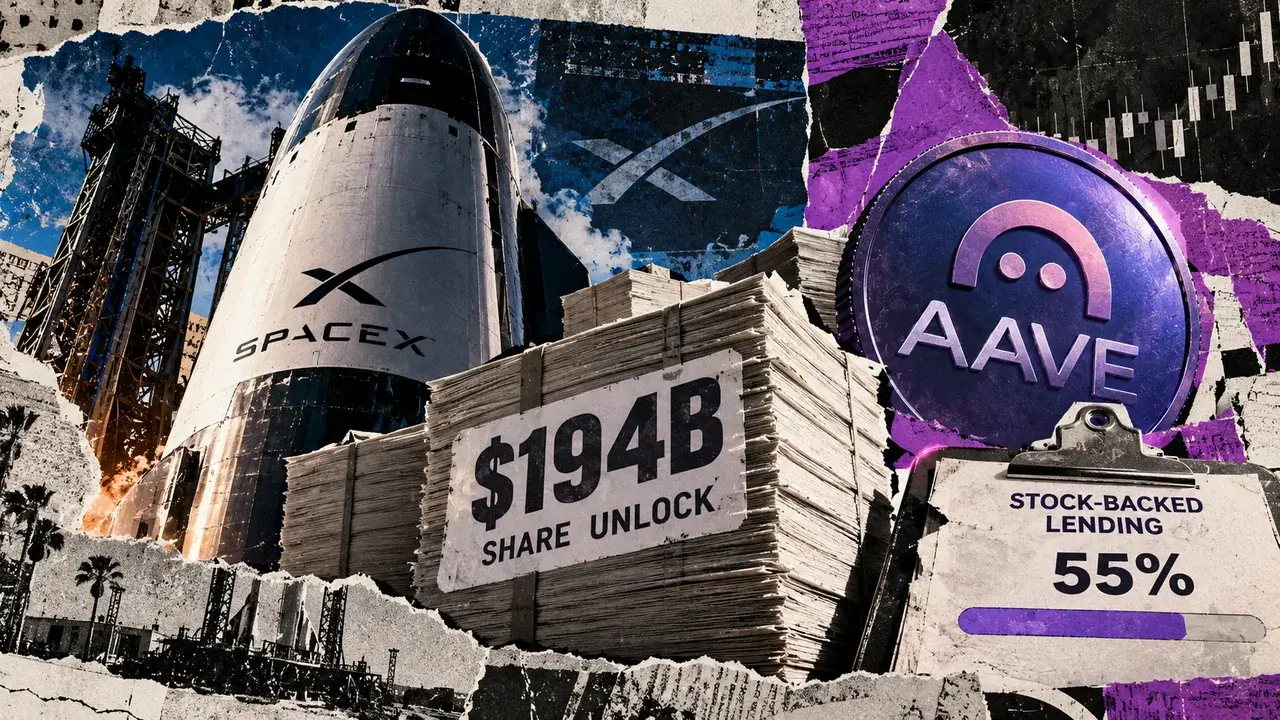
About 1.3 billion SpaceX shares become eligible for sale on Oct. 22, worth roughly $194.3 billion at the Oct. 20 close of $147.89.
A week earlier, Aave Labs proposed accepting tokenized SpaceX shares (SPCXc) as collateral on its V4 Equities Hub on Base. Aave's risk adviser LlamaRisk published its assessment of the listing on Oct. 15 with the largest unlock dated for early November, and SpaceX's earnings date pulled that release forward by about two weeks.
LlamaRisk modeled the earnings-linked release for Nov. 5 to Nov. 9 using third-party earnings estimates.
SpaceX confirmed on Oct. 16 that it would report on Oct. 20, when it posted about $14.6 billion in revenue and $4.4 billion in net income, which places the release on Oct. 22.
In the public thread reviewed as of Oct. 20, the assessment carried the November window, and the original assessment stood as the latest entry.
A smaller release of about 328.4 million shares, worth $48.6 billion at the same price, arrives Oct. 26. The Oct. 22 tranche is 28% of a roughly 4.691 billion-share lockup pool, which adds about 45% to the 2.9043 billion shares already tradable. LlamaRisk's calendar had the larger tranche arriving later and calculated a 40.2% float expansion.
Why the borrowing limit is 55%
LlamaRisk recommends a 55% collateral factor for SPCXc, below the 65% on Tesla and Meta, the most conservative equities Aave supports.
It also proposes a 6.5% maximum liquidation bonus, a 1,000 basis point collateral risk premium, USDC as the borrowable asset, and a cap of 37,000 SPCXc.
A modeled severe off-hours decline of 41%, a 6.5% liquidation bonus, and about 0.279% of accrued interest over the longest market closure give 0.59 divided by 1.065 times 1.00279, or roughly 0.552.
SpaceX's realized annualized volatility since its IPO is about 81.4%, against roughly 52% for Tesla, and the sample is short enough that LlamaRisk built the tail estimate from other stocks.
The most recent 30 sessions show 51.8%, and the 81.4% includes initial price discovery. The earlier date leaves the haircut formula as written, and the collateral math stands while the event calendar needs an update.
A borrower who deposits $1,000 of SPCXc and borrows $400 of USDC starts at a 40% loan-to-value ratio and reaches the 55% threshold on a 27.3% fall in the share price. At the 55% maximum borrowing level, the position reaches its liquidation threshold.
The haircut protects the lender during liquidation and exposes the borrower to liquidation.
SpaceX shares eligible for sale
The unlock makes shares eligible to trade, and the size of any selling is unknown. LlamaRisk reports average daily volume of about 91 million shares over 30 sessions.
If 1% of the 1.31 billion shares were sold, that would be 13.1 million shares, about $1.94 billion and 14% of average daily volume. At 5%, the figure is 72% of daily volume, and at 10% it is 144%.
SpaceX rose 6.1% on its Aug. 6 unlock day and fell around 4% around the Aug. 20 and Sept. 9 events. The stock closed Oct. 20 at $147.89, down 5.5% from Oct. 13 and about 14% from $171.92 on Oct. 6. Elon Musk's own holdings sit under a separate lockup that runs to June 2027.
LlamaRisk counted 13,214 SPCXc outstanding on Oct. 13, worth about $2 million. The Aerodrome SPCXc/USDC pool held $1.04 million, with about $452,000 of USDC and roughly $370,000 of depth for a 2% price move, and more than 99% of trading ran through that one pool.
LlamaRisk expects larger liquidations to rely on issuer redemptions or perpetual futures hedges, and a liquidator's redemption path carries eligibility restrictions. Chainlink pricing on Aave runs 24 hours a day, five days a week, and Nasdaq trades in set sessions.
At $147.89, the 37,000-token cap is worth about $5.47 million, which supports roughly $3 million of borrowing if it fills completely, or about 0.0028% of the unlock's value.
The reviewed records show the proposal pending governance steps, and any SPCXc-backed Aave borrowing remains prospective. The $194.3 billion measures traditional-market supply, and Aave's exposure capacity is a tiny fraction of it.
Where the test goes from here
Citi Research's Oct. 19 note, “US Digital Assets: Aave – Bringing Real World Finance Onchain,” casts Aave as a collateral-mobility layer for tokenized markets, according to Aave's post and coverage of it.
Citi's separate Oct. 13 public paper argues that programmable collateral can improve settlement speed and mobility, and it cautions that moving an asset onchain leaves its liquidity and fundamentals where they were.
If the unlock brings orderly trading, with a small share of the tranche sold and the stock holding near $147.89 or rallying, the 55% factor faces little stress.
Aave's governance would then weigh a listing whose collateral math survived a larger float than the original assessment modeled, and the unlock would strengthen the case for volatile equities as onchain collateral.
If the stock falls 30% to about $103.52, the $400 loan against $1,000 of collateral becomes liquidatable under the proposed factor. A fall near LlamaRisk's 41% tail, to about $87.25 during a market closure, would test liquidation execution at once.
The $370,000 of DEX depth, issuer redemption access, and perpetual hedges would all carry the load together. The 41% is a modeled tail used as a stress assumption.
Tokenized lending can speed collateral transfers, and the SpaceX listing shows that a volatile underlying stock, equity-market closures, and thin on-chain exit liquidity set the limits.
Mentioned in this article







Editorial credits