

Quick Take
- Six House candidates are slated for $1 million each in outside support.
- Bipartisan backing gives crypto relationships across competing congressional coalitions.
- The most important thing is what the next bill permits, requires, and leaves out, rather than how many supported candidates win.


The crypto industry has finally found a way to participate in America's partisan warfare without committing to either of the (only) two available parties: help elect people who agree with it about crypto, then let them argue about everything else.
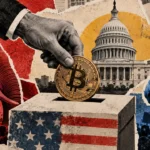
Fairshake's latest House spending plans cover 32 candidates, with 19 Republicans and 13 Democrats on the list. Six are slated for $1 million each in support, while the amounts for the other races haven't been disclosed, according to the AP.
The Super PAC is essentially giving both parties a reason to keep crypto on its policy agenda no matter what voters decide about who controls Congress.
Nothing wrong with that. Since the dawn of time, companies whose businesses depend on financial law have wanted a say in what that law looks like.
Their owners, investors, and ultimately their customers expect them to defend the business, and the people doing the defending would rather have friends than foes writing the rules.
The crypto industry has grown so much that dozens of crypto companies in the US can and want to defend their business with the same strength and money as their much larger tradfi counterparts. And seeing how crypto is largely politically ambiguous, these companies can attack both fronts with the same amount of strength.
They invest almost equally in Democratic and Republican candidates, from local municipal contests to Congressional elections.
They can defend their donations any way the wind turns: Democrats can make their involvement in crypto regulation sound like tightening the reins on evil capitalist corporations, while Republicans can make it look like they're liberating hard-working Americans from the shackles of government-controlled money.
Crypto companies don't really care what it looks or sounds like; they just want to reap tangible legislative crops from the seeds they've sown.
But Fairshake is a federal independent expenditure-only committee, which means it can only finance political activity outside candidates' campaigns, under rules that specifically prohibit coordination.
So when we hear that it announced $1 million in support for a candidate, it doesn't mean it just gave them a million in cash.
Your party is your business, your crypto vote is ours
Republicans French Hill, Bryan Steil, and Bill Huizenga are among the six candidates receiving the disclosed $1 million commitments. Hill chairs House Financial Services, Steil chairs its digital-assets subcommittee, and Huizenga is the full committee's vice chair.
The three Democrats are Janelle Bynum, Steven Horsford, and Derek Tran, Roll Call reported.
The selection of Republican candidates puts money behind people that already have significant influence over financial legislation. The Democratic donation rewards members of the coalition that voted for the industry's largest and most consequential bill: the CLARITY Act.
In July 2025, the House passed CLARITY 294–134, with 216 Republicans and 78 Democrats voting yes. Every voting Republican supported it, while Democrats split.
That's why backing Democrats who crossed that divide tells other Democrats that there can be electoral help (i.e., money) on the other side of a pro-crypto vote. Backing the Republican committee leadership just protects relationships with the people already doing the legislative work.
While Fairshake's political spending is and has to be transparent, the motivations behind each candidate's support for crypto never are. There are a million reasons why a politician would support the crypto industry, so we can't assume any of the candidates were bought with the donations. Donors usually choose allies who already agree with them or at least somewhat agree.
The money just creates a pretty good incentive for other politicians who might be on the verge of supporting actually to jump ship.
In a hypothetical race, suppose an outside group spends heavily to advertise your campaign while your opponent has to buy the same airtime with their own money. Your campaign can then devote more of its own money elsewhere.
The assistance is valuable even if you never helped write the advertisement, and even if the advertisement discusses local jobs. In this example, the outside group helps pay for the politician's general public image while pursuing a much narrower policy goal.
Buying allies is easier than passing a bill
Crypto companies are right when they complain about doing business under rules that leave basic classifications unsettled. The industry needs to know which regulator it answers to, what registrations and licenses require, when software creates obligations, and which disclosures it must provide, to name a few.
The fact that we need more laws is one of the few things Republicans and Democrats actually agree on. However, they usually don't agree on what those laws should include.
So the wording of a proposed bill matters more than the bill's existence, because every word assigns costs, permissions, and consequences to somebody.
Both parties align themselves with grand, abstract goals like reducing government interference and defending consumers. But when it comes to legislation, both have to deal with the petty and trivial: titles, subtitles, chapters, subchapters, sections, subsections, paragraphs, subparagraphs, and clauses.
Their preferred campaign language still has to translate into an enforceable rule, complete with costs somebody will pay.
The bills also have to address officials profiting from business affected by their public decisions. Roll Call reported that disputes over ethics provisions helped prevent agreement on CLARITY before the Senate blocked its advancement last month.
Senators still had to agree on those provisions, regardless of the size of the House coalition.
The commercial desire for predictable rules is therefore compatible with a political desire to scrutinize the rules. Companies can both be right about the cost of uncertainty and self-interested about the solution.
Lawmakers can oppose a weak provision without declaring war on every American who owns Bitcoin. The public shouldn't have to choose between endorsing the whole industry package and returning to regulation by litigation.
Shared donors, competing obligations
Supporting both parties is sensible insurance when neither can promise permanent control. It also lets an entire industry build relationships within each coalition, including with lawmakers who may disagree on taxation or immigration but share a view on financial regulation.
Voters tend to choose representatives that align with their broad views about how their city/district/state/country should be governed. Industries, on the other hand, are laser-focused. They don't care where a candidate falls on the political compass, just how big and fast an impact they can have on crypto legislation.
Issue-based political spending builds that asymmetry. Someone voting on housing costs may help elect a candidate whose expensive campaign was financed by companies focused on an exchange-registration provision the voter has never heard of.
Crypto companies are entitled to make their argument, including when they identify an actual defect in financial regulation.
Their interests also need to be weighed against those of everyone else using an open blockchain. What a large exchange wants from a law can differ from what an individual developer needs. So can the priorities of a token issuer and a customer who wants to understand what happens to their money in bankruptcy.
Everyone should be at least a little skeptical here. Republicans shouldn't get automatic credit for financial freedom because donors like their bill. Democrats shouldn't get automatic credit for consumer protection because they dislike the donors.
Read the obligations each side proposes, and ask yourself which companies gain permission, which users gain recourse, and who pays to comply.
Fairshake will count its electoral victories in November.
Customers will have to judge what those victories produce when Congress next takes up the rules. Friendly lawmakers give the industry access to that process, but customers will get their rights from the resulting text, long after the applause has stopped.
Mentioned in this article

Editorial credits