

MetaMask combines EVM dApp access with native Bitcoin, Solana and TRON accounts. It offers hardware connections and optional linked-login recovery, with a 0.875% wallet swap fee.
MetaMask vs Trust Wallet: Which Wallet Should You Use?
A Trezor-connected browser workflow points toward MetaMask. Native XRP and Cosmos holdings point toward Trust Wallet. Bitcoin and Solana alone no longer settle the choice—both support them, and recovery still depends on the account type you create.
Trust Wallet combines multichain accounts with optional cloud backup and a separate SWIFT passkey wallet. Check account-specific recovery, swap costs and access after its announced September network changes.
Affiliate Disclosure
Some links in this comparison are affiliate links. CryptoSlate may earn a commission if you sign up through these links. Our ratings remain editorially independent.
Overview
MetaMask is our higher-rated overall pick, while Trust Wallet offers a useful native-network alternative. Compare your signer, required app connection and recovery method rather than assuming every account inside either app works the same way.
MetaMask Trust Wallet
Best Fit
EVM browser sessions with compatible external signers
Mobile portfolios including XRP and Cosmos
Standard Key Custody
Phrase-controlled keys encrypted on the device
Classic-wallet keys encrypted on the device
Optional Recovery
Social login plus password, with exportable phrase
Encrypted cloud backup for classic wallets, or SWIFT passkeys
Transaction Warnings
Default-on alerts and simulation on supported requests
Automatic Security Scanner in supported signing flows
Native Network Examples
Ethereum-compatible networks, Bitcoin, Solana and TRON
Those networks plus XRP and Cosmos in classic wallets
Custom Networks
Custom EVM RPC configuration
Custom EVM configuration documented in its network-sunset notice
Mobile dApps
In-app browser and compatible remote connections
WalletConnect v2 for EVM apps, with conflicting Solana guidance
Hardware Accounts
Extension includes Trezor, Ledger and other signers
Ledger connection through the browser extension
Public Code Scope
Extension and mobile repositories, with restrictive licenses
Apache 2.0 Wallet Core library, not a complete-app license
Swap Fee Snapshot
0.875% wallet component
0.7% advertised standard component, qualifying stablecoin waiver
MetaMask wins overview
Comparison scope: MetaMask mobile and extension vs Trust Wallet classic mobile and extension, with optional recovery and hardware accounts identified separately. Base product and fee evidence checked September 11, 2026. Network-transition wording and conflicting TRON connection documentation reviewed September 17. No hands-on app testing, installed-version claim or matched executable quote.
Screenshots
MetaMask screenshots
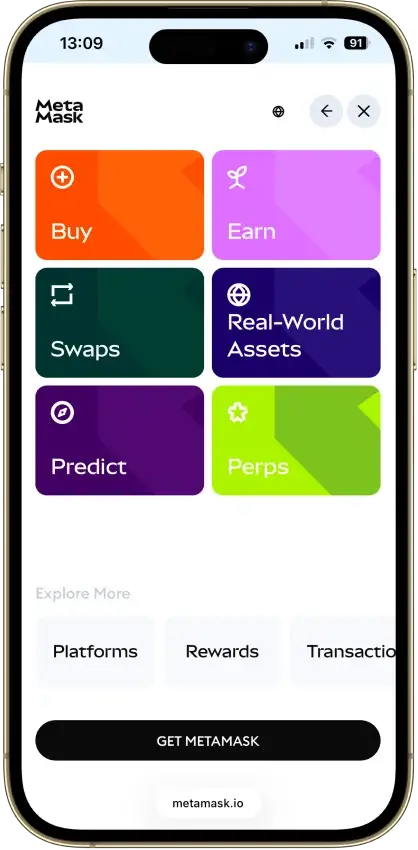
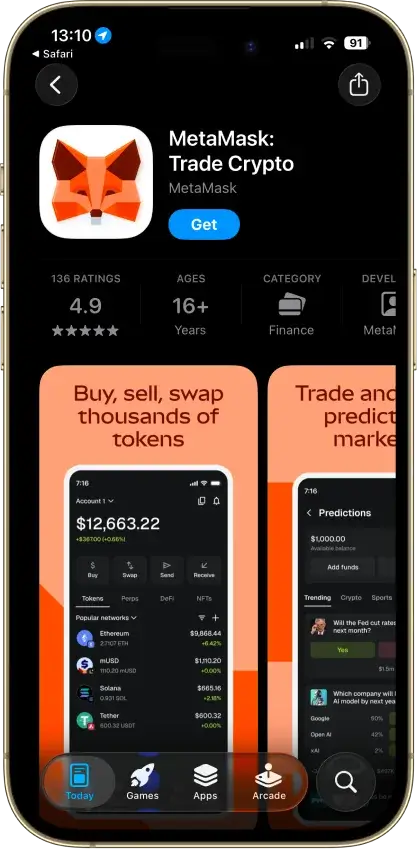
Screenshot 1 of 4
Trust Wallet screenshots
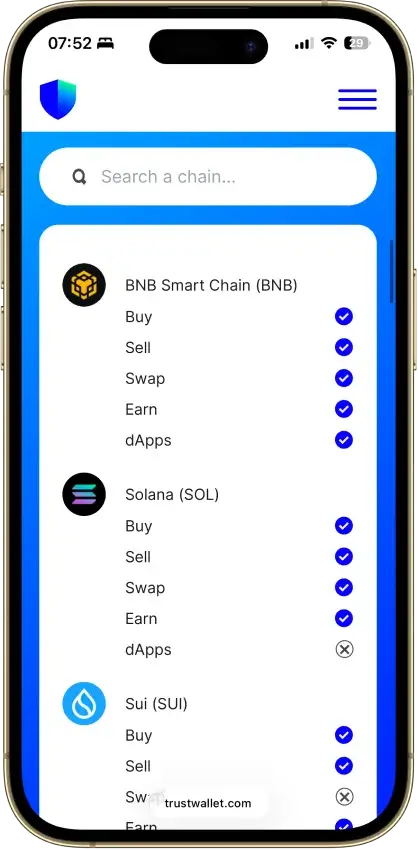
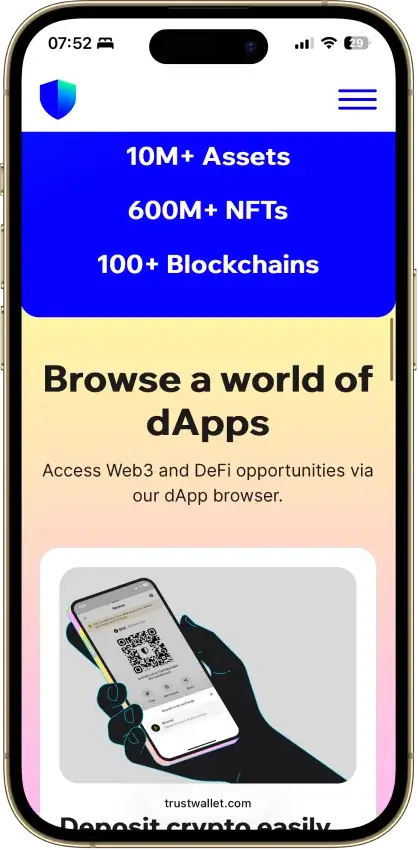
Screenshot 1 of 4
Winners By Category
MetaMask wins the specific Trezor browser-signing comparison. Trust Wallet wins for native XRP and Cosmos accounts. Those advantages do not establish broader dApp compatibility, lower total swap costs or a security winner.
MetaMask Trust Wallet
Standard phrase-based accounts keep signing credentials under user control. Optional accounts introduce different dependencies.
Phrase-controlled keys in an encrypted local vault, optional social login
Classic-wallet keys encrypted on the device, optional SWIFT smart-contract account
Both provide transaction warnings and have scoped incident histories. No matched current attack test establishes a safer application.
Default-on alerts and simulation, 2022 Demonic disclosure mitigated in 10.11.3
Automatic Security Scanner, December 2025 malicious extension 2.68 incident
MetaMask social backup retains a phrase, while Trust Wallet SWIFT uses passkeys. The recovery choice changes the account and dependencies.
12-word phrase, social login with encrypted online backup, extension passkeys
Classic phrase or encrypted cloud backup, SWIFT passkeys
Native XRP and Cosmos access favors Trust Wallet for mixed mobile holdings, subject to its September network changes.
Ethereum-compatible networks, Bitcoin, Solana and TRON, custom EVM RPC
Those networks plus native XRP and Cosmos, September 15 network removals
Trezor connectivity makes MetaMask the fit for that browser workflow. Trust Wallet also supports Ledger extension connections.
iOS, Android, Chrome and Firefox, Trezor, Ledger and Lattice on the extension
iOS, Android, Chrome and Brave, Ledger on the extension
Published wallet fees leave execution prices, provider charges and staking conditions unmatched.
0.875% swap fee, 1% Buy charge, 15% pooled and 10% validator ETH reward share
0.7% advertised swap fee, stablecoin waiver, network-specific staking routes
Both process off-chain data. Different notices and RPC settings do not establish a measured privacy ranking.
Temporary IP processing, custom EVM RPC or local node, simulation shares request data
Device and usage data, brief IP routing, Scanner field mapping not published
MetaMask exposes client development, while Trust Wallet's network transition demonstrates the need to check ongoing support. Neither offers a matched support guarantee.
Public extension and mobile repositories, online social-recovery infrastructure
Public Wallet Core, September 2026 network sunset, Trust Handle discontinued
Trust Wallet’s announced September 15 network-transition date has passed. Check whether your holdings need custom EVM configuration or another compatible non-EVM interface.
Custody And Key Control
Ordinary MetaMask and classic Trust Wallet accounts leave credentials with the owner, not an exchange.
MetaMask Trust Wallet
Standard Phrase Accounts
Signing credentials encrypted locally
Classic keys generated and encrypted locally
Optional Account Choices
Social phrase backup or connected hardware accounts
Classic cloud backup, SWIFT or connected Ledger accounts
Tie
Standard phrase accounts in both wallets leave key custody with the user. Choose optional social, cloud or smart-contract accounts according to their recovery requirements, not an assumption that every account inside one app has identical custody.
Key Generation And Storage
A phrase-based MetaMask account stores its signing material in an encrypted local vault. The installation password opens that vault, whereas the recovery phrase can recreate accounts elsewhere. Trust Wallet's classic setup similarly generates and encrypts keys on the device. Its passcode and biometrics restrict local access without replacing the backup.
MetaMask's software and hardware accounts can coexist in one interface, but they do not acquire the same protection merely by appearing together. A connected hardware account signs on the external device. A pre-existing software account continues using its own credentials until assets are transferred to the hardware-controlled address.
Trust Wallet also offers an optional smart-contract wallet called SWIFT. Its passkey authorization differs from classic phrase custody. Treat SWIFT as a separate account choice, not a setting that gives every existing Trust Wallet asset passkey recovery.
Portability And Vendor Dependence
MetaMask's social-login option restores an encrypted online phrase backup using the linked identity and password. Trust Wallet's optional classic-wallet cloud backup uses a separate encryption password that support cannot reset.
Security And Transaction Signing
Both inspect supported signing requests, but their extension incidents show the limits of transaction warnings.
MetaMask Trust Wallet
Supported Request Checks
Default-on alerts and supported simulations
Scanner and previews on supported networks
Current Comparative Safety
No matched whole-app safety test
No matched whole-app safety test
No clear winner
Both wallets provide useful warnings, but their incident histories and different audit scopes do not establish current relative safety. Trust Wallet's release compromise deserves scrutiny, while MetaMask's own historical vulnerability prevents treating it as an incident-free alternative.
Code, Audits, And Security Response
MetaMask makes its extension and mobile source repositories viewable, under different restrictive licenses. Trust Wallet's Apache 2.0 Wallet Core is a library, not the complete consumer application. WalletScrutiny's July 2024 Android assessment identified missing complete-app source, preventing that release from being independently reproduced.
Least Authority published its MetaMask Snaps extension-integration audit in September 2023. CertiK's Trust Wallet assessment dated February 24, 2023 covered extension 0.0.200 and excluded important external-library implementations, including wallet creation and key derivation. These are scoped assessments, not certifications of every current client or its delivery through an app store.
Halborn's June 2022 Demonic disclosure concerned recovery phrases left on disk under specific browser-import and device-access conditions. MetaMask said extension 10.11.3 introduced mitigations. Ledger Donjon, a competing hardware vendor's lab, documented predictable phrases in early Trust Wallet extensions in April 2023. Trust Wallet had already replaced the generator in a November 21, 2022 code change, months before that publication. A software update cannot make an already exposed phrase secret again.
Trust Wallet's malicious extension 2.68 reached the Chrome Web Store in December 2025. Its incident update attributes about $8.5 million in impacted assets to the event and identifies affected logins during December 24–26, excluding those after 11:00 UTC on December 26. Wiz independently found leaked development and store credentials, supporting a likely supply-chain connection without reproducing every part of the attack.
Trust Wallet distributed clean version 2.69. Its July 2026 reimbursement update still requires case-specific verification. The company excludes mobile from this incident, but opening an exposed account on a phone does not replace its credentials.
Signing And Scam Resistance
MetaMask enables security alerts by default on mobile and extension. Its supported transaction simulations send requests to MetaMask servers for EVM checks or Blockaid for non-EVM checks. Trust Wallet automatically screens transactions on supported networks in both clients, with previews and risky-permission warnings. Some off-chain signatures and new scams can evade those checks.
MetaMask and Trust Wallet software accounts keep keys and previews on the same host. A connected hardware account moves signing to the device, where the transaction details still need verification.
Recovery And Backup
MetaMask social login restores a phrase-based wallet. Trust Wallet SWIFT uses passkeys for a smart-contract account.
MetaMask Trust Wallet
Classic Recovery
Phrase plus account-compatible restore
Phrase plus account-compatible restore
Optional Online Recovery
Linked identity and MetaMask password
Classic encrypted backup/password or SWIFT passkey
No clear winner
Both standard wallets offer phrase recovery through apps that recognize the relevant accounts. MetaMask social backup and Trust Wallet SWIFT solve access differently, so convenience alone cannot decide which recovery arrangement is preferable.
Recovery Methods
MetaMask's standard setup generates a 12-word Secret Recovery Phrase. Google and Apple provide alternative onboarding, with Telegram limited to the extension. The social option requires the linked identity and MetaMask password, and users can export the phrase for an independent backup.
MetaMask stores an encrypted phrase backup online. Its social-login service uses the linked identity and password to make that backup usable again. An offline phrase provides a fallback when social recovery fails.
Trust Wallet's classic and SWIFT recovery require different preparation. A classic wallet restores from its phrase or a usable encrypted cloud backup and password. SWIFT instead requires its passkey to remain available. Trust's February 2024 SWIFT guide links recovery to iCloud or Google and warns against deleting the passkey.
MetaMask extension passkeys open one existing phrase-based installation. They cannot restore a new installation or serve social-login accounts. Biometrics alone do not establish a recovery method.
Restore Compatibility
Classic phrase portability depends on the destination's supported networks and address derivation. MetaMask's Bitcoin import currently requires Native SegWit accounts. Its EVM import guidance specifies a default BIP44 derivation path. A phrase accepted by an app may still display different accounts from those you expected.
Imported private-key accounts and external signers need separate backups. SWIFT passkeys cannot restore classic MetaMask accounts.
Networks, Assets, And dApp Access
Both wallets handle Bitcoin, Solana, TRON and Ethereum-compatible assets. Trust Wallet adds native XRP and Cosmos accounts to that mobile portfolio, making those holdings a more useful distinction than an advertised total token count.
MetaMask Trust Wallet
Native XRP And Cosmos
Not native accounts in this comparison
Native accounts supported
Bitcoin And Solana
Native software accounts
Native classic accounts
Native XRP and Cosmos accounts make Trust Wallet the choice for a phone-based portfolio needing those networks alongside Bitcoin. This is a holdings-focused result, not a dApp-compatibility win, and the September support removals still need checking against the intended portfolio.
Networks And Tokens
MetaMask can add custom EVM networks through RPC configuration, which selects the server used to communicate with a blockchain. That flexibility does not apply uniformly: native Solana uses Infura without a custom RPC option, and TRON dApp compatibility needs a client-and-app check. As of September 17, MetaMask’s help page still says connectivity is unavailable, while its published TRON connector documents application connections. Neither source establishes that every TRON dApp works in every client.
Trust Wallet's sunset notice explains custom configuration for affected EVM networks. Its classic-wallet network coverage does not transfer wholesale to SWIFT, whose current beta page lists Base, Arbitrum, Avalanche, BNB Smart Chain, Optimism and opBNB. Check each required function, not just asset display.
Trust Wallet’s announced September 15, 2026 date for built-in support removals has passed. Its notice lists affected networks, including Polygon zkEVM, Moonbeam, MultiversX and Nano. Affected EVM networks can use custom configuration, while affected non-EVM networks need another wallet that can recreate the affected account. Assets stay on the blockchain. What changes is access through the app.
dApps, WalletConnect, And Integrations
MetaMask's extension connects directly to dApps that implement its connector. Mobile users can use its built-in browser, and MetaMask Connect provides supported remote connections through QR codes or deep links. Trust Wallet's mobile developer documentation supports WalletConnect v2 for EVM networks and Solana. These connection methods do not guarantee every application's compatibility.
Trust Wallet's homepage marks Solana dApps unavailable while its developer documentation describes Solana WalletConnect support. A Solana user should test the intended application and connection method before choosing it for dApp use. MetaMask separately supports Solana applications, so the network label alone does not favor Trust Wallet for that activity.
Platforms, Hardware, And Daily Use
MetaMask and Trust Wallet both offer iOS, Android and browser extensions. MetaMask includes Firefox, while Trust Wallet's extension page specifically identifies Chrome and Brave.
MetaMask Trust Wallet
Trezor Browser Hardware Route
Supported models through the extension
No equivalent route documented here
Ledger Account Scope
EVM-only hardware integration
Extension support depends on device and network
MetaMask is the supported option here for a Trezor-based browser workflow. Trust Wallet remains usable with Ledger on the extension, and neither choice eliminates device, browser or network compatibility checks.
Software vs Software
A Trezor user connecting to Ethereum applications has a supported MetaMask extension workflow. MetaMask also offers Ledger and Lattice connections, alongside other compatible signers. Trust Wallet supports Ledger through its extension. Check the actual device, browser and chain instead of assuming that a hardware logo covers every wallet function.
MetaMask's Ledger integration is EVM-only, so its native Bitcoin and Solana software accounts do not become Ledger accounts through that connection. MetaMask also warns of Ledger connection problems from Firefox version 112 onward. Firefox availability is not a promise that every external signer works there.
On mobile, MetaMask supports Ledger, Keystone and NGRAVE ZERO connections. Comparable Trust Wallet mobile hardware pairing is Not disclosed.
Importing a hardware phrase into either hot wallet exposes those credentials to the connected host.
Support And Accessibility
Use official support channels for either wallet, with payment-provider issues routed to the provider handling the order. Never send recovery credentials to support. Matched accessibility testing and response-time guarantees are Not disclosed, so neither wallet wins on those grounds.
Swaps, Staking, And Costs
Both apps are free. Optional services add costs beyond the advertised wallet fee.
MetaMask Trust Wallet
Dated Standard Wallet Swap Component
0.875%
Advertised 0.7%, with eligible stablecoin waiver
Matched All-In Cost
No matched executable quote
No matched executable quote
Trust Wallet's advertised fee and qualifying waiver are reasons to compare quotes, not proof of a lower total cost. MetaMask's ETH reward fees are explicit, but unmatched validator terms prevent a general staking-cost winner.
Purchase And Ownership Cost
Standard accounts need no hardware purchase or holding subscription. External signers and financial products such as MetaMask Card are optional.
Swaps, Bridges, And Fiat Services
On September 11, 2026, MetaMask's swap guide gives a 0.875% wallet fee. Trust Wallet advertises a 0.7% standard swap component on its comparison page. Those figures describe wallet charges, not two simultaneously available quotes for the same trade.
Trust Wallet's August 27, 2026 offer removes its wallet fee for eligible same-chain stablecoin swaps through the in-app interface. Ethereum and cross-chain swaps do not qualify, and gas still applies. USDC-to-USDT on Base is an eligible example. The offer has no stated fixed expiry, so check the displayed fee when swapping.
MetaMask obtains bridge routes through aggregators including LI.FI and Socket. Trust Wallet also offers cross-chain routes, with provider and bridge costs depending on the selection. Compare the destination asset received, gas, price impact and any extra approval transaction. A slippage tolerance sets acceptable execution movement. The wallet's service fee is a separate cost.
MetaMask's normal Buy flow includes a 1% charge on the requested fiat amount within the displayed processing fee. Providers such as Transak execute eligible purchases and can require identity verification. Trust Wallet's payment partners likewise set their own purchase terms. Do not add MetaMask's percentage twice when comparing an already itemized quote.
Staking And Earn
MetaMask's pooled ETH staking deducts 15% of rewards, while validator staking deducts 10%. These are reward shares, not deductions of those percentages from the initial deposit. Trust Wallet offers network-specific staking choices including ETH, SOL and TRX, with provider conditions varying by route.
Before comparing MetaMask ETH rewards with a Trust Wallet staking option, match the service's commissions, minimum and exit conditions. Penalties and delayed withdrawals can matter more than the headline return.
Privacy And Data Collection
The documented standard MetaMask and classic Trust Wallet setup flows need no email-based vendor account. Both nevertheless communicate with servers and third-party services, and their public blockchain activity remains observable.
MetaMask Trust Wallet
Custom EVM RPC
Supported, other services still communicate separately
Custom EVM configuration supported
Measured Data Exposure
No matched traffic measurement
No matched traffic measurement
No clear winner
MetaMask users can choose where EVM blockchain requests go, while scans and optional services retain their own data paths. The policies describe those flows without comparable measurements of how much information each wallet sends.
Wallet-Level Data
MetaMask's privacy notice describes temporary IP processing for functions such as routing, security and service delivery. Device and usage information can also be processed. EVM users can choose custom RPC infrastructure or connect a local node, but that does not disable every other data-sharing feature. Native Solana does not offer the same custom-RPC control.
Trust Wallet's notice identifies device and usage information, with IP addresses used briefly to route services by region and connect selected third parties. Its homepage's privacy slogan does not mean no data leaves the app.
Third-Party And KYC Boundaries
MetaMask simulation can share the dApp URL, chain ID, request method and transaction payload with its checking services. Trust Wallet's complete Scanner recipient-and-field mapping is Not disclosed. That difference in documentation is not a measurement of which wallet sends less data.
Know-your-customer checks belong to services such as fiat purchases and eligible financial products, not standard phrase creation. MetaMask social login adds an identity-provider relationship, while Trust Wallet's cloud backup or SWIFT recovery adds cloud-account dependencies. Neither is equivalent to an anonymous offline wallet.
Updates, Longevity, And Ecosystem
MetaMask exposes client development, while Trust Wallet's network transition demonstrates the need to check ongoing support. Neither offers a matched support guarantee.
MetaMask Trust Wallet
Network Maintenance
Client and account compatibility remain specific
Announced September 15 support transition date has passed
Guaranteed Support Horizon
No fixed horizon for every client and network
No fixed horizon for every client and network
No clear winner
Both products have maintained components. Neither publishes a support horizon for every current workflow, leaving Trust Wallet holders to prepare for network changes and optional-account users to preserve their distinct backups.
MetaMask exposes client development through its extension and mobile repositories. Trust Wallet exposes Wallet Core development and maintains separate consumer releases. Public source access helps inspection without proving that every installed build matches the repository.
Trust Wallet's September 2026 network transition illustrates a maintenance decision that changes what existing holders can do. Trust Handle's announced discontinuation date, September 7, 2026, has passed. The notice directs users to ordinary wallet addresses. A recovery phrase remains useful only when a compatible interface can derive and transact from the relevant account.
MetaMask's social backup depends on its online recovery infrastructure, while Trust Wallet SWIFT depends on the smart-account and passkey workflow. Standard phrase accounts reduce dependence on one interface but do not guarantee automatic migration of settings, imported accounts or application permissions.
Neither provides a fixed support horizon for all clients and networks. Use official updates and maintain account-specific backups.
Final Verdict
MetaMask is our overall pick at 8.2 versus Trust Wallet’s 8.0, especially for supported hardware-connected browser use. Choose Trust Wallet if native XRP and Cosmos accounts are central to your mobile portfolio.
Affiliate Disclosure
Some links in this comparison are affiliate links. CryptoSlate may earn a commission if you sign up through these links. Our ratings remain editorially independent.
MetaMask wins final rating
The score difference is an editorial overall assessment, not a claim that MetaMask defeats every attack. Both have documented extension incidents, and transaction warnings have limits. Select the account you can reliably recover, then verify the signer and application you intend to use.
MetaMask vs Trust Wallet FAQs
Is MetaMask or Trust Wallet safer for DeFi?
Neither has a proven universal safety advantage. MetaMask and Trust Wallet both warn on supported requests, and both have historical extension vulnerabilities or incidents. Trust Wallet's December 2025 malicious extension release did not affect its mobile app according to the company, but an already exposed account stays exposed when opened on another device.
Does MetaMask or Trust Wallet support more networks?
Trust Wallet offers native XRP and Cosmos accounts alongside networks both wallets handle, including Bitcoin, Solana and TRON. MetaMask also supports custom EVM networks. Trust Wallet has scheduled built-in network removals for September 15, 2026, so check the intended asset and function instead of choosing by an advertised total. SWIFT supports a separate network set.
Is MetaMask or Trust Wallet better for beginners?
Trust Wallet can suit a beginner managing XRP and other native accounts on a phone. MetaMask can suit someone following a browser-based Ethereum application or Trezor workflow. Neither removes backup responsibility. Choose the recovery method first, then verify a small transfer and the exact application connection before committing more funds.
Can MetaMask and Trust Wallet use the same recovery phrase?
Compatible classic accounts can share recovery material, but MetaMask and Trust Wallet do not necessarily display identical accounts after import. Network support and derivation paths still apply, including MetaMask's Native SegWit Bitcoin restriction. SWIFT passkeys are a different recovery system. Reusing a phrase also exposes the same credentials through both software installations.
Are MetaMask passkeys and Trust Wallet SWIFT recovery equivalent?
No. MetaMask extension passkeys open a particular phrase-based installation and cannot restore it on a replacement device. Trust Wallet SWIFT uses passkeys for its smart-contract wallet, with recovery dependent on retaining the passkey and relevant cloud-account access. MetaMask's social-login backup is another arrangement, requiring the linked identity and password.
Is MetaMask or Trust Wallet cheaper for swaps?
MetaMask lists 0.875%, while Trust Wallet advertises a 0.7% wallet fee in the September 11, 2026 snapshot. Trust Wallet's qualifying same-chain stablecoin offer removes its wallet component, excluding Ethereum and cross-chain trades. Gas and execution pricing remain. Compare a matched live quote in both apps before deciding which costs less.
Is MetaMask or Trust Wallet fully open source?
Neither should be described that way without component qualifications. MetaMask's extension and mobile source are viewable under restrictive licenses. Trust Wallet's Wallet Core uses Apache 2.0, but that library is not its entire consumer app. Source visibility, permission to reuse code and reproducibility of an installed release are separate questions.
Does MetaMask or Trust Wallet require KYC?
Standard phrase-based MetaMask and classic Trust Wallet creation do not require identity verification. Purchases and other provider services can require it and impose regional conditions. MetaMask's social-login option creates an identity-provider dependency, while Trust Wallet's optional backup and SWIFT use cloud-account recovery. Those account links are not themselves a wallet-wide KYC requirement.

Both handle native Bitcoin, Solana and TRON accounts alongside EVM assets. That overlap does not make their hardware routes identical. A connected Ledger account in MetaMask remains EVM-only, and Trust Wallet documents Ledger pairing through its extension rather than an equivalent mobile flow.