

Free standard ACH and crypto near your investments, with different pricing for market maker and exchange-routed orders.
Robinhood vs Kraken: US Fees, Staking and Trading Compared
Kraken wins for dedicated US crypto trading through lower entry Pro commissions, advanced orders and reserve checks. Robinhood wins for New York and Maine access and lower SOL commission than Kraken Flexible staking.

Kraken combines quarterly reserve-inclusion checks with separate Pro trading tools and account security controls. Its entry spot fees and funding-related withdrawal holds are the main tradeoffs.
Affiliate Disclosure
Some links in this comparison are affiliate links. CryptoSlate may earn a commission if you sign up through these links. Our ratings remain editorially independent.
Winners by Category
Kraken takes the overall verdict for dedicated crypto trading. Robinhood wins for New York and Maine access and for SOL staking commission compared with Kraken Flexible.
Robinhood Kraken
Kraken wins for a dedicated crypto-trading account. Robinhood remains the practical choice for the specific state and staking advantages below.
Crypto beside securities in one app, with broader US state access
Lower entry Pro commissions, advanced orders and personal reserve checks
Kraken wins on published entry commission. Market spread and slippage remain separate.
0.50% maker / 0.95% taker, where available
Kraken Pro: 0.40% maker / 0.80% taker
Robinhood takes less of the rewards. This does not establish a higher net yield or faster unstaking.
25% combined deduction on eligible SOL
30% Flexible deduction
Robinhood wins for residents of these states. Other features have separate eligibility rules.
Basic crypto trading available, subject to coin restrictions
Core service unavailable in both states
Kraken wins on this specific verification tool. The snapshot does not cover every asset or all corporate liabilities.
No public customer Merkle-inclusion tool
Customer verification for supported balances in an independently attested snapshot
Tie on the platform charge. Funding holds and processing times differ.
No platform fee for standard deposits or withdrawals
No platform fee for Plaid deposits or standard ACH withdrawals
Kraken has the lower published fee for a matched amount eligible on both routes. Settlement and account holds still apply.
1.75%, $1 minimum and $150 maximum
RTP: 1.5%, capped at $50, with a $20 minimum transfer
Screenshots
Robinhood screenshots


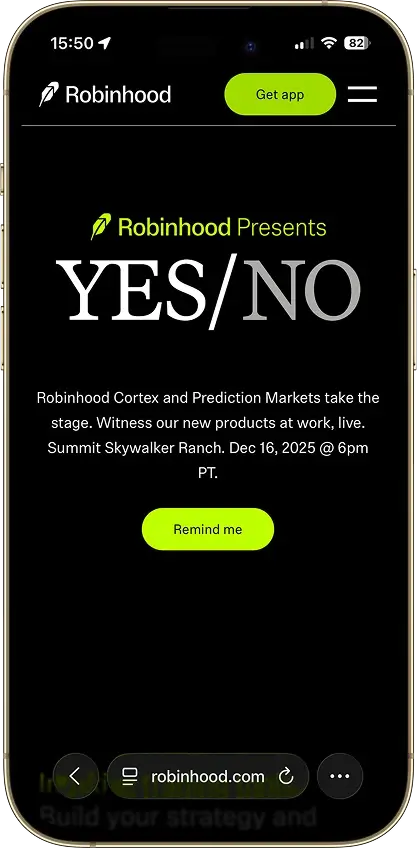
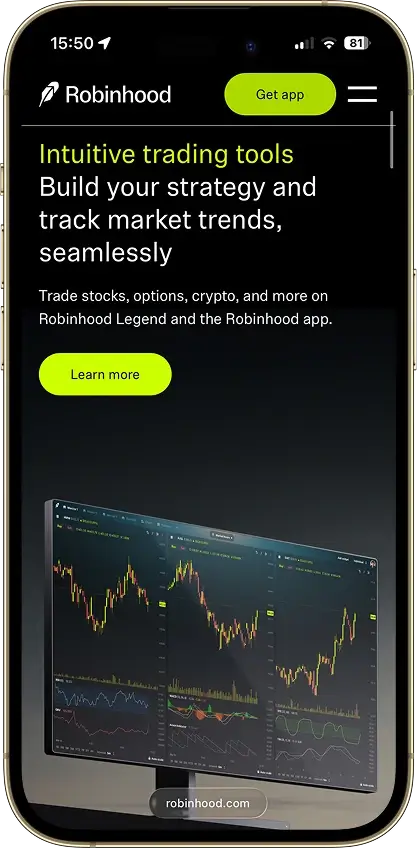
Screenshot 1 of 4
Kraken screenshots

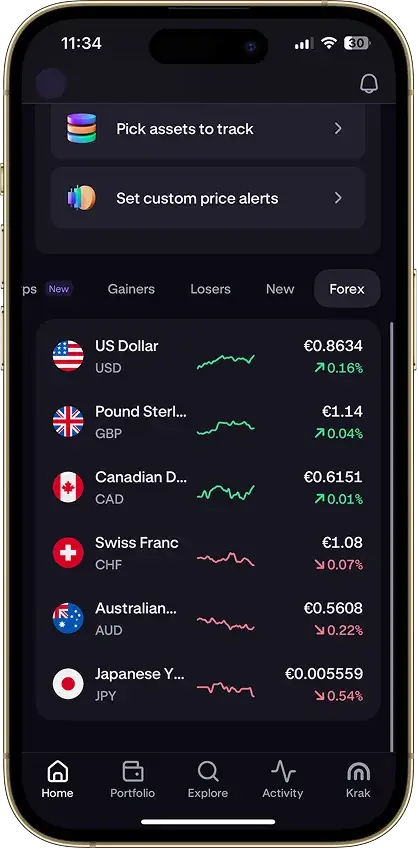
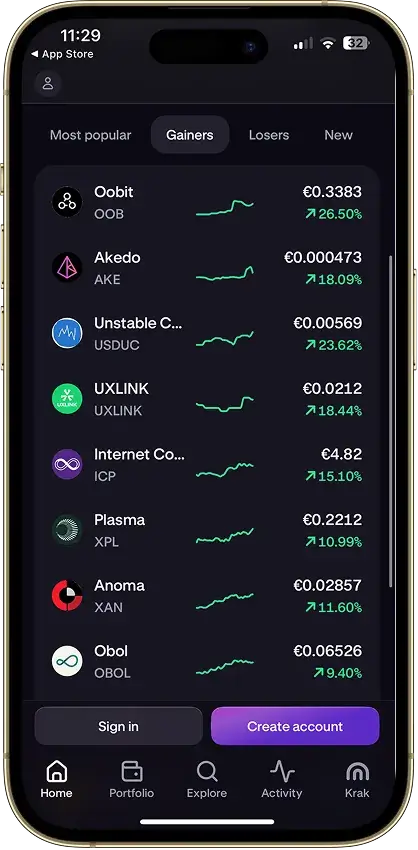
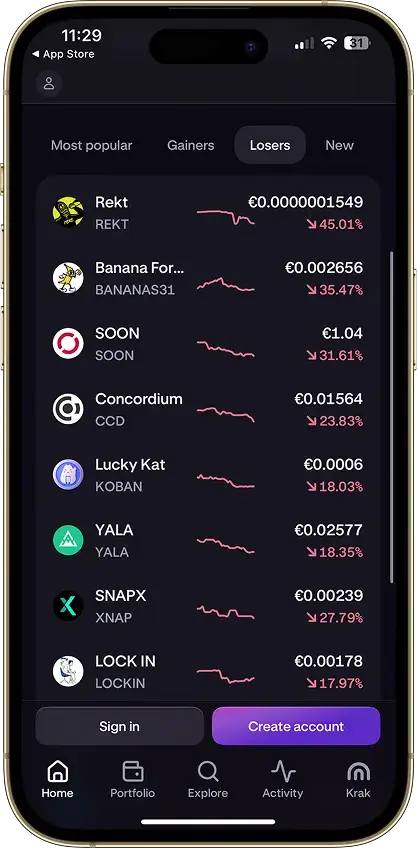
Screenshot 1 of 4
Robinhood vs Kraken Overview
This comparison covers US Robinhood Crypto and US Kraken retail accounts, including Kraken Pro. Separate securities, wallets and derivatives products are identified where relevant.
Trading Fees
Kraken Pro wins on published entry commission. Robinhood’s commission-free market-maker route uses a different pricing model, so it needs a separate quote comparison.
Robinhood Kraken
Entry Maker Commission on $1,000
Kraken wins by $1 in commission on this example. The order must qualify as a maker.
0.50%: $5, subject to maker-pricing rollout
0.40%: $4
Entry Taker Commission on $1,000
Kraken wins by $1.50 in commission. Neither figure includes market spread or slippage.
0.95%: $9.50
0.80%: $8
Robinhood’s entry tier applies below $10,000 of qualifying 30-day volume. Kraken’s first volume discount starts at $2,500 in trailing activity. Its separate Assets on Platform qualification begins at $20,000. Rates can change after those thresholds, so the opening-tier winner is not a promise that Kraken is cheaper at every account size.
Robinhood market-maker routing has no separately charged trading commission. Its disclosure says liquidity providers pay Robinhood $0.95 per $100 traded, included in the spread. That is compensation within the execution price, not a fixed measurement of the total spread or an additional fee to add again.
Kraken’s consumer buy flow charges 1% for instant and recurring trades or 1.5% for custom orders, plus variable spread and payment costs. Pro pricing does not apply to that screen. Compare the received amount for the same dollar spend when choosing between either platform’s simpler purchase route.
Kraken+ costs $4.99 monthly or $49.99 annually and waives eligible consumer transaction fees on up to $10,000 of monthly activity. Spread and processing charges remain, and Pro, futures, API and OTC trades are excluded. Robinhood’s exchange-routing volume discounts do not require Gold or a house token.
Order Types and Trading Interfaces
Kraken Pro gives active traders advanced order controls. Robinhood offers market, limit and stop instructions, but its interface also determines routing.
Robinhood Kraken
Market and Limit Orders
Tie on these basic instructions. A limit order can still execute as a taker.
Supported, with pricing determined by route
Supported on Kraken Pro
Kraken documents post-only, stop-loss, take-profit, OCO, trailing, iceberg and conditional-close controls, with availability depending on the market and interface. These instructions help specify how an order should behave, but a stop or limit price cannot guarantee execution during a fast move.
Robinhood Legend and its mobile trading ladder use exchange routing for supported coins. Web classic supports market-maker routing, while advanced mobile charts can fall back to that route for ineligible assets. Robinhood’s partners include EDX Markets and Bitstamp, with resting limit orders normally routed to affiliated Bitstamp.
Before submitting a trade, inspect the route, fee and received amount. Lower commission alone does not guarantee a better fill price.
Supported Crypto and US Access
Robinhood reaches all 50 states. Kraken’s global asset count is not a US inventory, so check the specific coin in each account before funding.
Robinhood Kraken
New York Spot Account
Robinhood wins for basic crypto access in New York.
Available, with token restrictions
Unavailable
Maine Spot Account
Robinhood wins for basic crypto access in Maine.
Available, subject to asset rules
Unavailable
Robinhood’s September 8, 2026 US table listed 90 market-maker-routed assets, including 66 marked for exchange routing. It also listed view-only coins that could not be bought. Kraken advertises more than 600 assets globally, with availability varying by location. That worldwide figure is not directly comparable with Robinhood’s US list.
Robinhood’s exchange routing is unavailable in North Carolina even though basic crypto trading remains available. New York and Texas have token restrictions, including limits affecting USDC or USDG. On both services, access to the required trading and withdrawal network matters more than the platform-wide count.
Both require identity verification and can request extra documents or review transfers. Consult the US exchange directory when a state or product restriction rules out one of these accounts.
Staking
For SOL, Robinhood deducts 25% versus Kraken Flexible’s 30%. Kraken Bonded starts at 25% and falls at qualifying asset tiers, so the staking mode changes the comparison.
Robinhood Kraken
SOL: Kraken Flexible Comparison
Robinhood wins on commission percentage for a shared eligible asset. Compare displayed net rewards and exit terms separately.
25% combined deduction on eligible SOL staking
30% Flexible commission
ETH: Entry Kraken Bonded Commission
Tie on the published deduction. Bonding periods, assets and reward calculation can differ.
25% combined deduction
25% at the opening Bonded tier
Kraken offers ETH through Bonded staking, not Flexible. At the opening Bonded tier, its 25% commission matches Robinhood’s combined deduction. The SOL Flexible winner does not apply to ETH.
Kraken applies its Bonded commission tiers to Flexible ADA, MINA and TAO too, so those assets should not be assigned the general 30% Flexible rate. Kraken’s Bonded tiers reduce its deduction to 20%, 10%, 5% or 0% as eligible assets under management increase. That can reverse Robinhood’s advantage over Flexible. Do not apply a higher-tier Kraken rate to an account that does not qualify.
Robinhood stakes ETH, SOL and ADA from as little as $1. Its combined 25% deduction already includes the partner fee. Batching means Robinhood ETH staking can earn 50%–100% of the protocol reward rate before the 25% deduction. ADA rewards begin after a 15-day bonding period. These details matter when comparing actual rewards rather than commission alone.
Robinhood excludes staking in California, Maryland, New Jersey and Wisconsin. Kraken’s staking menu also depends on state and asset eligibility, while its core account excludes New York and Maine. Protocol bonding and unstaking can take weeks, and flexible access is not an unconditional promise of immediate withdrawal.
Robinhood Earn is different: it moves USDG into an integrated self-custody wallet and a Morpho lending vault. Available liquidity can delay redemption, and the feature excludes New York and Texas. This lending product is separate from crypto staking and is not an insured bank deposit.
Deposits and Withdrawals
Standard ACH fees tie. Kraken has lower published eligible instant cash-out fees, but its seven-day hold on Plaid-funded amounts can matter more than transfer speed.
Robinhood Kraken
Standard ACH Deposits and Withdrawals
Tie on platform charges. Deposited funds can be tradable before they are withdrawable.
No Robinhood fee
No Kraken fee for Plaid deposits or ACH withdrawals
Eligible Instant Withdrawal of $1,000
Kraken wins by $2.50 in platform fees when both methods are available for the same withdrawable amount.
$17.50 at 1.75%
$15 through RTP at 1.5%
Eligible Instant Withdrawal of $10,000
Kraken wins by $100 under the published caps. Both the account and bank must permit the transfer.
$150, after the fee cap
$50, after the RTP fee cap
Kraken lists free ACH cash-out with a zero-to-two-business-day estimate. FedWire costs $4 with a $20 minimum and a zero-to-one-business-day estimate. Eligible RTP also requires at least $20 and costs 1.5%, capped at $50. These estimates start after Kraken releases the transfer.
Robinhood lists one day for standard ACH withdrawal processing, with receiving-bank delays possible. Eligible instant withdrawals cost 1.75%, with a $1 minimum fee and $150 cap. Account-specific limits can be lower than general published transfer ceilings.
Plaid ACH amounts on Kraken face a seven-day withdrawal hold, including later deposits. Robinhood deposits can take up to five business days to settle, and moving money to a different source account within 60 days can require extra verification. Instant buying power on either account does not mean the same funds can immediately leave.
Robinhood adds no platform fee to supported crypto withdrawals, but network charges apply. Kraken quotes an asset-network fee and minimum before confirmation. Those are different fee models, not proof that one total will always be lower. Compare the same coin, network and amount. Robinhood does not support Bitcoin Lightning transfers.
Security and Custody
Kraken wins for customer reserve-inclusion verification. Robinhood supplies audited public-company reporting. These disclosures serve different purposes and neither insures crypto balances.
Robinhood Kraken
Customer Reserve-Inclusion Tool
Kraken wins for checking personal inclusion in a reserve snapshot. It is a point-in-time, limited-scope check.
No public Merkle-inclusion tool
Available for supported balances in the June 30, 2026 snapshot
Authenticator-Based Two-Factor Authentication
Tie on this login safeguard. Other security controls and recovery procedures differ.
Supported
Supported
Kraken’s June 30 snapshot carries independent attestation. Users can check whether supported balances were included, but the procedure does not cover every token or every corporate liability. It is not a complete balance-sheet audit or a guarantee about the next withdrawal.
Robinhood Markets publishes audited annual financial statements and interim SEC reports. Robinhood says most customer crypto is held offline and ordinary holdings are not lent or borrowed against. Its partial crime insurance protects against specified custody events, not every customer loss. Crypto is neither FDIC-insured nor SIPC-protected merely because it appears beside brokerage assets.
Kraken offers FIDO2 passkeys and security keys, a Master Key and Global Settings Lock. Robinhood offers authenticator access, supported Apple-device passkeys and withdrawal allowlisting. Robinhood’s new-address and configuration changes have a 48-hour wait, while existing approved addresses remain usable. Kraken’s address confirmation does not by itself impose a blanket 72-hour hold.
Robinhood’s 2021 support-social-engineering incident exposed customer information, and its crypto business received a 2022 New York regulatory penalty. Kraken mitigated a 2024 deposit flaw and said client assets were not impacted. When evaluating exchange safety, weigh these incidents alongside today’s account protections and custody disclosures.
Apps, APIs and Customer Support
Robinhood suits an existing brokerage workflow. Kraken provides dedicated crypto interfaces and a broader documented API protocol set, including WebSocket and FIX.
Robinhood Kraken
Web, iOS and Android
Tie on access formats, not app quality or reliability.
Available
Available
24/7 Live Chat
Tie on published chat availability. Chat availability is not a measure of resolution speed.
Available
Available
Robinhood keeps crypto near an existing securities account, although the legal protections and balances differ. Kraken splits consumer buying, Pro trading, payments and self-custody across Kraken, Pro, Krak and Wallet. An active trader may prefer those dedicated screens, while someone managing a small allocation may value fewer app changes.
Kraken documents REST, WebSocket and FIX access, subject to endpoint and onboarding rules. Kraken’s public demo covers futures, not retail spot trading. Robinhood documents retail REST V1 and V2. API permissions must match the intended integration.
Robinhood V2 tiered orders count toward qualifying volume, while V1 non-tiered orders do not. Its help page says V2 orders receive taker pricing until the maker/taker rollout completes. A trading bot cannot assume that a limit instruction earns the advertised maker rate.
Robinhood has 24/7 chat and a dedicated Crypto, Spending and Cash Card phone resource. General investing callbacks have narrower weekday hours. Kraken offers 24/7 chat and messaging, with in-app voice when available and no public direct-dial support number. These contact options do not establish matched response or resolution times.
Futures, Cards and Separate Wallets
Both offer separately approved US futures access. Cards and self-custody products have their own terms and do not change the spot-trading verdict.
Robinhood’s US futures use Robinhood Derivatives and separate approval. Kraken distinguishes CME-listed futures from 16 US perpetual contracts brokered through Kraken Derivatives US and NinjaTrader. Fees, funding and suitability checks depend on the specific contract. International perpetuals and global spot-margin limits do not establish ordinary US retail access.
Kraken Card is limited to eligible UK and EEA personal clients, so it is not a US account benefit. Robinhood’s credit and spending products are separate from its custodial crypto account. A securities-account cash reward should not be relabeled a crypto reward.
Robinhood Wallet and Kraken Wallet are separate self-custody products. Their network coverage is not part of the exchanges’ coin inventories. Moving funds to either wallet makes recovery credentials and transaction approvals the user’s responsibility.
Final Verdict
Kraken wins for dedicated US crypto trading, with lower entry Pro fees, advanced orders and reserve checks. Choose Robinhood for New York or Maine access, a shared brokerage app, or lower SOL commission than Kraken Flexible.
Affiliate Disclosure
Some links in this comparison are affiliate links. CryptoSlate may earn a commission if you sign up through these links. Our ratings remain editorially independent.
Robinhood vs Kraken FAQs
Is Robinhood or Kraken better for US crypto trading?
Kraken wins for dedicated crypto trading through lower entry Pro commissions, advanced orders and customer reserve checks. Robinhood is useful for an existing brokerage workflow and serves New York and Maine, where Kraken is unavailable.
Which has lower trading fees, Robinhood or Kraken?
At entry, Kraken Pro charges 0.40% maker and 0.80% taker, versus Robinhood exchange routing at 0.50% and 0.95% where that pricing is available. Spread and slippage remain separate. Robinhood market-maker routing and Kraken consumer purchases use different pricing.
Does Robinhood have free crypto trading?
Its market-maker route has no separately charged commission, but Robinhood receives compensation included in the spread. Exchange-routed orders have tiered fees. Compare the final executable quote rather than treating no commission as no cost.
Which is better for staking?
For SOL, Robinhood takes a combined 25% of rewards, below Kraken Flexible’s 30%. Kraken Bonded starts at 25% and falls at qualifying asset tiers. Net rewards, asset eligibility and unstaking waits can change the choice.
Can New York or Maine residents use Kraken?
Kraken’s core service excludes both states. Robinhood offers basic crypto trading in both, subject to coin and product restrictions. Staking and derivatives eligibility must be checked separately.
Are ACH withdrawals free on both platforms?
Yes, standard ACH withdrawals have no platform fee on either. Funds must first be withdrawable. Kraken applies a seven-day hold to Plaid-funded amounts, and Robinhood can require settlement or extra transfer verification.
Can I transfer crypto from Robinhood to Kraken?
Yes, if both accounts support the same coin and transfer network and the balance is withdrawable. Check the address, any required memo, the network charge and account limits. Robinhood does not support Bitcoin Lightning transfers.
Does Kraken’s proof of reserves make it risk-free?
No. The independently attested snapshot lets customers check supported balance inclusion at a point in time. It does not cover every listed asset or all corporate liabilities, insure crypto holdings or guarantee future withdrawals.

Kraken earns the recommendation for someone choosing a dedicated crypto-trading account. Pro combines an order book with advanced instructions and lower opening commission than Robinhood’s exchange-routed schedule. The Kraken exchange review also documents a customer reserve check, with important limits on what that check proves.
Robinhood is easier to justify when you already use its brokerage app. Supported crypto sits beside existing investments, and standard ACH transfers have no platform fee. The Robinhood Crypto review explains how changing the trading screen can change the order route and the price you pay.
Robinhood supports basic crypto trading in all 50 states, while Kraken excludes New York and Maine. Someone in either state does not need to weigh Kraken’s Pro advantages against an account they cannot open.