
Crypto.com Exchange scores 6.4/10 across its documented Global Exchange footprint. Its dated reserve snapshot and jurisdiction-dependent fiat rails limit the result.
Crypto.com vs Kraken: Fees, Cards, and Reserves (2026)
Kraken leads on stated asset inventory and reserve recency. Crypto.com leads on opening commission and US card access.

Kraken scores 7.8/10 for security controls, quarterly reserve checks, bank rails and advanced tools. Entry fees, reserve coverage and product restrictions are the main tradeoffs.
Affiliate Disclosure
Some links in this comparison are affiliate links. CryptoSlate may earn a commission if you sign up through these links. Our ratings remain editorially independent.
Overview
Crypto.com Kraken
Overall Result
Split: wins opening spot fees, US state coverage, and card range
Split: wins stated asset inventory, reserve freshness, US crypto perpetuals, and named order controls
Entry Order-Book Fees
0.25% maker / 0.50% taker
0.40% maker / 0.80% taker
Stated Asset Inventory
400+ in the consumer App. The Aug. 28, 2026 Exchange API showed 422 spot base assets
600+ across the global platform
Global Spot Pairs
576 in the global Exchange API on Aug. 28, 2026
Hundreds of markets, with totals changing by residence and listing status
US Consumer Access
49 states, D.C., and territories, excluding New York
All states except New York and Maine
US Crypto Perpetuals
No global Exchange perpetual access. CDNA offers separate event and limited-risk contracts
16 CFTC-regulated contracts on Kraken Pro, listed by Bitnomial and brokered through Kraken Derivatives US/NinjaTrader, after required checks
Latest Published Reserve Snapshot
Dec. 7, 2022, nine assets
June 30, 2026, eight assets
Card
Prepaid under country-specific terms and US Visa Signature credit card
Mastercard debit for verified UK and EEA clients
Self-Custody
Crypto.com Onchain
Kraken Wallet
Standard Support
24/7 in-app live chat and Help Center
24/7 messaging or live chat and support forms
No clear winner
A feature on one surface does not automatically appear on every other surface.
Winners by Category
Crypto.com Kraken
Lower entry commissions, Maine access, two card models, and DCA, Grid, and TWAP bots
More stated global assets, a fresher reserve snapshot, US crypto perpetuals, and more named order controls
0.25% maker / 0.50% taker
0.40% maker / 0.80% taker
400+ in the consumer App. The Aug. 28 Exchange API separately showed 422 spot base assets
600+ across the global platform
Variable preview fee
1% plus spread and any payment fee on instant or recurring orders
Maine is available. New York is excluded
Maine and New York are excluded
US CDNA products are different contract types
16 contracts on Kraken Pro, listed by Bitnomial and brokered through Kraken Derivatives US/NinjaTrader for qualifying accounts
The Aug. 28 API showed 246 crypto perpetuals and eight crypto futures
Offers global futures but does not state a comparable current contract count, and regional product definitions differ
Dec. 2022 independent procedures report
June 2026 published snapshot
Prepaid card plus a separate US credit card
Debit card for verified UK and EEA clients
Built-in DCA, Grid, and TWAP bots
More named conditional order types and FIX access
25 App staking assets
Flexible and bonded commission tiers that can reach 0% for qualifying bonded balances
24/7 in-app live chat and Help Center, without a general consumer direct-dial number
24/7 chat or messaging and forms, plus in-app voice in selected situations but no general consumer direct-dial number
Crypto.com leads on entry spot fees, while Kraken leads on the stated global asset inventory, US crypto perpetuals, its newer reserve snapshot, and named advanced order controls. Crypto.com lists more App staking assets, while Kraken publishes flexible and bonded commission tiers. Both publish 24/7 support access, but neither provides service-quality data for a direct ranking.
Screenshots
Crypto.com screenshots

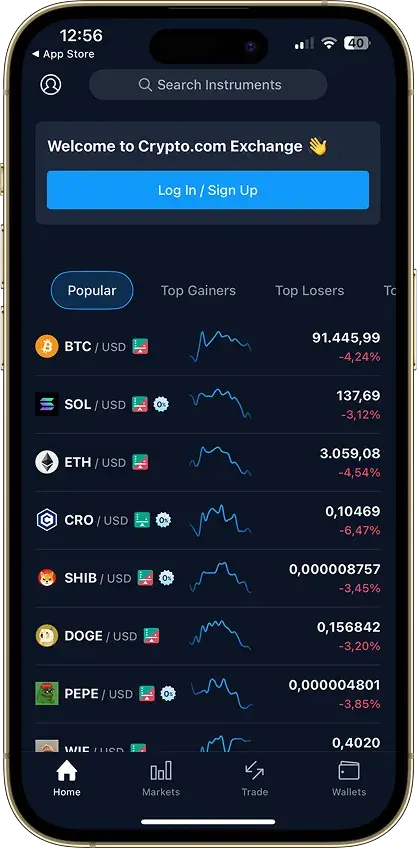
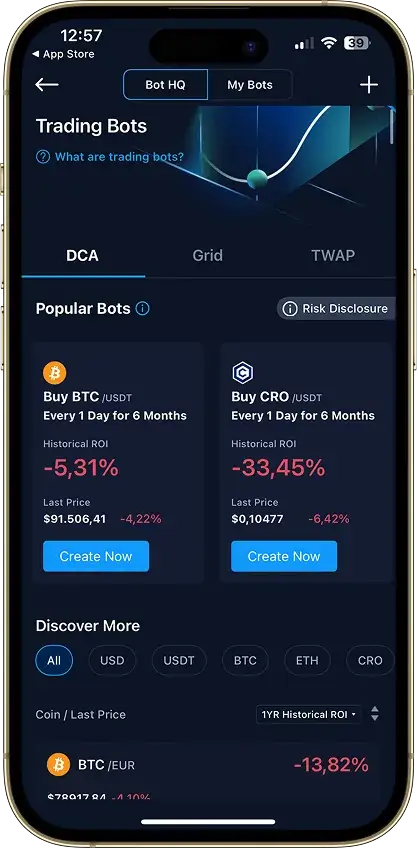
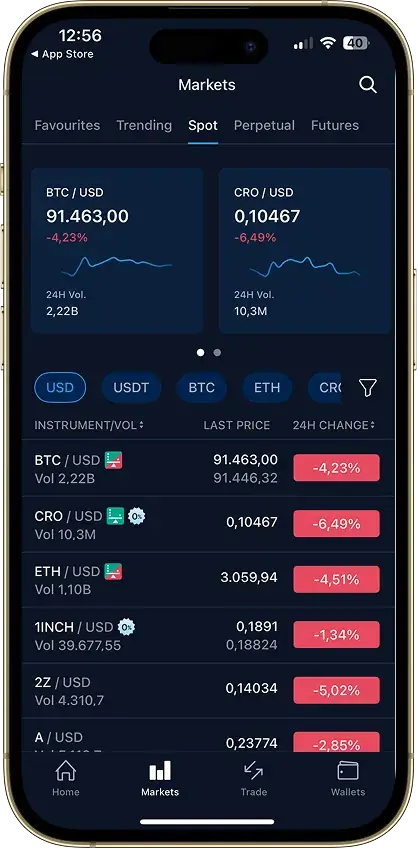
Screenshot 1 of 4
Kraken screenshots

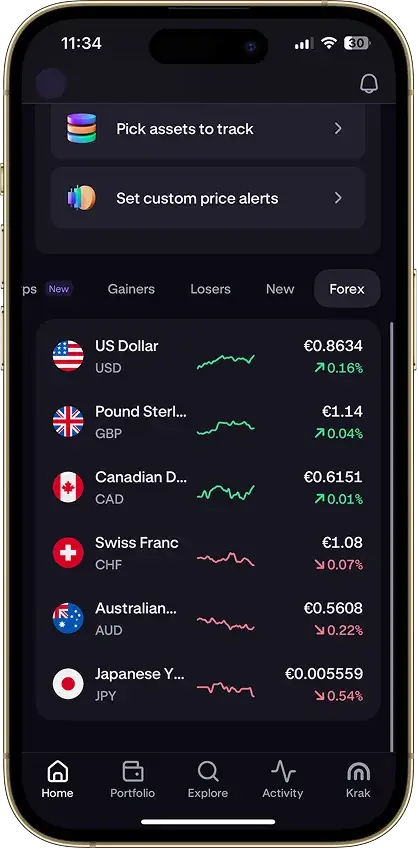
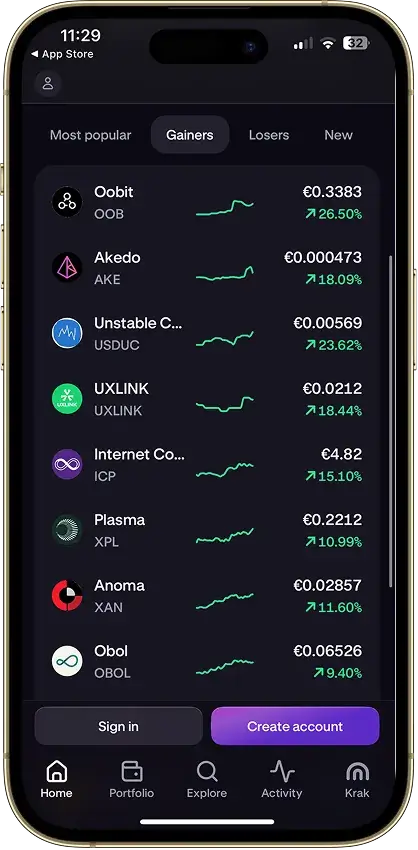
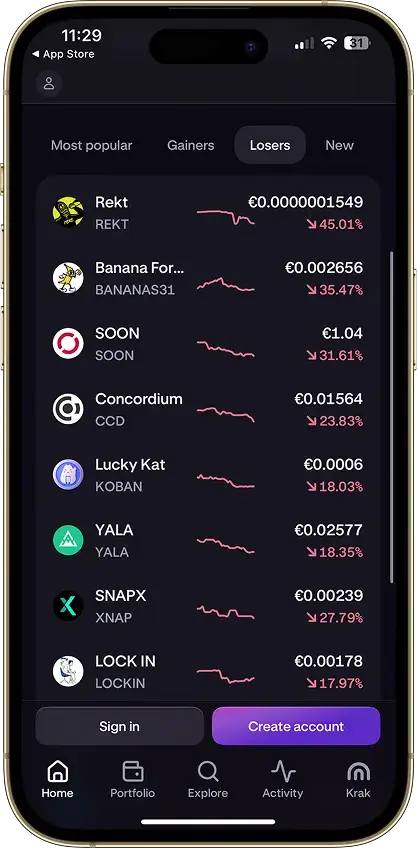
Screenshot 1 of 4
Trading Fees and Pricing
Crypto.com Kraken
Entry Maker
0.25%
0.40%
Entry Taker
0.50%
0.80%
Lowest Published Maker Rate
0% under qualifying schedules
0%
Lowest Published Taker Rate
Reduced taker commission under the CRO, volume, and VIP schedules, with no comparable published endpoint rate
0.05% at the highest published Pro tier
CRO or Asset-Balance Qualification
Holding 50,000 CRO removes the opening maker charge and sets taker commission at 0.44%
Qualifying assets on platform can improve the Pro fee tier
Consumer Instant Purchase
Variable quote and possible admin fee shown before confirmation
1% transaction fee plus variable spread and any payment fee
Consumer Custom Order
Variable quote and possible admin fee
1.5% plus spread and any payment fee
Subscription
Level Up Plus costs $4.99 monthly or $49.90 yearly, and Level Up Pro costs $29.99 monthly or $299.90 yearly. Both include plan-limited App trading allowances in supported markets. Spreads and processing remain, and Exchange order-book commission is not covered
Kraken+ at $4.99 monthly or $49.99 yearly waives consumer Buy, Sell, and Convert transaction fees on up to $10,000 of eligible monthly activity. Spreads and processing remain, while Pro, API, futures, and OTC are excluded
Named Stablecoin Parity Conversion
No equivalent USD/USDC or USD/USDG term disclosed
USD to or from USDC and USDG at 1:1 in supported Convert flows
Crypto.com wins trading Fees and Pricing
Crypto.com is cheaper at the opening order-book tier. The lowest published taker endpoints have no winner because they sit on unlike qualification paths.
Crypto.com Exchange charges 0.25% maker and 0.50% taker below $10,000 in 30-day spot volume without a qualifying CRO balance. At Kraken Pro's first tier, maker orders incur 0.40% and taker orders incur 0.80%.
Commission is only one component of a fill. The order-book trading mechanics explain how spread, order size, depth, and price movement affect the result.
What a $1,000 Opening Spot Order Costs
Crypto.com Kraken
Maker Commission
$2.50
$4.00
Taker Commission
$5.00
$8.00
Crypto.com wins what a $1,000 Opening Spot Order Costs
On a $1,000 order, Crypto.com is $1.50 lower for a maker and $3.00 lower for a taker before bid-ask spread and price movement.
The calculation applies only the published entry maker or taker commission. It excludes the bid-ask spread and price movement.
Supported Crypto and Markets
Crypto.com Kraken
Stated Asset Inventory
400+ in the consumer App
600+ across the global platform
Dated Spot-Market Snapshot
422 base assets and 576 pairs in the Aug. 28, 2026 Exchange API
Hundreds of direct markets, with totals changing by residence and listing status
US Asset Availability
Coin and product-specific. The core App excludes New York
Lower than the 600+ global figure and account-specific. New York and Maine are excluded
Kraken wins supported Crypto and Markets
Kraken's stated inventory advantage applies at the global level and does not prove that any particular coin is available to a US, UK, or EEA account.
Crypto.com advertises more than 400 crypto assets in its consumer App, and its global Exchange API returned 422 unique crypto spot base assets across 576 tradable spot pairs on August 28, 2026. Kraken states more than 600 assets across its global platform.
Spot, Margin, Derivatives, and Staking
Crypto.com Kraken
Consumer Spot Buy and Sell
App and Web
Kraken app and web
Advanced Spot
Crypto.com Exchange
Kraken Pro
Spot Margin
Global Exchange where approved, with no comparable marketed spot-margin ratio disclosed
Kraken Pro where approved, marketed up to 10x
Global Futures and Perpetuals
246 crypto perpetuals and eight crypto futures in the Aug. 28, 2026 global API, with up to 50x on many instruments
Global futures under a separate schedule, without a comparable fixed contract count
US Crypto Perpetuals
Not the global Exchange product. CDNA offers other contract types
16 contracts through Kraken Pro, listed by Bitnomial and brokered through Kraken Derivatives US/NinjaTrader, after required checks
US Event and Limited-Risk Contracts
CDNA event contracts, Strike Options, and UpDown Options where approved
US perpetuals and CME futures are different products
OTC
OTC options for qualifying institutional or VIP clients
OTC for qualifying clients
No clear winner
Crypto.com's 50x global derivatives figure and Kraken's 10x spot-margin figure describe different products. They do not support one ratio winner.
The shared baseline is spot trading, margin in approved regions, staking, and institutional services. The split begins with derivatives access. Crypto.com's up-to-50x figure applies to global derivatives, while Kraken's up-to-10x figure applies to spot margin. These are different products and do not support a cross-product ratio winner. Higher borrowing leaves less room for adverse price movement, so margin trading liquidation risk rises with exposure.
Both exchanges reserve OTC services for qualifying clients. Crypto.com names OTC options for institutional or VIP accounts, while Kraken provides OTC access through its higher-verification account path.
Crypto.com vs Kraken Staking
Crypto.com Kraken
Stated Asset Count
25 in App staking
More than 20
Flexible Commission
Asset-specific App deduction of 15%, 20%, or 35%
30%
Bonded Commission
No comparable eligible-balance ladder disclosed
25%, 20%, 10%, 5%, or 0% by eligible balance
Reward Timing
Up to three credits weekly, protocol-dependent
Generally weekly
Unbonding
Protocol-specific, about one to 31 days for named assets
Protocol-specific for bonded assets
US Restrictions
NY, CA, MD, NJ, and WI for App staking
NY and ME service exclusions, plus CA, MD, NJ, and WI for staking
No clear winner
The staking commission table produces no single winner because asset counts, flexible deductions, and bonded tiers point in different directions.
Crypto.com App staking lists 25 assets. Kraken supports flexible and bonded staking across more than 20 assets, plus Auto Earn. Proof-of-stake reward mechanics make the platform deduction only one component of net yield.
Order Types, Execution, APIs, and Limits
Crypto.com Kraken
Market and Limit Orders
Yes
Yes
Stop-Loss and Take-Profit
Yes
Yes
OCO
Yes, unavailable while margin mode is enabled
Yes where supported
Additional Named Controls
None beyond the controls listed above
Stop-limit, post-only, trailing-stop, trailing-stop-limit, iceberg, and conditional-close
Bots or Scheduled Execution
DCA, Grid, and TWAP
TWAP and conditional workflows
Minimum Spot Notional
$1 across spot pairs, with pair rules
Pair-specific
Retail API
REST and WebSocket
REST, WebSocket v1/v2, and FIX
Published API Rate
10 calls per URL per second
Varies by API endpoint and the account's rate-limit counter
Test Environment
Institutional test environment by invitation
Futures demo. Spot test access for qualified, onboarded clients
Like-for-Like Execution Test
No public test
No public test
Kraken wins order Types, Execution, APIs, and Limits
The available sources establish trading features, while execution quality and liquidity remain unranked.
Crypto.com Exchange supports market, limit, stop-loss, take-profit, and OCO orders. Kraken Pro adds stop-limit, post-only, trailing-stop, trailing-stop-limit, iceberg, conditional-close, and OCO controls.
Deposits, Withdrawals, Fiat Rails, and Holds
Crypto.com Kraken
Fast ACH Deposit
Instant Deposit, followed by a seven-business-day withdrawal restriction
Plaid ACH, followed by a seven-day withdrawal hold
ACH Withdrawal Fee
None
None
ACH Withdrawal Minimum
$1
$1
ACH Withdrawal Limits
$100,000 daily and $500,000 monthly for standard App users
Account and verification-specific
ACH Withdrawal Timing
No current universal estimate published
Estimated 0–2 business days
US Wire Withdrawal
SWIFT has no Crypto.com fee, $100 minimum, and prior-deposit condition. Bank fees may apply
FedWire costs $4 with a $20 minimum, estimated 0–1 business day
Instant Bank Withdrawal
No comparable near-instant bank method disclosed
RTP near-instant at 1.5%, capped at $50, with $20 minimum
New Crypto Address
Optional 24-hour lock when the control is enabled
Email confirmation. A password change can trigger 24-hour hold for new or updated addresses
Crypto Withdrawal Fee
Asset and network-specific preview
Kraken flat fee and minimum by asset and network
No clear winner
Arrival, trading availability, and withdrawal availability follow separate timelines, so immediate trading access does not create immediate transfer access.
A deposit can appear before the associated value becomes withdrawable because Crypto.com's Instant Deposit and Kraken's Plaid ACH route make funds available for trading quickly while imposing a seven-business-day or seven-day withdrawal restriction on the associated amount.
KYC, Licensing, and Geographic Availability
Crypto.com Kraken
Identity Verification
Required
Required
US Consumer Access
49 states, D.C., and territories, excluding New York
All states except New York and Maine
New York
Unavailable
Unavailable
Maine
Available
Unavailable
US Fiat Deposit Currency
USD
USD only
EEA Position
MiCA-approved entity
MiCA authorization and Irish e-money institution structure
US Derivatives Structure
CDNA designated contract market and derivatives clearing organization products, separate from global Exchange derivatives
CFTC-regulated perpetuals on Kraken Pro, listed by Bitnomial and brokered through Kraken Derivatives US/NinjaTrader
Staking State Restrictions
NY, CA, MD, NJ, and WI
NY, ME, CA, MD, NJ, and WI
Crypto.com wins KYC, Licensing, and Geographic Availability
Named licenses establish an operating framework, while each product retains separate location and onboarding checks.
Identity verification is required for the core exchange flow on both platforms. Crypto.com's consumer App serves 49 states, Washington, D.C., and US territories, excluding New York. Kraken excludes New York and Maine.
Security, Custody, Reserve Checks, and Account Controls
Crypto.com Kraken
User-Verifiable Merkle Inclusion
Yes for in-scope balances
Yes for in-scope balances
Latest Published Reserve Snapshot
Dec. 7, 2022, nine assets
June 30, 2026, eight assets
Snapshot Scope
Point-in-time agreed-upon procedures, not a current full audit
Point-in-time in-scope reserve procedure, not every listed asset
Offline Storage Disclosure
Institutional reserve accounts and cold-storage controls
Majority of client crypto held offline
Account Controls
Passkeys and FIDO2, MFA, address whitelisting, and device controls
FIDO2, authenticator 2FA, Master Key, Global Settings Lock, PGP email, and session controls
Customer-Loss Insurance
$120 million disclosure limited to Crypto.com Custody Trust Company
Ordinary exchange accounts and digital assets are not insured against loss
Eligible USD Protection
Partner-bank pass-through FDIC coverage up to $250,000 in aggregate, bank failure only
No FDIC or SIPC protection for exchange accounts
Unauthorized-Transaction Program
Discretionary goodwill protection up to $250,000 for qualifying incidents
No equivalent goodwill program stated
Self-Custody Alternative
Crypto.com Onchain
Kraken Wallet
No clear winner
A reserve snapshot addresses whether selected balances and liabilities matched at one time, while account controls address unauthorized access or withdrawal.
Crypto.com lets users check Merkle-tree inclusion, but its linked independent agreed-upon procedures report is dated December 7, 2022 and covers nine named assets. Kraken's latest published reserve snapshot is dated June 30, 2026.
Crypto.com Card vs Kraken Card
Crypto.com Kraken
Product Types
Prepaid card plus separate US credit card
Mastercard debit card
Current Availability
Prepaid under country-specific terms, including a US alternative. Credit card in App-served US states
Verified UK and EEA personal clients
Advertised Maximum
Up to 5% prepaid or 6% US credit, subject to plan and eligibility
Up to 2% by 30-day average balance tier
Reward Asset
US credit card can pay BTC or CRO
Cashback under the Krak program
Paid or Token Condition
Level Up Plus or Level Up Pro subscription when shown in-account, or a qualifying CRO arrangement
Reward tier depends on average balance
Exchange Card Fee
Plan and product terms apply
No Kraken transaction fee, with conversion or third-party fees possible
Crypto.com wins crypto.com Card vs Kraken Card
Kraken's card is a debit product and should not be compared with a US credit line as if approval, funding, and rewards worked alike.
Crypto.com's prepaid and credit cards use different limits, funding rules, and approval paths, as the Crypto.com card fees and rewards review details. Kraken Card is a physical or virtual Mastercard debit card for verified personal clients in the UK and EEA.
Websites, Mobile Apps, Wallets, APIs, and Support
Crypto.com Kraken
Consumer Mobile
Crypto.com App
Kraken app
Advanced Mobile and Web
Crypto.com Exchange App and Web
Kraken Pro App and Web
Desktop Trading Interface
Web Exchange and TradingView integration
Kraken Desktop and Pro Web
Self-Custody
Crypto.com Onchain
Kraken Wallet
Card Management
Crypto.com App
Krak
Live Support
24/7 in-app live chat and Help Center
24/7 chat or messaging and forms
Voice Support
No public direct-dial number
In-app voice in selected situations, no public direct-dial number
No clear winner
The interface handoff matters more than app count because active trading, card management, and self-custody cross different surfaces.
Crypto.com uses its consumer App and Web interface for simple trades, payments, cards, and account history. Advanced order-book trading and APIs sit on the Exchange. Kraken uses the Kraken app and website for consumer trading, Kraken Pro for its order book, Kraken Desktop for another advanced interface, Kraken Wallet for self-custody, and Krak for transfers and card management. The Kraken self-custody setup review covers its recovery model.
Moving assets to either self-custody wallet gives the user control of the private keys and responsibility for recovery. Non-custodial wallet controls explains how recovery phrases, approvals, and platform access differ.
Final Verdict
Affiliate Disclosure
Some links in this comparison are affiliate links. CryptoSlate may earn a commission if you sign up through these links. Our ratings remain editorially independent.
Choose Kraken when a required coin is absent from Crypto.com or when the June 2026 reserve snapshot outweighs the opening fee gap. Its Pro order controls, FIX access, and US perpetuals through Kraken Derivatives US/NinjaTrader matter next.
Choose Crypto.com when repeat spot commission or card access takes priority. Where Crypto.com Exchange is available, a $1,000 opening taker order costs $5 instead of $8 in commission. The consumer App's availability in Maine and the two card models can outweigh Kraken's advanced tools.
If neither condition dominates, confirm the exact coin, payment rail, and staking asset before opening the account. Kraken leads on stated asset inventory and reserve recency. Crypto.com leads on opening commission and US card access.
Choose Crypto.com If
- You expect to place recurring spot orders through the Exchange at the 0.25% maker or 0.50% taker opening rate.
- You live in Maine and need a centralized exchange available in that state.
- You want a prepaid card or a US Visa Signature credit card and accept the relevant plan, approval, and reward conditions.
- You want DCA and Grid bots built into the advanced Exchange workflow alongside TWAP.
- You need global derivatives markets where Crypto.com Exchange is available and understand the liquidation risk.
- You prefer access to Crypto.com's discretionary goodwill program for qualifying unauthorized transactions and partner-bank protection for eligible USD.
Choose Kraken If
- You want access to a stated global list of more than 600 crypto assets.
- You value a June 2026 user-verifiable reserve snapshot over Crypto.com's older independent report.
- You need trailing-stop, trailing-stop-limit, iceberg, conditional-close, or other named Pro order controls.
- You want REST, WebSocket, and FIX access or a separate Kraken Desktop interface.
- You are in the US and want 16 crypto perpetuals through Kraken Pro and Kraken Derivatives US/NinjaTrader, subject to account and location checks.
- You are a verified UK or EEA client who wants the Krak-managed debit card.
Crypto.com vs Kraken FAQs
Is Crypto.com or Kraken cheaper for spot trading?
Crypto.com is cheaper at the opening order-book tier because it starts at 0.25% maker and 0.50% taker, while Kraken Pro starts at 0.40% and 0.80%. On a $1,000 order, that is $2.50 versus $4 for a maker or $5 versus $8 for a taker, before bid-ask spread and price movement. Consumer-app quotes use different pricing.
Does Crypto.com or Kraken list more crypto assets?
Kraken states more than 600 assets across its global platform, while Crypto.com advertises more than 400 in its consumer App. Crypto.com's global Exchange API separately showed 422 unique spot base assets and 576 spot pairs on August 28, 2026. Local availability can be lower on either platform, and Kraken's 600+ figure must not be treated as a US count.
Does Crypto.com or Kraken have more current proof of reserves?
Kraken has the more current published snapshot. Its latest report is dated June 30, 2026 and lets users verify in-scope inclusion. Crypto.com's linked independent procedures report is dated December 7, 2022 and covers nine assets. Both are point-in-time checks, not full audits of every listed asset and liability.
Can US users trade derivatives on Crypto.com and Kraken?
US users can trade derivatives on both platforms, but the products are not equivalent. Crypto.com gives US users CDNA event and limited-risk contracts instead of its global Exchange perpetuals. Kraken offers 16 crypto perpetuals through Kraken Pro, listed by Bitnomial and brokered through Kraken Derivatives US/NinjaTrader, after the user passes verification, location, and product checks. CME-listed futures are also available.
Is the Crypto.com card or Kraken Card available in the US?
Qualifying US users in App-served states can apply for Crypto.com's Visa Signature credit card, while the prepaid card remains an alternative for users who do not want or qualify for credit. Kraken Card currently serves verified personal clients in the UK and EEA and excludes US accounts. Reward rates and funding rules differ by product and tier.
Is Crypto.com or Kraken better for staking?
Crypto.com lists 25 App staking assets and deducts 15% for ETH, 35% for NEAR and INJ, and 20% for the other listed assets. Kraken flexible staking and Auto Earn deduct 30%, while bonded staking can fall from 25% to 0% as the eligible balance rises. The better choice therefore depends on the asset, staking mode, and qualifying balance.
How do Crypto.com and Kraken withdrawal holds differ?
Crypto.com's Instant Deposit restricts withdrawal of unsettled funds and assets bought with them for seven business days. Kraken Plaid ACH applies a seven-day withdrawal hold to the associated amount. Crypto.com's 24-hour new-address delay is optional. Kraken applies a 24-hour hold after a recent password change, not merely because an address was added.
Do Crypto.com and Kraken require KYC?
Yes. Identity verification is required for core trading and funding access on both platforms. Crypto.com serves every US state except New York through its consumer App. Kraken excludes New York and Maine. Staking, derivatives, cards, assets, and payment methods have additional location and account conditions.


Crypto.com's trading platform review separates simple App orders from advanced Exchange trading. Kraken's consumer trades stay in the standard interface and advanced orders move to Pro, a split captured in its crypto exchange rating.
Both exchanges split features across several interfaces, with Crypto.com's US derivatives in Crypto.com | Derivatives North America (CDNA), a product line separate from the global Exchange. Kraken moves card management to Krak and adds Desktop as another advanced trading interface.