
Quick Take
- The Fed will decide rates on Sept. 16 before official August PCE and its annual revision arrive Sept. 30.
- Waller said one method change could trim 12-month PCE inflation by a few tenths, but the total revision may differ.
- Bitcoin faces two tests: the Fed decision first, then a revised inflation baseline that could reshape later rate bets.


Bitcoin’s next Federal Reserve test is split across two dates.
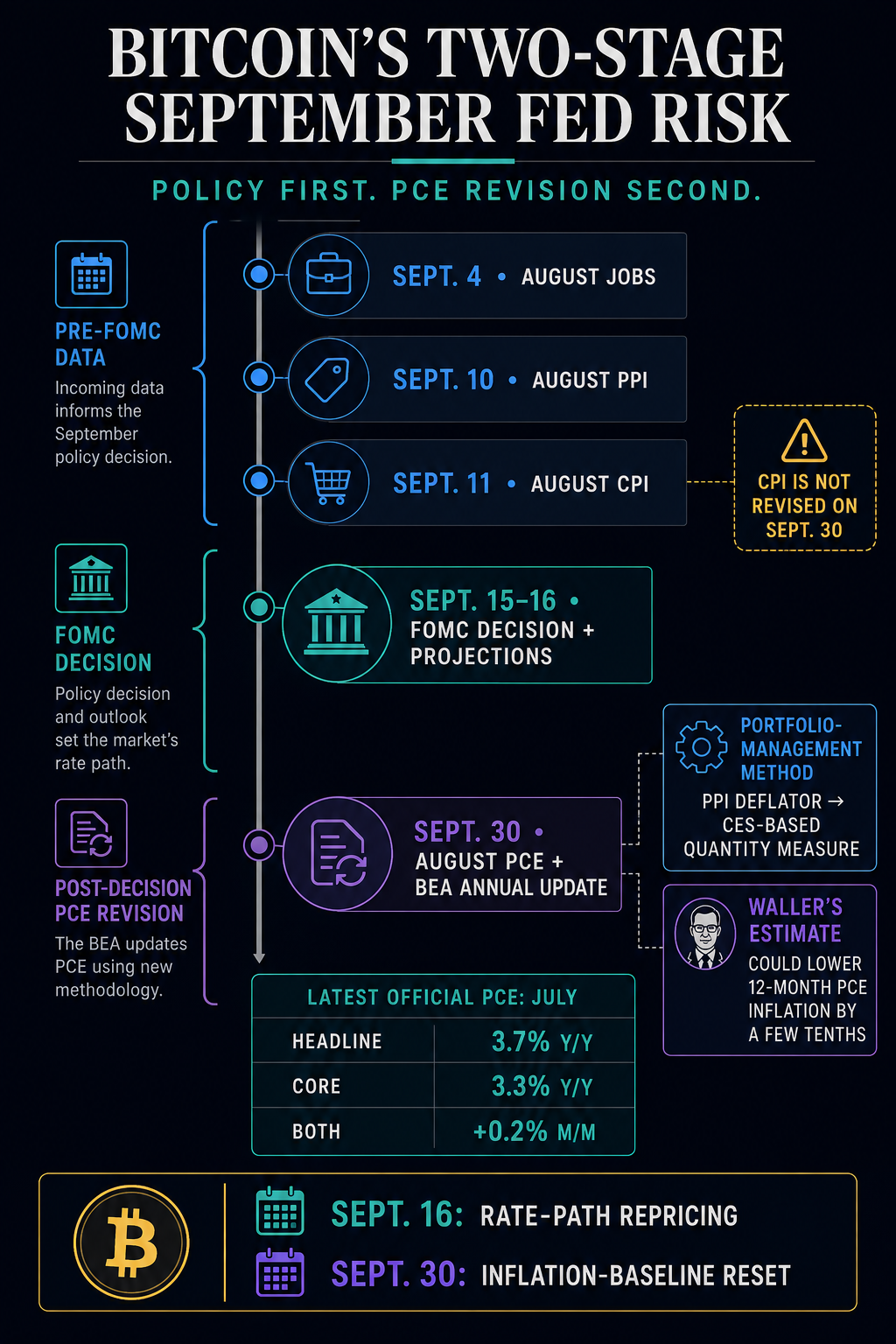
The Federal Open Market Committee will decide policy on Sept. 16 after seeing August payrolls, producer prices and consumer prices. Official August personal consumption expenditures inflation, along with a Bureau of Economic Analysis annual update that will revise the PCE series, is not scheduled until Sept. 30.
Governor Christopher Waller has already put a number on one part of that pending change. He said a new method for portfolio-management services could lower 12-month PCE inflation by a few tenths of a percentage point. That was Waller’s estimate for one component, not a confirmed estimate of BEA’s total revision.
For Bitcoin, the schedule creates a policy event first and a measurement reset two weeks later. Each can change rate expectations, but neither supplies a predetermined price signal.
What the Fed will know on Sept. 16
The Bureau of Labor Statistics schedule puts the August employment report on Sept. 4, producer price inflation on Sept. 10 and consumer price inflation on Sept. 11. The FOMC meets Sept. 15-16, with a new Summary of Economic Projections due alongside the decision.
The latest official PCE reading available before then covers July. BEA reported that headline and core PCE prices each rose 0.2% from June. Over 12 months, headline PCE inflation was 3.7% and core inflation was 3.3%.
August PCE arrives at 8:30 a.m. Eastern on Sept. 30, according to BEA’s release calendar. The agency says the release will also incorporate its annual update and supersede the currently published estimates.
| Date | What becomes known | Bitcoin relevance |
|---|---|---|
| Sept. 4-11 | August jobs, PPI and CPI | Markets can revise expectations for the FOMC decision before policymakers meet. |
| Sept. 15-16 | Policy decision and new Fed projections | The expected rate path and risk appetite can change before revised PCE data are public. |
| Sept. 30 | Official August PCE and revised PCE history | Markets can reassess the inflation baseline used to price later Fed meetings. |
The annual update includes a technical change with a potentially visible effect on the inflation rate. BEA’s methodology preview says portfolio management and investment advice will no longer be adjusted using the industry’s producer price index. Instead, BEA will estimate the quantity of services using employment data for that industry.
In plain language, BEA is changing how it separates changes in prices from changes in the amount of portfolio-management services consumers receive. A different split can move measured PCE inflation even though it does not represent a fresh change in September prices.
Waller said in his Sept. 3 speech that the correction for fees paid to stock-market traders and related professionals could lower 12-month PCE inflation by a few tenths. BEA’s annual-update notice lists other source-data and methodology changes, so the overall result does not have to equal Waller’s estimate for this one component.
The update will not rewrite CPI. CPI is a BLS index released Sept. 11, while PCE is a separate Commerce Department measure tied to the Fed’s 2% longer-run inflation objective. Some CPI and PPI data feed PCE calculations, but changing a PCE method does not change the already published CPI series.
Waller’s remarks show that policymakers can know about the timing gap in advance. His comments put the pending change into the public policy debate before Sept. 16.
They do not create a committee rule for handling it. Waller is one policymaker, and his estimate does not show that the full FOMC will subtract a few tenths from the published inflation rate before BEA releases the revised series.
His rate signal was also conditional. Continued progress in August inflation would make him willing to hold the federal funds rate at its current setting, he said. A hot reading could lead him to consider a hike. That is his reaction function, not a promise or a statement for the entire committee.
A known measurement issue therefore cannot automatically cancel a hot CPI report. The Fed expresses its inflation goal in PCE terms, while examining price components and making policy from forecasts. Policymakers can account for a suspected distortion without claiming to know the final Sept. 30 revision.
Bitcoin’s risks arrive in sequence
The first event is about policy and projections. August jobs, PPI and CPI will shape expectations going into the meeting, then the statement and new projections can reset the expected path of rates.
A hotter CPI print could raise the perceived chance of tighter policy and pressure risk appetite before the FOMC meets, even if traders expect the later PCE revision to trim measured inflation. A softer run of data could produce the opposite setup, but it would still leave the market waiting to see whether the committee shares Waller’s interpretation.
Bitcoin’s market response depends on that change in expectations, not on the calendar alone. The same hold decision could be read differently if the projections and policy language point toward more restraint, while even a more hawkish outcome could be partly anticipated before Sept. 16.
Recent CryptoSlate coverage has framed Bitcoin’s September setup around the jobs, CPI and FOMC sequence. Other analysis examined the intersection of labor data, oil and Bitcoin and noted that August PCE arrives after the meeting. Waller’s quantified methodology estimate adds a second layer: part of the inflation history used to assess the decision is about to change.
The Sept. 30 event is different. It cannot alter the policy action already taken, but it can change how investors judge the inflation trend before later FOMC meetings.
If the revised PCE path is lower, and other changes do not offset it, the market could conclude that inflation was less persistent than the pre-meeting data suggested. That could support expectations for less restrictive policy and improve the backdrop for risk assets. If other revisions offset the portfolio-services effect, or if the broad inflation trend remains elevated, the release could weaken that interpretation.
The key is not to treat Waller’s “few tenths” as a guaranteed dovish catalyst. It applies to a particular measurement change, while BEA’s annual update is broader and Waller’s own policy choice still depends on August inflation.
Bitcoin traders therefore face a sequence. Sept. 16 settles the immediate rate decision using the data and forecasts available to policymakers. Sept. 30 reveals how durable that decision’s inflation premise looks once BEA publishes the Fed’s preferred measure on a revised basis.
Mentioned in this article

Editorial credits