


Overview
Introduction
Cryptocurrency analysis is a process for testing claims, not a way to guarantee returns. It combines project research, token economics, technical design, governance, on-chain evidence, market structure, valuation and risk. Each area answers a different question.
The process starts with a written research question. “Is this token good?” is too broad. “Does network usage create recurring token demand that can outpace scheduled supply over the next two years?” is specific enough to investigate and revise.
Key takeaways
Define the Asset and Research Question
Begin by identifying exactly what is being analyzed:
- native network coin or application token
- governance, utility, staking, collateral or claim on another asset
- canonical contract address and chain
- spot token, wrapped representation or liquid staking token
- current circulating and total supply definitions
Tokens with the same ticker can exist on different chains or have no relationship. Confirm the official contract through primary project sources and a reputable explorer. The live cryptocurrency directory can anchor identity and current market data, but project documentation should remain the source for protocol rules.
Write the question, horizon and decision before collecting evidence. A short-term liquidity question needs different data from a five-year network-adoption thesis. This also reduces the temptation to keep searching until one source supports a preferred answer.
Understand the Project and Token Value Path
Describe the product without price language. Who uses it, what problem does it address, and what action happens on the network or application? Then trace the token's role.
A useful value path looks like this:
user activity → protocol action → required token demand or fee → distribution or burn → possible holder value
Every arrow needs evidence. A network can attract users while fees are paid in another asset. A governance token can have voting rights without a claim on cash flow. A protocol can generate revenue while rewards dilute holders by more than the revenue retained.
Separate project success from token value. A widely used application does not make its token valuable if users do not need the token, supply expands quickly or another group captures the economics.
The fundamental analysis definition frames this type of research. The full process goes further by testing how each operational fact reaches the token.
Analyze Token Supply and Distribution
Record circulating, total and maximum supply, then explain why they differ. Check:
- issuance schedule and inflation
- burns or fee removal
- vesting and release dates
- allocations to team, investors, treasury and community
- staking rewards and penalties
- bridge and wrapped-token accounting
- concentration among identifiable holders
- authority to mint or change supply
The market cap and price relationship shows why unit price cannot be read without supply. CryptoSlate's circulating supply definition covers one input.
The token lockup term covers another, but the investment question needs the schedule, recipients and likely market behavior.
Use hypothetical dilution scenarios. If supply grows 20%, demand measured in value must grow roughly 20% for the same price to hold. Ask what adoption would produce that result, then treat the answer as a sensitivity test rather than a forecast.
Check Team, Governance, and Control
Identify the people and entities that can change the system. A project may describe itself as decentralized while a small multisignature wallet can upgrade contracts, pause transfers, change fees or move treasury funds.
Review:
- named contributors and relevant work history
- legal entities and foundations
- administrator and upgrade keys
- multisignature signers and thresholds
- governance proposal and voting process
- quorum, delegation and voter concentration
- treasury balances and spending reports
- incident response and disclosure history
Ethereum's smart-contract upgrade documentation explains how access controls, multisignature approval and timelocks alter trust assumptions. A timelock can provide notice but cannot make a harmful change impossible. Check who can bypass or modify it.
A roadmap is not a commitment. Ethereum's public roadmap explicitly describes future plans as changeable when research, priorities or outside conditions change. Apply the same distinction to every project: shipped code is evidence, a dated plan is an intention and a marketing statement is a claim.
Review Technology and Security
This section covers system design and security rather than price charts. Chart reading belongs to a separate technical-analysis task. Read architecture documentation, source repositories, audit reports and incident records. Ask:
- What consensus or settlement system is used?
- Which assumptions can cause loss or halt the network?
- Are contracts upgradeable?
- Which external oracles or bridges are required?
- Does a rollup depend on a service that orders transactions?
- Are audits public, scoped and recent?
- Were findings fixed and verified?
- Is there a bug bounty and clear disclosure path?
- How has the system handled earlier incidents?
An audit is evidence about a defined code version and scope. It is not insurance and does not cover later changes unless the report says so. A proof-of-reserves report is similarly narrow. Investor.gov's bulletin on proof-of-reserves reports warns that it does not replace a financial-statement audit under the standards that apply to registered public accounting firms.
Repository activity also needs context. Many commits can reflect automation or minor changes. Few commits can be normal for stable code. Read releases, contributors, issue resolution and whether live contracts match reviewed code.
Measure Usage and On-Chain Activity
Usage evidence should match the project's claimed purpose. A payments network may track transaction value and active senders. A lending protocol may track deposits, borrows, liquidations and retained fees. A rollup may track active accounts, fees, the data it publishes for availability and withdrawal paths.
The on-chain metric framework separates raw records, labels and derived estimates. One address is not one user. Incentive programs can create transactions that disappear when rewards end. Total value locked can rise because asset prices rise even when token units do not change.
Compare usage with costs. Subsidized activity that pays users more than they pay the network may be a customer-acquisition phase or an unsustainable loop. Record both interpretations and the evidence that would distinguish them.
The Bitcoin price and supply data and Ethereum market record show current market data for networks with very different designs.
Solana asset data and the XRP market record provide two more contrasting records. Do not apply one chain's activity metric to all four of these networks without adjustment.
Assess Volume, Liquidity, and Market Access
Market analysis asks whether the token can be bought, sold and custodied under realistic conditions. Check main trading pairs, exchange concentration, spread, depth, reported volume, derivatives, funding rates and holder concentration.
A high displayed volume can be less useful than modest but verifiable depth. A token listed mainly on one exchange carries access and continuity risk. Perpetual futures can add hedging and price discovery, but positions larger than posted collateral can also amplify liquidations.
Use the crypto chart reading process for price structure and liquidity at intended size for execution.
The centralized exchange directory and a detailed profile such as Kraken exchange research help check access, fees and custody. A token thesis should not depend on an exchange the reader cannot legally or practically use.
Custody is another part of market quality. Compare crypto wallet options and verify whether the asset uses a supported canonical network. A low-liquidity wrapped version can carry risks absent from the native asset.
Evaluate Valuation Claims
Crypto assets do not share one valuation formula. A payment coin, stablecoin, governance token and fee-bearing network have different claims. Start with scenarios and ratios rather than a single “fair price.”
Possible fields include market cap, fully diluted value, fees paid, revenue retained, token incentives, active users, settled value and treasury assets. Each ratio needs a reason. Market cap divided by fees is not comparable to an equity price-to-sales ratio unless token holders have a related economic claim.
Build at least three scenarios:
- base case under current use and supply schedule
- upside case with stated adoption assumptions
- downside case with slower use, higher dilution or security failure
Change one or two major assumptions at a time. A scenario with ten favorable assumptions says more about the author's optimism than the asset.
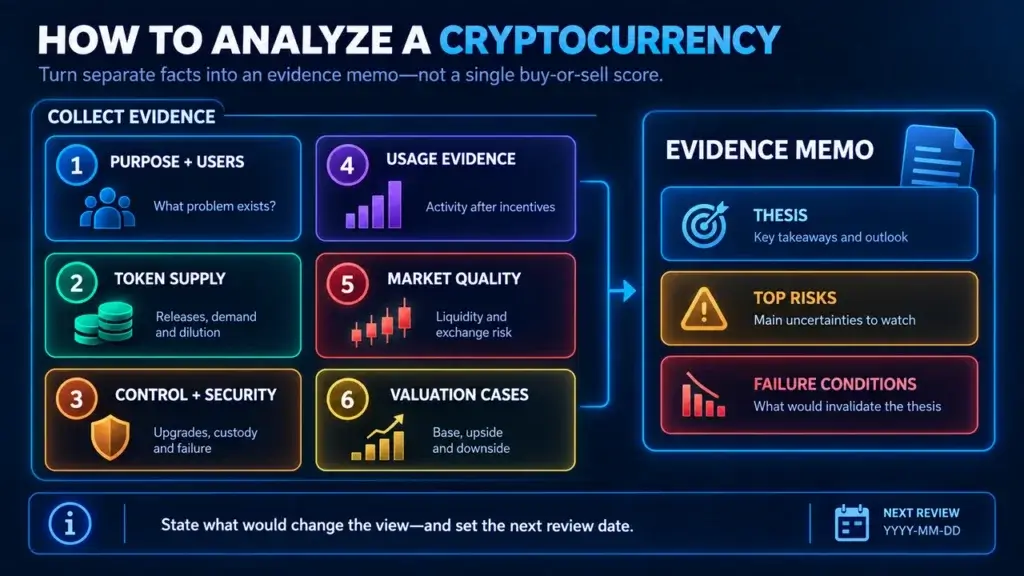
A Worked Evidence Memo
Consider a fictional network token called ARC. The network charges transaction fees in ARC, burns 30% of each fee and pays the rest to validators. Circulating supply is 400 million, with 100 million team and investor tokens scheduled for release over two years. A five-of-eight multisignature can upgrade the fee contract after a seven-day delay.
| Question | Evidence | Confidence | What would change the view? |
|---|---|---|---|
| Does use require ARC? | Fees are paid in ARC in live contracts | High | A governance change permits another fee asset |
| Is usage durable? | Transactions rose during a reward program | Low | Activity remains after rewards fall |
| Is dilution material? | Official schedule adds 25% of current supply | High | Release is delayed or recipients commit to long lockups |
| Is control distributed? | Five signers can approve upgrades | Medium | Signer identities or threshold change |
| Is liquidity adequate? | Two exchanges hold most depth | Medium | More exchanges and deeper books develop |
The memo does not collapse into a buy or sell score. It identifies a token-demand path visible in live contracts, material dilution, uncertain organic use, concentrated upgrade power and limited exchange depth. The next research tasks are clear: measure post-incentive activity, verify signer control, model release scenarios and test liquidity at the intended trade size.
Write the Thesis and the Failure Conditions
A final memo should contain:
- one-sentence project description
- token value path
- supply and control summary
- usage evidence
- market and custody conditions
- valuation scenarios
- top risks
- disconfirming evidence
- next review date
Disconfirming evidence is essential. Examples include falling activity after incentives, an unexpected mint, a failed upgrade, worsening concentration or loss of major exchange support. Decide what matters before it happens.
The SEC's cryptocurrency investor statement recommends asking whether the product and exchange are lawful, markets are fair, prices can be manipulated and assets can be sold when wanted. Its 2023 crypto investor alert also highlights volatility, illiquidity, opaque control, platform failure and fraud risks. Those are research questions, not boilerplate.
Common Analysis Errors
Starting With the Price Target
A target can pull every later assumption toward the desired number. Start with the value path and evidence.
Treating the White Paper as Proof
Documentation explains intended design. Verify live code, usage and control.
Counting Activity Without Incentives
Rewards can buy temporary transactions. Compare activity before, during and after subsidies.
Ignoring Token Value Capture
A useful product can coexist with a token that has no required demand or receives no retained value.
Using One Metric as a Verdict
Market cap, TVL, active addresses and developer counts each omit important context.
Forgetting Market Conditions
Even a careful thesis can face sharp price moves. Why crypto markets are volatile explains liquidity, margin and common shocks.
Frequently Asked Questions
What should I check before buying a cryptocurrency?
Check the asset and contract identity, project use, token value path, supply schedule, holder distribution, upgrade control, security history, observable activity, liquidity, custody and major legal or platform risks. Write what would disprove the thesis before making a decision.
Is fundamental or technical analysis better for crypto?
They answer different questions. Fundamental analysis examines use, supply, control and value. Technical analysis examines price and volume behavior. Neither is complete alone. A decision can use both, with on-chain and risk evidence added where relevant.
How do I know whether tokenomics are good?
Avoid a universal score. Trace who receives new supply, when it becomes transferable, why users need the token, who can change issuance and whether demand can plausibly absorb distribution. Good token economics for one use may be unsuitable for another.
Are white papers reliable sources?
They are primary sources for a project’s stated design and intentions, not independent proof that the system works. Compare claims with live code, official contracts, audits, governance records, incident history and observable use. Note the version and date because documents can change.
Can cryptocurrency analysis remove investment risk?
No. Analysis can expose assumptions and reject weak claims, but it cannot know every future event or eliminate market, technical, custody and legal risk. Use scenarios, limits and review dates. Only risk an amount consistent with the possibility of a total loss.