

Israel x Iran ceasefire continues through…?
The ceasefire can hold if extension talks keep moving and no side chooses a retaliatory response to the latest nuclear-diplomacy pressure. Continued IAEA/UN diplomacy, including any effort to avoid a Security Council referral, would support a stable status quo through the close date.
A breakdown in extension talks or a fresh escalation trigger, such as a Security Council referral after the IAEA Board process, would make a ceasefire lapse more plausible.
AI-Assisted. May contain errors.
Odds summary
Polymarket prices a 86.5% chance of Yes and a 13.5% chance of No, meaning traders currently favor Yes.
Odds, liquidity, volume, and open interest are sourced from Polymarket and last synced at Sep 10, 2026 10:07 am.
Diplomatic restraint supports July while Israeli discretion weighs on August
The price curve treats the ceasefire as temporarily enforceable through external pressure, yet vulnerable over longer horizons because Israel has preserved freedom to strike. The central question is whether U.S. and UN pressure can repeatedly contain incidents before they terminate the ceasefire under the market’s rules.

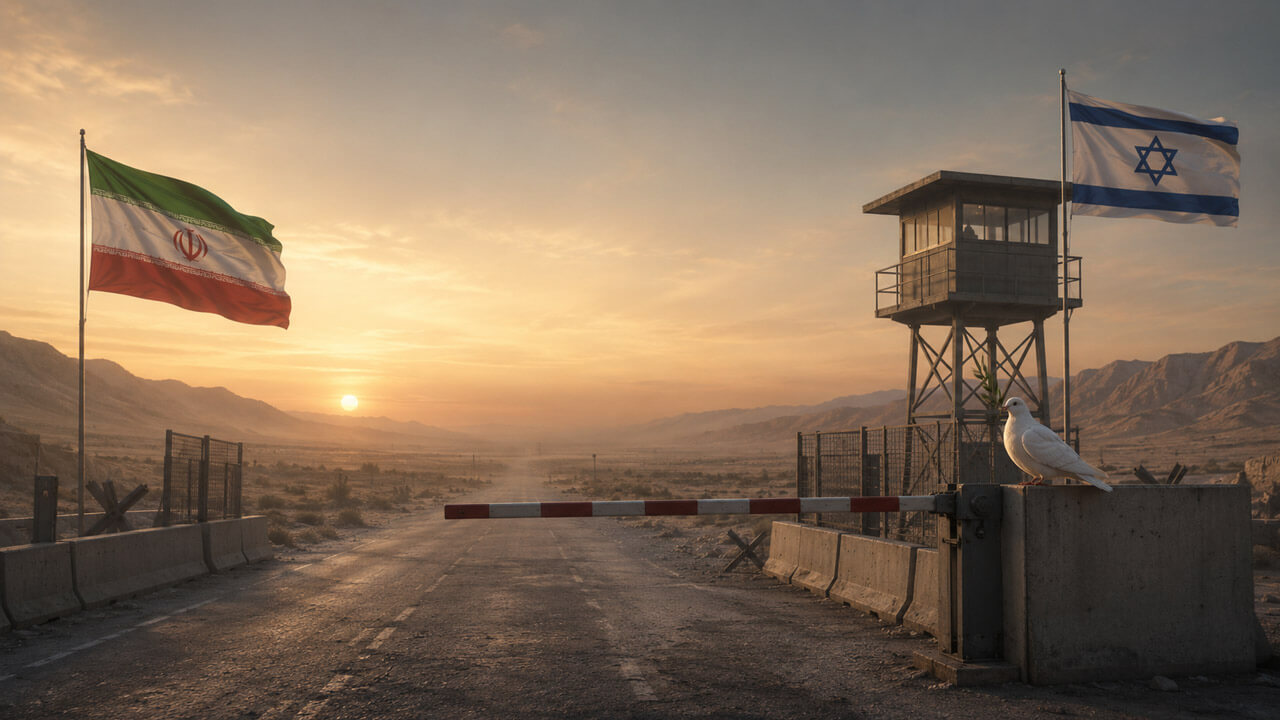
The market’s hierarchy points to a ceasefire sustained by active crisis management instead of durable mutual commitment. Near-term survival is priced very highly, while each additional interval creates another opportunity for missile fire, retaliation, or a disputed defensive action to end the qualifying state of ceasefire. Israel’s stated freedom to act makes that cumulative risk especially important.
June 24 established a pattern of violation followed by containment
Israel’s prime minister said the ceasefire took effect on June 24, 2026. According to the Israeli government statement, Iran then fired missiles at 7:06 a.m. and again at 10:25 a.m. Israel responded with a strike on a radar near Tehran and halted further attacks following U.S. intervention.
That sequence supports two competing readings. The optimistic reading is that escalation controls worked quickly: a direct exchange occurred, outside pressure intervened, and broader fighting did not resume. This helps explain why July 18 trades at 99.8% and July 20 at 91.5%.
The weaker reading is that the ceasefire was tested within hours and required a powerful third party to stabilize it. Extending the same arrangement through July 31 at 60.5%, August 15 at 42.5%, or August 31 at 32.5% assumes that similar interventions will remain timely and effective after future incidents. That is a demanding assumption because each episode can differ in casualties, target sensitivity, and domestic political pressure.
Israel’s unilateral reservation drives the longer-dated decline
On June 24, the Israeli prime minister told the Knesset Foreign Affairs and Defense Committee that no agreement with Iran would bind Israel and that Israel would continue doing everything necessary to defend itself. The statement does not establish that another strike will occur. It does establish that Israel has publicly preserved decision-making freedom despite the ceasefire.
This matters most for the August contracts. The cumulative price falls 39.3 percentage points between July 18 and July 31, then another 28 points by August 31. Market inference: buyers assign a recurring probability that Israel will identify a threat serious enough to justify action, or that Iran will take an action prompting retaliation. The official language makes strict observance dependent on evolving threat assessments rather than the calendar alone.
The rules make small incidents potentially decisive
Resolution requires a state of ceasefire to remain in effect through each listed date at 11:59 p.m. Iran Standard Time. The wording creates a hidden legal and evidentiary assumption: an incident must be interpreted as ending the ceasefire, rather than as a contained violation within a continuing truce.
The June 24 episode shows why that distinction matters. Missile launches and a retaliatory radar strike occurred, yet official accounts continued to describe a ceasefire that had stabilized. A comparable exchange could produce disagreement over whether the truce survived. Clear declarations terminating the ceasefire, sustained direct attacks, or official confirmation that hostilities resumed would weigh much more heavily than an isolated event followed by reaffirmation.
External pressure is the strongest counter-signal
On July 2, the UN secretary-general called for maximum restraint to preserve the broader ceasefire involving the United States and Iran. Combined with the U.S. role on June 24, this provides sourced evidence that influential external actors have incentives to prevent renewed escalation.
That diplomatic capacity is the strongest challenge to the failure thesis. Repeated mediation, publicly reaffirmed Israeli and Iranian restraint, and incident-resolution channels would support later dates by showing that the June 24 containment mechanism can persist. The market’s $689,450 in volume, $269,200 in liquidity, and $324,900 in open interest indicate meaningful exposure to this judgment, though those figures do not validate either interpretation.
Official attribution and retaliation would force the largest reassessment
The clearest positive catalyst would be a bilateral or externally guaranteed statement defining prohibited actions and procedures for handling alleged violations. Verified implementation, continued absence of direct strikes, and repeated official reaffirmations would weaken the inference that every additional week carries similar escalation risk.
The clearest negative catalysts would be attributed Iranian missile fire, an acknowledged Israeli strike on Iranian territory, mobilization paired with explicit operational warnings, or either government declaring the ceasefire void. An isolated incident followed by immediate restraint would present a harder case under the rules. The August 31 contract closes on August 31, 2026 at 11:59 p.m. UTC, leaving the longest outcome exposed to the full accumulation of these political, military, and interpretive risks.
Sources
What could move the odds?
Informational summary of factors that may affect the reported prediction-market probabilities.
Market-implied thesis
At 85.5%, the contract implies the ceasefire is more likely than not to remain in force through September 30, despite a meaningful residual breakdown risk.
Because a winning share pays 1 USDC and a losing share zero, the price functions as an approximate market-implied probability before fees and trading frictions.
What could reprice it
IAEA Board action on the EU-backed draft seeking a report of Iranian non-compliance to the UN Security Council could alter perceived escalation risk before expiry.
The EU statement says the proposed report would complete a procedural step under the IAEA Statute. Movement toward a Security Council referral could test the durability of the ceasefire framework.
Where the market may be weak
The rules do not specify a settlement source or define what events mean a ceasefire no longer “remains in effect,” leaving room for interpretation during a disputed incident.
That ambiguity matters more near the cutoff: limited displayed liquidity relative to outstanding positions can make prices less reliable as a measure of broad consensus when settlement interpretation becomes central.
Counter-signal
The strongest challenge is that the EU-backed non-compliance process could elevate Iran’s case toward the UN Security Council, creating a concrete channel for renewed confrontation.
This does not establish that the ceasefire will fail, but it supplies a documented diplomatic escalation pathway that is difficult to reconcile with an unqualified assumption of stability.
Market details
- Resolution criteria
- This market will resolve to "Yes" if a state of ceasefire remains in effect between Israel and Iran through the listed date, 11:59 PM Iran Standard Time (IRST). Otherwise this market will resolve to “No”.
- Platform
-


- Category
- Politics › Middle East
- Close date
- September 30, 2026, 8:29 PM UTC
- Market rules summary
- Binary market. Payout is 1 USDC for a winning outcome, 0 USDC for a losing outcome. View full rules
Frequently asked questions
What are the current Israel x Iran ceasefire continues through… odds?
Polymarket reports Israel x Iran ceasefire continues through… odds with Yes at 86.5% and No at 13.5%. These probabilities are market-implied and can change as liquidity and trading activity update. The latest market snapshot includes $1.64M volume, $53.35K liquidity, and $586.97K open interest. CryptoSlate last synced this market data at Sep 10, 2026, 09:07 UTC.
What could move the Israel x Iran ceasefire continues through… prediction market odds?
At 85.5%, the contract implies the ceasefire is more likely than not to remain in force through September 30, despite a meaningful residual breakdown risk. Because a winning share pays 1 USDC and a losing share zero, the price functions as an approximate market-implied probability before fees and trading frictions. Catalysts to watch include Ceasefire status through the September 30 settlement cutoff, Potential IAEA Board action and referral procedure, and A contested ceasefire incident or settlement question.
How does the Israel x Iran ceasefire continues through… prediction market resolve?
This market will resolve to "Yes" if a state of ceasefire remains in effect between Israel and Iran through the listed date, 11:59 PM Iran Standard Time (IRST). Otherwise this market will resolve to “No”. Binary market. Payout is 1 USDC for a winning outcome, 0 USDC for a losing outcome.
Related Middle East markets
 Israel withdraws from Lebanon date
  Bab el-Mandeb Strait effectively closed by…?
  Netanyahu out by…?