
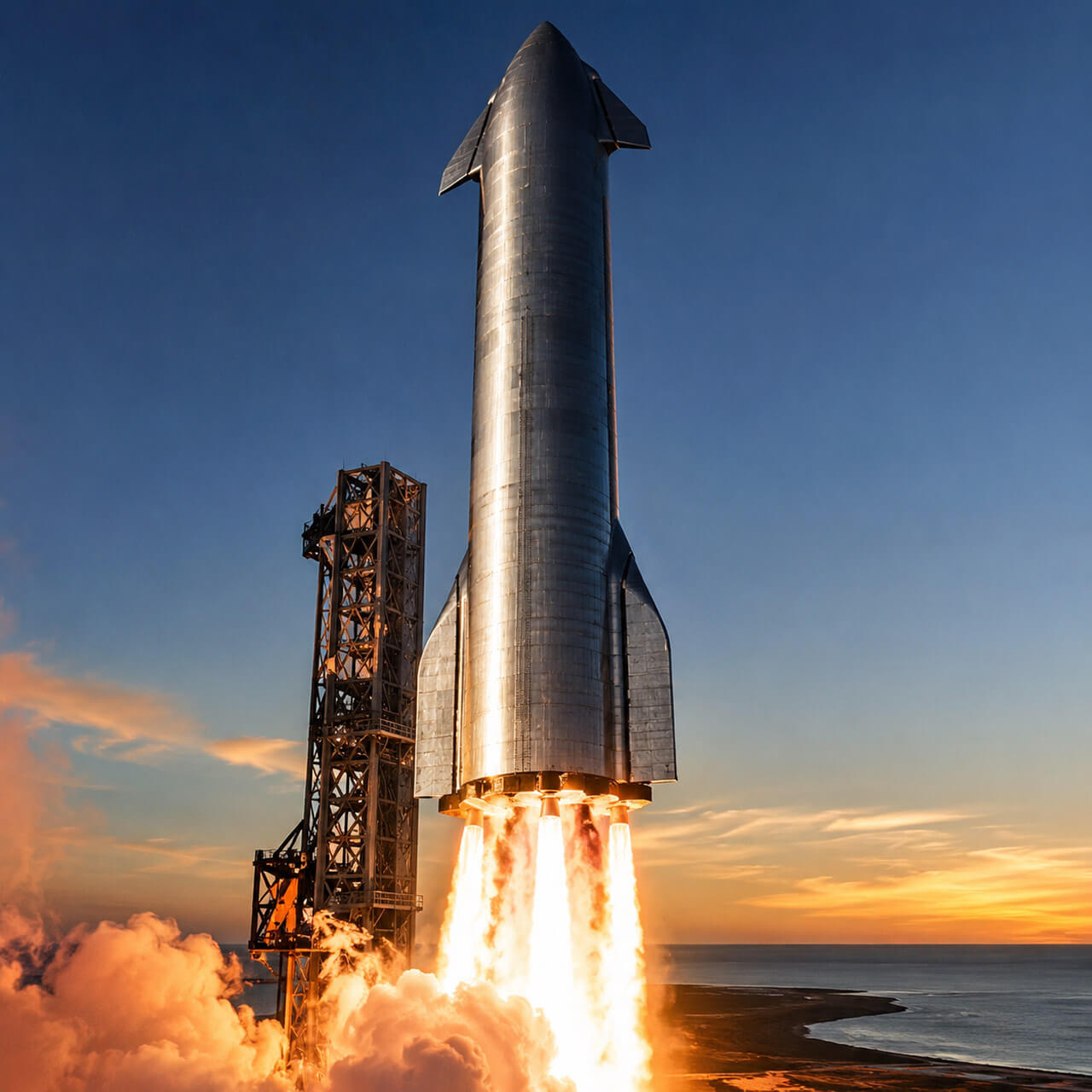
SpaceX Starship Flight Test 13
7 more outcomes Other final results
Market resolution
This SpaceX Starship Flight Test 13 prediction market is settled. The percentages above are the final outcome probabilities reported by Polymarket.
Final probabilities, volume, and open interest are sourced from Polymarket and were last synced at Jul 25, 2026 7:37 am.
 SpaceX Starship Flight Test 14
  Human moon landing in 2026?
 Flight 13 Pricing Separates Schedule Confidence From Recovery Ambition
FAA traffic advisories make a July launch operationally credible, yet repeated window changes concentrate confidence later in the month. The recovery contracts tell a separate story: recent booster performance supports another controlled attempt while leaving a tower catch as a remote mission objective.

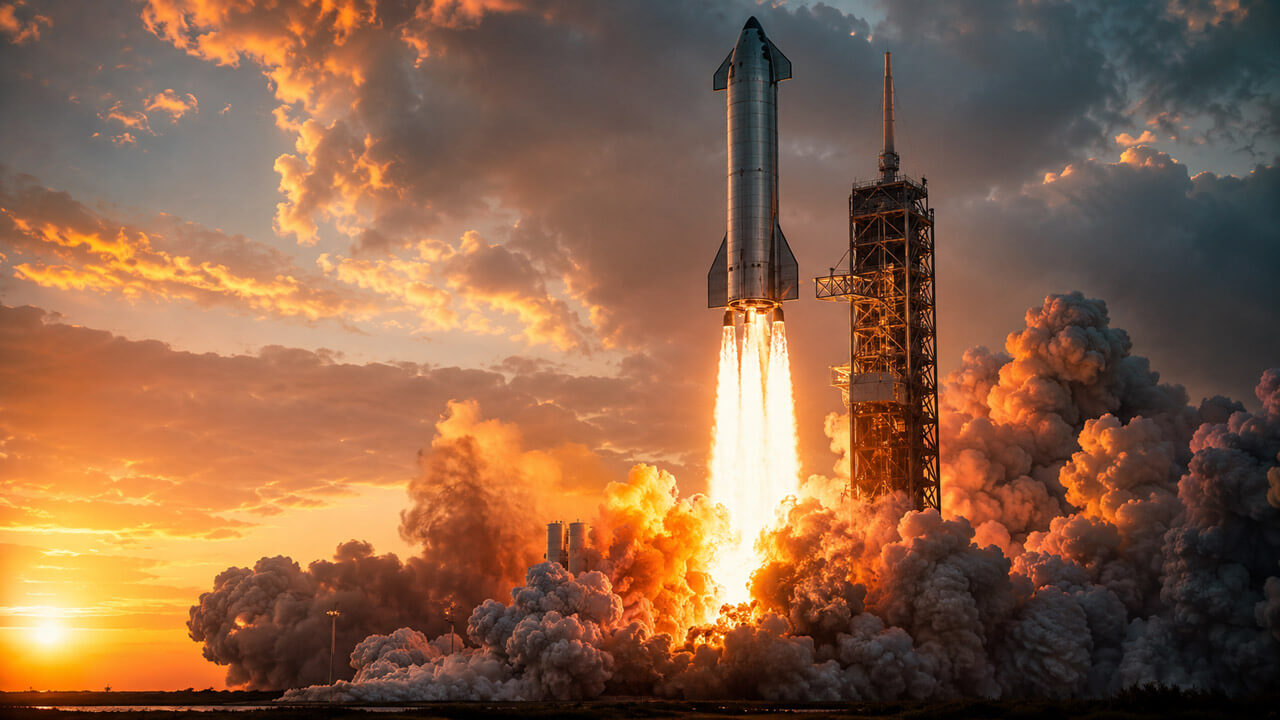
Flight 13’s price hierarchy implies that launch infrastructure and regulatory coordination are advanced, while the exact day remains vulnerable to short delays. That distinction explains how the market can assign only 19.5% to July 20 and 43% to July 23, then rise sharply to 83.1% by July 31 and 96.1% by August 31. The implied thesis is that remaining obstacles are likely measured in days or weeks rather than months.
Repeated FAA windows support readiness while documenting slippage
FAA Air Traffic Control System Command Center advisories dated July 8 and July 16 listed “SPACEX STARSHIP FLT 13, STARBASE, TX,” with primary windows on July 14 and July 16. Those entries matter because airspace planning requires a sufficiently concrete operation to enter the FAA’s near-term traffic schedule. They provide stronger timing evidence than an aspirational launch target.
The same record also contains the market’s main warning. Flight 13 moved through multiple near-term windows by July 17 without resolving the earliest date contract, which was priced at 0.6%. Each missed or replaced window weakens confidence in the next specific day even when it leaves the broader monthly schedule intact. The July 20-to-July 31 jump therefore assumes that recent delays involve tasks that can be cleared within the existing campaign.
An ATCSCC advisory alone does not establish that every launch condition has been satisfied. It coordinates traffic around a planned operation. Treating its presence as proof of launch authorization would overstate what the cited document shows.
The late-July price embeds a short-delay assumption
The 83.1% July 31 price carries a hidden engineering assumption: whatever displaced the July 14 and July 16 windows can be addressed without lengthy hardware replacement, a broader investigation, or a new regulatory process. No supplied source identifies the cause of those schedule changes, so assigning them to weather, hardware, range availability, or paperwork would be speculation.
This assumption would gain support from another FAA advisory retaining a near-term Starbase window, especially if SpaceX also issued a matching launch announcement. A completed countdown rehearsal or other company-confirmed readiness milestone would be a hypothetical additional signal. Conversely, a new advisory moving the operation into August, withdrawal of a listed window, or a company statement identifying hardware work would weaken the late-July case.
The market has attracted $281,660 in volume, with $73,500 of liquidity and $96,290 in open interest. Those figures show sustained engagement with the timing distinctions, although they cannot validate the underlying engineering assumptions.
Licensing remains a separate gate from airspace coordination
FAA environmental-review materials state that Starship and Super Heavy operations at Boca Chica require an experimental permit or launch license, with environmental review forming part of the authorization process. This matters because traffic scheduling and launch authorization serve different functions. A mission can enter operational planning while a required approval or modification still constrains execution.
The August 31 contract at 96.1% assumes that any remaining authorization issue can be completed within roughly six weeks. A public FAA license decision, applicable modification, or confirmation that existing authority covers Flight 13 would reinforce that premise. A request for additional environmental analysis, operational restrictions, or an unresolved license amendment would create a longer-tailed delay scenario. The supplied record does not show that any such setback has occurred.
Recovery prices imply another splashdown campaign, not a catch attempt
The 71.5% successful-splashdown price sits far above the 1.4% price for a chopsticks catch of Super Heavy. The clearest inference is that the expected mission profile emphasizes flight data and controlled recovery over tower capture. The supplied research record says Flight 12 introduced major new hardware but ended with a booster hard splashdown. That outcome supports caution around precision recovery and gives the market little recent-performance basis for assigning a high probability to a catch.
The 80% “Super Heavy booster explodes” contract requires careful interpretation alongside the splashdown price. These contracts may depend on distinct wording and footage-based settlement, and the supplied rules provide no detailed definition of explosion or successful splashdown. A booster could conceivably complete key flight phases and later break apart or produce an explosion during termination or impact. Exact resolution language and the linked settlement video could therefore move these prices even without a change in engineering expectations.
A launch-plan disclosure is the strongest recovery catalyst
The largest recovery repricing would follow a SpaceX statement defining Flight 13’s intended booster disposition. Confirmation of an offshore splashdown target would reinforce the current hierarchy. A declared tower-catch attempt, supported by company documentation, would directly challenge the 1.4% catch price. The strongest counter-signal across the event remains the combination of repeated date changes and Flight 12’s hard splashdown: both show that advanced preparation can coexist with late operational changes and incomplete recovery execution.
Sources
Market details
- Resolution criteria
- This is a market on the outcome of the SpaceX Starship Flight Test 13.
- Platform
-


- Category
- Tech › Space
- Settlement source
- youtube.com
- Market rules summary
- Multi-timeframe Polymarket event. Each listed timeframe is represented by its Yes price on the underlying binary market. View full rules
Frequently asked questions
What was the final result of the SpaceX Starship Flight Test 13 prediction market?
Polymarket reports the SpaceX Starship Flight Test 13 prediction market as closed. The final snapshot shows July 24 at 100%, July 25 at 100%, July 26 at 100%, and July 27 at 100%. The final market snapshot includes $887.16K volume and $137.59K open interest. CryptoSlate last synced the final market data at Jul 25, 2026, 06:37 UTC.
How does the SpaceX Starship Flight Test 13 prediction market resolve?
This is a market on the outcome of the SpaceX Starship Flight Test 13. Multi-timeframe Polymarket event. Each listed timeframe is represented by its Yes price on the underlying binary market. The settlement source listed for this market is youtube.com.
Related Space markets
SpaceX Starship Flight Test 14 Human moon landing in 2026?  Which company has the best AI model end of September?