

Human moon landing in 2026?
Current Odds
Odds Summary
Polymarket reports 1.1% for Yes and 98.9% for No.
Polymarket · Last synced
Market Analysis
Moon Landing Odds Treat 2026 as a Deadline Problem
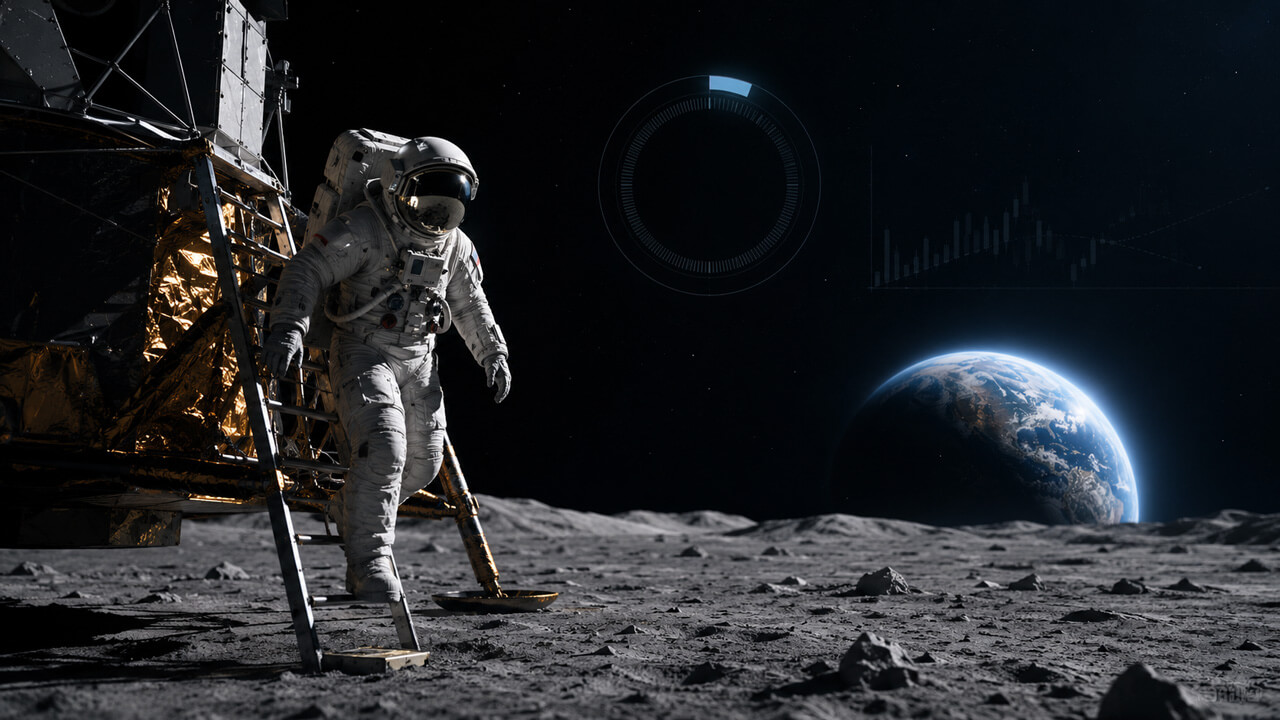
The wager hinges on whether broad resolution language can overcome the unforgiving calendar. A single credible 2026 landing path would challenge the market’s deadline-first reading, while ordinary schedule slippage keeps the no-landing case structurally dominant.

A 3.3% Yes price makes this market read like a judgment on calendar compression. The resolution rule requires an actual human-crewed moon landing by Dec. 31, 2026, 11:59 PM ET, so partial progress, test flights, crewed lunar orbit, or a landing after the cutoff all point to the same No outcome. That structure pushes the price toward a simple thesis: the moon may be reachable, yet the 2026 deadline is doing most of the work.
The price treats time as the decisive technical risk
The market-implied story is that execution risk compounds as the deadline approaches. A human landing is a final event in a chain, and the rule gives no credit for intermediate milestones unless they culminate in touchdown during the eligible window. That matters because a late-stage delay has the same resolution impact as a complete absence of launch activity. The No price near 96.8% therefore reads as an inference that the deadline leaves little tolerance for unresolved dependencies.
The one-off structure sharpens that interpretation. There is no rolling settlement for readiness, no payout for a launch, and no distinction between a near miss and a dormant program. The market only needs to answer whether any human-crewed mission lands on the moon before the cutoff. That binary framing makes schedule slippage unusually powerful, since a move from 2026 into 2027 would convert a technologically successful path into a losing Yes outcome under these rules.
Broad eligibility keeps the tail alive
The strongest feature of the Yes case is hidden in the wording. The criterion says any human-crewed mission, which means the outcome is not tied to a named agency, country, or sponsor in the supplied rule text. That breadth helps explain why Yes has not collapsed to a negligible quote: a qualifying landing from any eligible mission would settle the market the same way.
The same broad wording also limits how much the market can rely on a single public schedule as the whole story. A hypothetical credible mission announcement from an actor outside the most discussed planning cycle would matter because the rule is event-based, not sponsor-based. The market’s low Yes price implies that breadth alone is not enough; it still requires a completed landing within a narrow window, and the deadline dominates the optionality created by the word any.
The No case wins through many ordinary paths
The hidden assumption behind the price is that ordinary failure modes are numerous and rule-relevant. A delay, a scrubbed launch, a mission redesign, a crewed flight that avoids landing, a landing attempt after the deadline, or the absence of a qualifying mission all resolve the same way. Yes needs one specific endpoint; No can be produced by many distinct paths. That asymmetry matters more than sentiment about space exploration because the contract pays only on the final landing event.
Market participation adds another clue. The market has drawn $1.94 million in volume, which suggests the question has sustained attention. Yet liquidity of $20.67K and open interest of $22.55K across 285 traders indicate that the live order book can still be sensitive to concentrated new information. Inference from those figures: the headline probability may be anchored by the dominant deadline thesis, while the path of future moves could be jumpy if mission-specific evidence arrives.
Only concrete 2026 landing evidence would change the story
For the Yes probability to move materially, the market would need evidence that compresses the landing chain into the remaining window. Generic enthusiasm about lunar exploration would matter little under these rules. Evidence would need to speak directly to a crewed landing before Dec. 31, 2026, because the contract is indifferent to broader progress that stops short of that event.
| Potential evidence | Why it matters to pricing |
|---|---|
| A publicly verifiable 2026 crewed landing timetable | It would challenge the assumption that the calendar is already too tight. |
| Completed precursor milestones that directly support a landing attempt | It would reduce the number of unresolved steps implied by the low Yes price. |
| A delay placing the landing after the cutoff | It would reinforce the market’s view that timing, not ambition, decides resolution. |
| Rule-relevant ambiguity over what counts as landing | It could shift attention from mission probability to settlement interpretation. |
The close date listed as Dec. 31, 2026, 12:00 AM UTC also matters because most of the tradable information should arrive before the resolution window fully expires. If a mission were plausibly scheduled at the very end of 2026, attention would likely focus on exact timing, verification, and whether the market can still absorb new evidence before trading closes.
The main counter-signal is an eligible mission outside the market’s assumed path
The market’s largest blind spot is the possibility that the broad rule captures a credible landing route that is not currently central to the implied consensus. Since the contract does not specify a sponsor, a hypothetical late-stage qualifying mission from any actor would attack the No thesis at its weakest point: its reliance on the absence of a concrete 2026 endpoint.
That counter-signal would need substance. A statement of ambition would have limited impact if it failed to establish a landing inside the resolution window. A firm schedule, crewed mission architecture, and externally verifiable progress would matter because they connect directly to the settlement test. Until evidence of that kind appears, the market’s pricing is best read as a deadline-first assessment: the rules are broad, but the calendar is narrow.
Sources
What Could Move the Odds?
Market-Implied Thesis
The 1.6% Yes price implies that a human lunar landing by any operator before the 2026 deadline is viewed as highly unlikely.
That reading aligns with NASA placing its first Artemis landing in early 2028 and China targeting a crewed landing by 2030, leaving no official major-program landing path in 2026.
What Could Reprice It
A credible official revision that assigns a crewed lunar landing to 2026 would most directly challenge the market’s No baseline.
NASA’s published framework places Artemis III in a 2027 low-Earth-orbit demonstration role and the first Artemis landing in early 2028; a departure from that plan would alter the core evidence behind No.
Where the Market May Be Weak
Reported turnover is much larger than available liquidity, so the price may reflect prior trading more than the depth available to absorb new information.
The market’s $1.98M volume is cumulative, while $21.39K liquidity describes the displayed trading depth. That gap can make a low-probability quote less resilient when credible news arrives.
Counter-Signal
The No case could fail because settlement covers any human-crewed mission, not only NASA or China, so official timelines do not eliminate every pathway.
The rule is outcome-based: one qualifying lunar landing before December 31, 2026 resolves Yes. NASA and Chinese schedules are strong negative evidence, but they are not an exhaustive list of possible operators.
Market Details
- Resolution criteria
- This market will resolve to "Yes" if any human-crewed mission lands on the moon between market creation and December 31, 2026, 11:59 PM ET. Otherwise, this market will resolve to "No".
- Platform
-


- Category
- Culture › Space
- Scheduled deadline
- January 1, 2027, 4:59 AM UTC
- Market rules summary
- Binary market. Payout is 1 USDC for a winning outcome, 0 USDC for a losing outcome. View full rules
Frequently Asked Questions
What are the current Human moon landing in 2026 odds?
Polymarket reports Human moon landing in 2026 odds with No at 98.9% and Yes at 1.1%. These probabilities are market-implied and can change as liquidity and trading activity update. The latest market snapshot includes $1.98M volume, $21.29K liquidity, and $20.15K open interest. CryptoSlate last synced this market data at Oct 21, 2026, 21:57 UTC.
What could move the Human moon landing in 2026 prediction market odds?
The 1.6% Yes price implies that a human lunar landing by any operator before the 2026 deadline is viewed as highly unlikely. That reading aligns with NASA placing its first Artemis landing in early 2028 and China targeting a crewed landing by 2030, leaving no official major-program landing path in 2026. Catalysts to watch include An official 2026 landing-plan revision or a qualifying landing, NASA revises its Artemis landing schedule, and Fresh official mission disclosure.
How does the Human moon landing in 2026 prediction market resolve?
This market will resolve to "Yes" if any human-crewed mission lands on the moon between market creation and December 31, 2026, 11:59 PM ET. Otherwise, this market will resolve to "No". Binary market. Payout is 1 USDC for a winning outcome, 0 USDC for a losing outcome.
Related Space Markets
 SpaceX Starship Flight Test 14
  SpaceX Starship Flight Test 13
  Wildwood opening weekend box office: October 23–25, 2026