
Venezuela leader end of 2026?
11 more outcomes Listed by current odds, highest first
Odds summary
Nicolás Maduro currently leads the Venezuela leader end of 2026 prediction market at 82% reported probability on Polymarket. The figures below combine live odds, liquidity, volume, and open interest so readers can compare the market signal before reading the full analysis.
Odds, liquidity, volume, and open interest are sourced from Polymarket and last synced at Jul 26, 2026 2:32 am.
Maduro’s 2026 Lead Hinges on Recognition and Succession Risk
The market’s structure rewards whoever is formally recognized by the settlement source, making control of institutional title more important than electoral narratives alone. That creates a narrow but meaningful lane for succession figures while keeping opposition outcomes highly path-dependent.

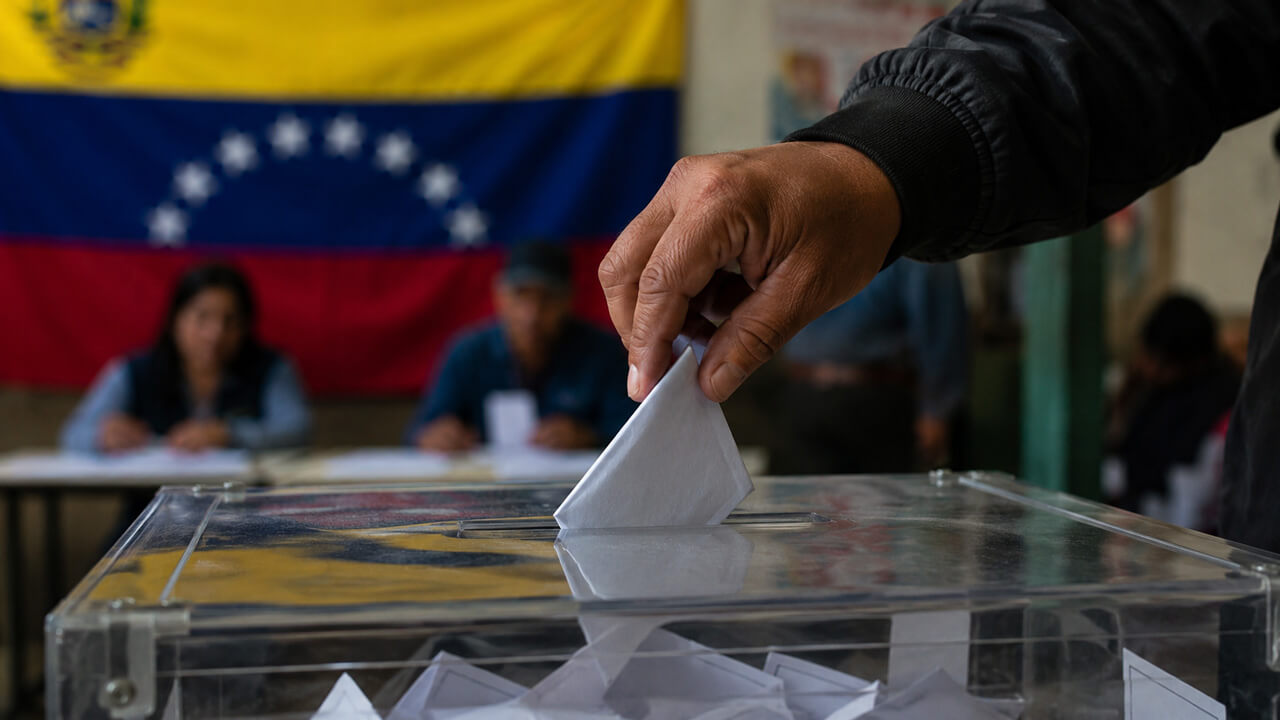
The market is pricing Venezuela’s end-2026 leadership as a question of institutional custody. Nicolás Maduro at 72.1% and Delcy Rodríguez at 14.5% imply that the dominant path keeps the official title inside the current governing structure, with succession treated as the main alternative to outright opposition victory. The settlement source matters: the contract resolves to the person who officially holds Venezuela’s head-of-state position according to the UN-linked source at a single timestamp, so formal recognition carries direct settlement weight.
The lead price is built around continuity of the official title
Maduro’s share points to a simple market-implied story: the office survives political pressure, and the named holder at the end of 2026 remains the incumbent. The inference rests on the odds and the resolution rule, leaving legitimacy or governing-performance judgments outside the contract logic. A fixed-date official-title market rewards scenarios where institutions produce a named officeholder even through contested politics, because the rule centers the official post at noon ET on Dec. 31, 2026.
The large $90.72 million volume gives this signal more editorial weight than a thin curiosity market, while $1.7 million of liquidity suggests the top outcomes can absorb disagreement. The 24-hour moves, with Maduro up 2.1 points and Rodríguez up 0.5 points, also lean toward continuity within the state apparatus. That movement matters because both gains sit on the same side of the regime-continuity branch, while opposition-linked names remain far behind.
Delcy Rodríguez carries the succession path the market can price
Rodríguez at 14.5% is the clearest secondary thesis because she offers a way for the title to change hands while keeping the market inside the current governing structure. Her pricing is an inference that an internal transition, illness, resignation, appointment, or negotiated handoff could still produce a recognized head of state from inside the same power structure. The market appears to treat her differently from smaller establishment names such as Jorge Rodríguez at 0.9% or Diosdado Cabello Rondón at 0.5%, which suggests a narrower succession map.
That distinction matters because a succession outcome can resolve cleanly if the formal title moves and the UN source records the change. It needs fewer steps than an opposition path: a domestic title transfer, external acknowledgement, and survival through the timestamp may be enough. The spread between Rodríguez and the rest of the field implies the market sees only a limited set of insiders as plausible holders of the official designation by then.
The opposition path depends on recognition catching up to politics
María Corina Machado at 3.4% and Edmundo González at 0.6% show that the market assigns some probability to a break from the current official structure, but the small combined share implies a demanding chain of events. Under these rules, a political claim must become the recognized head-of-state title by the settlement source. That chain could include a domestic transition, international recognition, and an official listing change before the deadline.
This is why the UN-linked settlement source is central. If there are rival claims, parallel institutions, or a contested transition, the market has to care about the administrative endpoint. A candidate can dominate headlines and still fail to become the recorded officeholder by the precise resolution time. Conversely, a figure with weaker political visibility can matter if the formal machinery elevates them and the source records that elevation.
Catalysts have to alter the official pathway
Signals that would force meaningful repricing are those that change the probability of who is officially listed at the deadline. The market’s structure makes narrative developments secondary unless they affect the title pathway.
- A public, institutional succession process naming an interim or permanent successor would give the Rodríguez branch, or another insider branch, a concrete route.
- A negotiated transition with clear recognition language from institutions used by the settlement source would strengthen opposition-linked outcomes.
- A documented change in the UN protocol listing would be the most direct evidence because it touches the settlement mechanism itself.
- A constitutional or legal dispute that produces no clear recognized head could lift the small No Head of State outcome, currently 0.6%, if it threatened the ability to identify one official holder.
The failure mode is an elite break that resolves faster than expected
The main counter-signal to the continuity-heavy pricing is a credible split among state institutions that produces a recognized successor before the deadline. This could come from a hypothetical elite realignment, a negotiated exit, or a rapid legal restructuring that installs a new head of state with enough official recognition to satisfy the settlement source. That scenario matters because the market’s top outcome relies on durability across two layers: domestic control of the title and external recording of that title.
The tiny prices on external or peripheral names, including Donald Trump at 0.4% and several U.S.-linked figures near 0.2%, show how little weight the market assigns to extraordinary recognition scenarios that would place a nonstandard figure into the official slot. Those tails still matter analytically because they reveal what the market is excluding: a settlement pathway driven by external designation or administrative anomaly. The dominant thesis is therefore conditional on official continuity, with Rodríguez serving as the priced hedge against an internal transfer and the opposition priced as a longer chain that must end in formal recognition by Dec. 31, 2026.
Sources
What could move the odds?
Informational summary of factors that may affect the reported prediction-market probabilities.
Market-implied thesis
Pricing implies Maduro remains the officially recognized Venezuelan head of state at the Dec. 31 resolution point, despite contested legitimacy.
UN usage naming Maduro as president in late 2025/early 2026 is key because the market settles on the official holder, not on who is viewed as democratically legitimate.
What could reprice it
Any official UN language, negotiated transition notice, or U.S.-Venezuela diplomatic announcement before Dec. 31 could sharply move successor outcomes.
The reopened U.S. Embassy in Caracas and limited engagement keep a negotiated political path live, even if the baseline official-title evidence still favors continuity.
Where the market may be weak
The market has large headline volume, but settlement turns on a narrow official-title test that may not match political control or opposition-recognition narratives.
Multi-outcome wording can trap buyers if a figure gains influence but does not officially hold head-of-state status at the exact Dec. 31, 12 PM ET resolution time.
Counter-signal
The price may understate transition risk if diplomatic engagement, sanctions policy, or elite-regime bargaining produces a formal handoff before year-end.
Delcy Rodríguez’s non-trivial pricing shows the market is not treating continuity as risk-free; an internal succession could satisfy the rules without an opposition victory.
Market details
- Resolution criteria
- This market will resolve to the individual who officially holds the position of the head of state of Venezuela on Dec 31, 2026 at 12 PM ET.
- Platform
-


- Category
- Politics › Global Elections
- Close date
- December 31, 2026, 12:00 AM UTC
- Settlement source
- un.org
- Market rules summary
- Multi-outcome Polymarket event. Each listed option is represented by its Yes price on the underlying market. View full rules
Frequently asked questions
What are the current Venezuela leader end of 2026 odds?
Polymarket reports Venezuela leader end of 2026 odds with Nicolás Maduro at 82%, Delcy Rodríguez at 11%, María Corina Machado at 3.1%, and No Head of State at 1.2%. These probabilities are market-implied and can change as liquidity and trading activity update. The latest market snapshot includes $94.3M volume, $1.98M liquidity, and $588.06K open interest. CryptoSlate last synced this market data at Jul 26, 2026, 01:32 UTC.
What could move the Venezuela leader end of 2026 prediction market odds?
Pricing implies Maduro remains the officially recognized Venezuelan head of state at the Dec. 31 resolution point, despite contested legitimacy. UN usage naming Maduro as president in late 2025/early 2026 is key because the market settles on the official holder, not on who is viewed as democratically legitimate. Catalysts to watch include UN or official state recognition language, Official UN or diplomatic announcement, and Negotiated or internal succession signal.
How does the Venezuela leader end of 2026 prediction market resolve?
This market will resolve to the individual who officially holds the position of the head of state of Venezuela on Dec 31, 2026 at 12 PM ET. Multi-outcome Polymarket event. Each listed option is represented by its Yes price on the underlying market. The settlement source listed for this market is Un.
Related Global Elections markets
 Clacton by-election Winner


 Russia Parliamentary Election Winner


 Next leader out of power before 2027? (No Orban)