
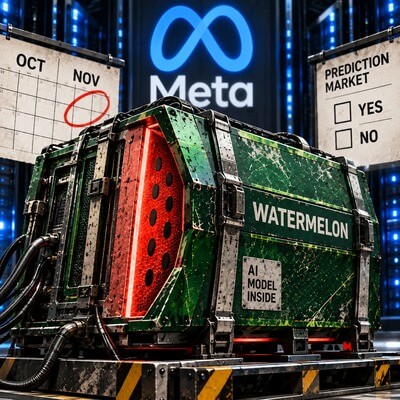
When will Meta release its Watermelon AI model?
Current Odds
Odds Summary
November 30 leads at 94.5% reported probability on Polymarket.
Polymarket · Last synced
Market Analysis
Meta Watermelon release timing hinges on what counts as a launch

A model announcement, a limited preview, and public access could produce different release dates. The supplied record leaves that threshold undefined, so the useful analysis separates evidence of technical readiness from evidence that a specific Meta release would satisfy the market.

The central question for Meta’s Watermelon release forecast is whether an announcement, restricted access, or public availability would count as release. Each threshold creates a different timeline, even for the same underlying model. The supplied record contains neither resolution rules nor outcome prices, so it cannot support an explanation of the market’s actual pricing hierarchy. It does support a narrower thesis: defining the qualifying launch event must precede a defensible date forecast.
Meta Watermelon needs an identifiable release event
The market question names “Watermelon,” but the supplied material provides no Meta announcement, model documentation, or corroborating reporting establishing its identity or release plans. The name in the question establishes the subject of the contract; it does not independently establish the model’s development status. Treating it as evidence of an imminent launch would introduce an unsupported assumption into every subsequent timing estimate.
Identity matters because a model could hypothetically reach users under a different public name. Evidence connecting that name to Watermelon would then become essential. A dated Meta statement explicitly making the connection would strengthen the case that the release belongs to this market. A product announcement without that connection would leave the identity question unresolved, even if the product were available immediately.
The first evidence that would materially improve the forecast is therefore documentation identifying the model and specifying what Meta plans to make available. That would turn an undefined label into a release process with observable milestones.
Watermelon launch criteria could shift the qualifying date
A hypothetical sequence illustrates the timing problem: Meta announces Watermelon, grants selected developers access, then opens access more broadly. If an announcement qualifies, the first event settles the timing question. If usable access is required, the second or third event could matter instead. The interval between those events would create different answers without any disagreement about when Meta completed the model.
This distinction changes how evidence should be weighed. A launch presentation could strongly support an announcement deadline while providing little evidence for a general-access deadline. Conversely, accessible model documentation and a functioning distribution channel could establish availability even without a prominent presentation, depending on the eventual rules.
The contract’s qualifying threshold is therefore a hidden assumption behind any date-based explanation. Since the supplied rules field is empty, assigning one would be speculation. Published criteria covering previews, restricted access, and renamed models would reduce ambiguity; broad wording could preserve it.
Meta’s release incentives allow competing timing scenarios
Technical readiness and release authorization answer different questions. A hypothetical model could perform well enough for demonstration while still awaiting decisions about distribution, eligibility, or support. Evidence of capability would strengthen a readiness thesis, but it would not by itself establish that Meta had committed to a qualifying launch date.
Two incentive stories could then point in opposite directions. If Meta sought an early public demonstration, it could choose an announcement or limited preview before broad availability. If it prioritized a complete launch package, it could wait until access and documentation were ready together. These are competing scenarios, not sourced descriptions of Meta’s current strategy.
The strongest counterargument to a delayed-access thesis is a narrowly scoped release. If the rules accept access for a small eligible group, Meta would not need to complete a broad rollout to satisfy the contract. Evidence of a limited preview would then carry more timing weight than it would under a public-availability requirement.
Evidence that would change the Watermelon timing assessment
The most consequential catalyst would be a dated Meta commitment that identifies Watermelon, describes the release format, and specifies who can access it. Those details would connect corporate intent to the contract’s threshold. A date without an access definition would resolve only part of the problem.
Actual availability would provide stronger evidence than a planned date. A verifiable access page, release documentation, or distributed model artifact could establish that a qualifying event had occurred, subject to the rules. A postponement or access restriction could weaken an earlier-release thesis if it affected the required audience.
The next useful update must therefore answer two concrete questions together: which public release is Watermelon, and what event qualifies as its release? Until those are documented, a launch headline alone cannot establish the contract’s date.
Sources
What Could Move the Odds?
Market-Implied Thesis
The 94.5¢ November contract implies Watermelon will be publicly released by November 30, not merely discussed or previewed.
Because each timeframe is a separate Yes-priced binary market, the rising prices read as a cumulative release-timing curve rather than mutually exclusive release-date odds.
What Could Reprice It
The key repricing event is a post-October 10 Meta Research announcement that explicitly names Watermelon and states its availability or launch timing.
The cited September 2 roadmap referenced “bigger models” but supplied no Watermelon deadline, leaving a formal product or research update as the clearest new evidence.
Where the Market May Be Weak
Reported volume shows attention, but $5.05K of liquidity is modest for a 94.5¢ claim, so the price may be vulnerable to limited opposing depth.
The gap between cumulative trading volume and current displayed liquidity means past participation does not itself establish that substantial capital can challenge the late-November consensus.
Counter-Signal
The cited roadmap does not name Watermelon or commit to a release date, so the market may be converting a broad model plan into an overly specific deadline.
Settlement criteria link the codename to credible reporting, while the cited Meta Research material only says its roadmap includes bigger models; that leaves identity and timing unconfirmed.
Market Details
- Resolution criteria
- On September 2, 2026, alongside the launch of Muse Spark 1.3, Meta announced a roadmap "including bigger models" (https://research.meta.ai/blog/introducing-muse-spark-1-3). Credible reporting has identified Meta's next-generation frontier model by the internal codename "Watermelon."
- Platform
-


- Category
- Tech › AI
- Scheduled deadline
- November 30, 2026, 11:59 PM UTC
- Settlement source
- research.meta.ai
- Market rules summary
- Multi-timeframe Polymarket event. Each listed timeframe is represented by its Yes price on the underlying binary market. View full rules
Frequently Asked Questions
What are the current When will Meta release its Watermelon AI model odds?
Polymarket reports When will Meta release its Watermelon AI model odds with November 30 at 94.5%, October 31 at 74%, and October 15 at 51.5%. These probabilities are market-implied and can change as liquidity and trading activity update. The latest market snapshot includes $92.02K volume, $4.38K liquidity, and $21.68K open interest. CryptoSlate last synced this market data at Oct 10, 2026, 12:54 UTC.
What could move the When will Meta release its Watermelon AI model prediction market odds?
The 94.5¢ November contract implies Watermelon will be publicly released by November 30, not merely discussed or previewed. Because each timeframe is a separate Yes-priced binary market, the rising prices read as a cumulative release-timing curve rather than mutually exclusive release-date odds. Catalysts to watch include A Meta Research release announcement or roadmap update, An explicit Watermelon launch or availability statement, and New liquidity or contrary reporting.
How does the When will Meta release its Watermelon AI model prediction market resolve?
On September 2, 2026, alongside the launch of Muse Spark 1.3, Meta announced a roadmap "including bigger models" (https://research.meta.ai/blog/introducing-muse-spark-1-3). Credible reporting has identified Meta's next-generation frontier model by the internal codename "Watermelon." Multi-timeframe Polymarket event. Each listed timeframe is represented by its Yes price on the underlying binary market. The settlement source listed for this market is Research.
Related AI Markets
 Which company will lead Code Arena WebDev in October 2026?


 Which company will lead Arena Math in October 2026?
 GPT Astra 6.1 release date?