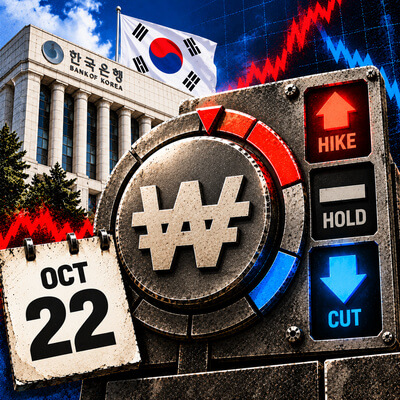
Bank of Korea interest rate decision: October 2026
Current Odds
Odds Summary
No Change leads at 96.4% reported probability on Polymarket.
Polymarket · Last synced
Market Analysis
Bank of Korea’s October 2026 decision hinges on earlier moves

An October hold could follow substantial earlier easing, while an October cut could follow months of restraint. Distinguishing those paths requires the preceding rate decisions and economic releases, plus contract terms that the supplied market record does not include.

The Bank of Korea’s October 2026 decision depends partly on how much policy adjustment happens before that meeting. Earlier cuts could strengthen the case for an October pause, even if economic conditions still favor easier policy. Delayed easing could concentrate pressure for a cut in October. That sequencing is the central analytical issue; the supplied record contains no outcome prices from which to establish the market’s preferred path.
October 2026 depends on the preceding Bank of Korea decisions
A meeting-specific forecast requires separating the direction of policy from the timing of its next adjustment. In a hypothetical easing cycle, several cuts before October would lower the starting rate for that decision. Policymakers could then wait for evidence about their effects. An October hold would be compatible with an easing cycle under that scenario.
The opposite sequence could produce an October cut: earlier meetings leave the rate unchanged, followed by evidence that weak demand warrants action. This means the same broad economic forecast can support different October outcomes depending on decisions taken along the way. Any claimed hierarchy among hold, cut, or hike therefore needs an explicit assumption about the rate entering the meeting.
Inflation evidence must establish room for an October cut
A conditional case for easing requires evidence that reducing rates would remain consistent with price stability. Softer inflation readings would help that argument if they persisted and extended across categories. A decline driven by a temporary comparison effect would provide a weaker basis for assuming policymakers have room to act.
The causal distinction concerns durability. If price pressures look likely to return, cutting could require a later reversal. If disinflation looks durable while demand weakens, maintaining the existing rate could impose a greater economic cost. These are analytical scenarios, not descriptions of current Korean conditions: the supplied material includes no inflation releases or Bank of Korea forecasts.
Evidence that would strengthen a cut thesis includes successive releases showing easing price pressure alongside weaker activity. Renewed inflation pressure would weaken it. The relevant question is whether incoming evidence changes the projected inflation path by October, including the effects of any earlier policy moves.
The won and financial conditions could complicate easing
A domestic slowdown alone would leave part of the decision unexplained. In a hypothetical scenario where lower rates contribute to currency depreciation, more expensive imports could complicate the inflation outlook. That mechanism could make policymakers more cautious about easing, even while domestic activity argues for support.
Financial conditions introduce another possible constraint. If easier credit stimulates borrowing or asset demand faster than it supports output, policymakers may judge another cut harder to justify. Conversely, evidence of strained financing conditions could strengthen the case for relief. The supplied record establishes neither condition, so neither can explain a claimed current market preference.
This is the strongest counterargument to a simple weak-growth-equals-cut thesis: the policy choice can involve competing costs. A persuasive October forecast would show why inflation, currency, and credit risks permit the response implied by the growth outlook.
Bank of Korea guidance could change the October timing
Communication before October could alter the expected sequence without changing the expected eventual direction of rates. A conditional signal that policymakers want more evidence could shift an anticipated adjustment into October. Guidance favoring earlier action could reduce the remaining need to move at that meeting.
The strongest confirmation would combine communication with subsequent decisions and releases. A statement indicating scope for easing carries different implications if the bank then cuts before October. Likewise, a cautious statement would lose predictive force if later data deteriorated enough to change the policy calculation. Each intervening meeting updates both the starting rate and the evidence available for October.
Missing contract terms limit any claim about the price
The supplied Polymarket link identifies the October 2026 Bank of Korea event, but the accompanying record supplies neither outcome definitions nor resolution rules. It therefore cannot establish whether particular move sizes receive separate outcomes or how an unusual decision would be classified. Those details could materially affect a price-based interpretation.
Without executable quotes or trading-depth information, there is also no basis for attributing a hierarchy to broad conviction or sparse participation. The next concrete requirements are the contract’s full terms and current outcome prices, followed by the Bank of Korea decisions preceding October. Together, those would allow an assessment of whether the quoted October outcome fits the assumed policy sequence.
Sources
Market Details
- Resolution criteria
- This market will resolve according to the change in basis points in the base rate resulting from the October 2026 meeting of the Bank of Korea's Monetary Policy Board, relative to the level it was prior to this meeting.
- Platform
-


- Category
- Economy › Economic Policy
- Scheduled deadline
- October 22, 2026, 12:00 AM UTC
- Settlement source
- bok.or.kr
- Market rules summary
- Multi-outcome Polymarket event. Each listed option is represented by its Yes price on the underlying market. View full rules
Frequently Asked Questions
What are the current Bank of Korea interest rate decision: October 2026 odds?
Polymarket reports Bank of Korea interest rate decision: October 2026 odds with No Change at 96.4%, 25 bps hike at 2.7%, 25 bps cut at 0.2%, and 50+ bps cut at 0.1%. These probabilities are market-implied and can change as liquidity and trading activity update. The latest market snapshot includes $43.42K volume, $22.71K liquidity, and $7.8K open interest. CryptoSlate last synced this market data at Oct 19, 2026, 23:22 UTC.
How does the Bank of Korea interest rate decision: October 2026 prediction market resolve?
This market will resolve according to the change in basis points in the base rate resulting from the October 2026 meeting of the Bank of Korea's Monetary Policy Board, relative to the level it was prior to this meeting. Multi-outcome Polymarket event. Each listed option is represented by its Yes price on the underlying market. The settlement source listed for this market is Bok.
Related Economic Policy Markets
 Bank of Russia interest rate decision: October 2026
 RBA interest rate decision: November 2026
 Bank of England interest rate decision: November 2026