


Overview
Introduction
A crypto index fund tracks a rules-based basket of digital assets so you can hold broad crypto exposure through one position. Instead of deciding whether to buy Bitcoin, Ethereum, Solana, or something else, you buy into a product that holds some combination of them based on a fixed set of rules. That sounds simple, but the product wrapping that basket can add fees, concentration risk, tax complexity, and custody questions that a coin list alone does not.
This guide explains how these funds work, examples of real-world products, and what to check before you buy.
Key Takeaways
Separate the basket from the wrapper and the convenience from the risk before comparing products:
- What it is. It tracks a rules-based basket of digital assets through one investment position.
- What it changes. It can reduce coin selection and rebalancing work for users who want broad crypto exposure.
- Main risk or limitation. It can still be concentrated, volatile, fee-heavy, and exposed to wrapper-specific risks.
What Is a Crypto Index Fund? Simply Explained
A crypto index fund follows a set of rules that decide which assets go in the basket, how much each one counts, and when the composition changes. No manager picks the tokens. The rules do.
The key word is “tracks.” A fund aims to mirror an index, but it is not the index itself. When you invest, you own shares, units, or tokens in a wrapper that tries to follow the basket. That wrapper is where fees, premiums, discounts, custody arrangements, tax documents, and eligibility limits enter the picture.
Broad exposure also does not mean balanced exposure. A fund holding the top 10 crypto assets can still be dominated by Bitcoin and Ethereum, because those two assets make up most of the eligible market value. Smaller names diversify the list, but they do not automatically make the risk cleaner or more predictable.
How Do Crypto Index Funds Work
The mechanics start with the index methodology, which is the rulebook the fund must follow. That rulebook screens assets by market value, exchange liquidity, whether they can be held in custody, stablecoin status, regulatory risk, and whether a token is a wrapped duplicate of something already in the basket. The fund then has to hold assets, derivatives, or tokenized exposure that mirrors what the index says.
Once capital enters the fund, the underlying assets sit in custody or a smart contract, and the fund periodically rebalances to bring weights back into line with the rules. Fees and execution costs are deducted along the way. What you receive as a return is not the raw index performance, it is that performance minus everything the wrapper introduces.
The flow below shows how capital moves from the investor to the return they actually receive:
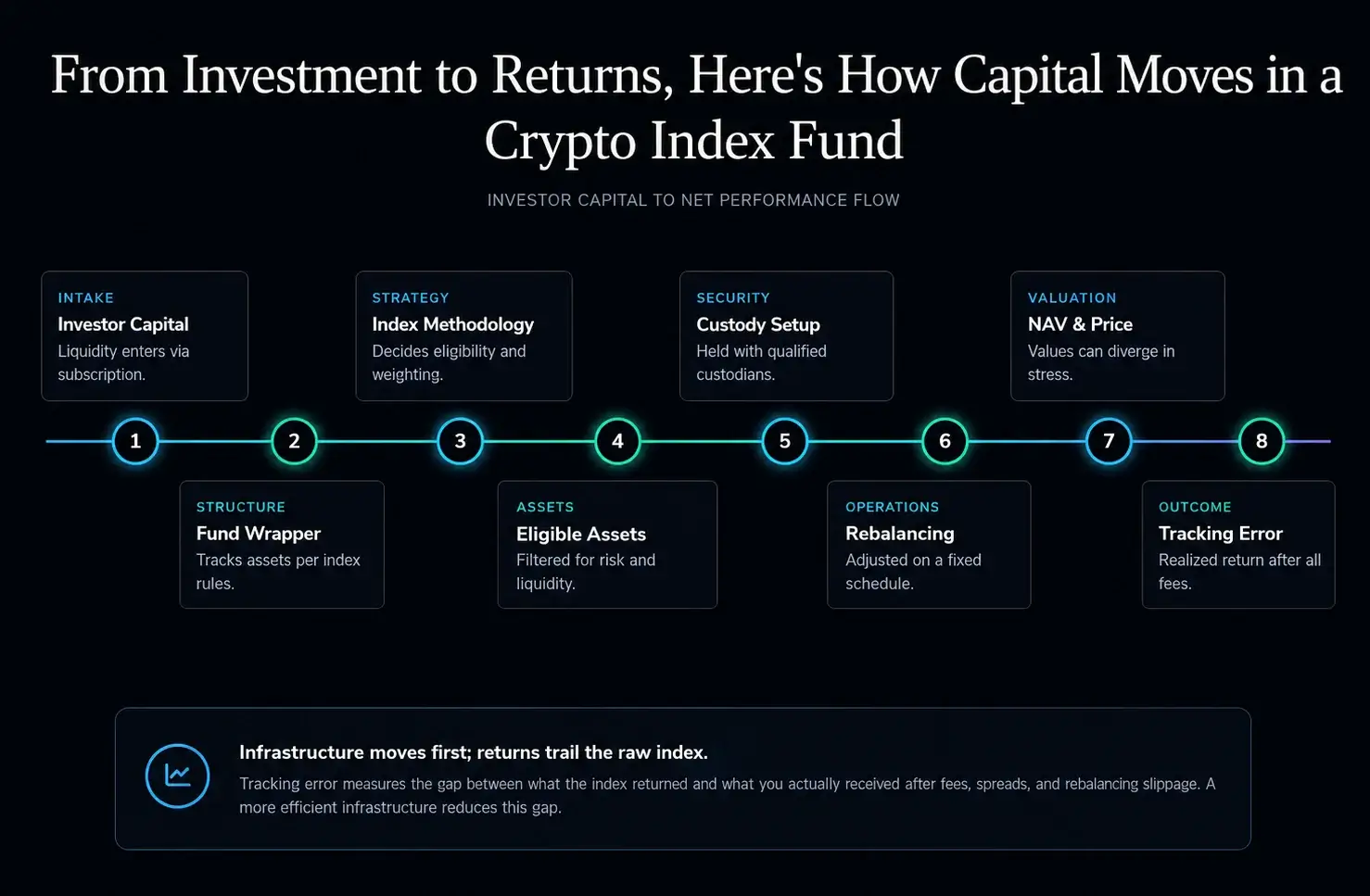
Tracking error is worth understanding before you invest. It measures the gap between what the index returned and what you actually received after fees, spreads, and rebalancing slippage. A fund can follow its rules perfectly and still trail the index by a meaningful amount each year. When you compare two products with similar holdings, the one with lower tracking error and lower fees tends to be the better deal, all else being equal.
Crypto Index Fund, ETF, ETP, Trust, or Token: What the Wrapper Changes
Two products can track almost identical assets while giving users completely different ownership rights, tax documents, trading hours, and failure points. The wrapper, the legal and technical structure around the basket, determines all of that.
| Wrapper | What Changes |
|---|---|
| Traditional Fund Or Private Trust | Access may be limited by eligibility, subscriptions, redemptions, and private-placement terms. |
| Exchange-Traded Product | Shares can trade through a brokerage account, but market price can differ from NAV. |
| On-Chain Index Token | Users hold a tokenized basket or strategy, with smart-contract and liquidity risk. |
| Self-Built Basket | The user buys each asset, chooses weights, stores keys, and handles rebalancing. |
Check the wrapper before the holdings list. The same underlying coins can be packaged in ways that are either accessible via a regular brokerage account or require a crypto wallet, a specific exchange, and comfort with smart contracts.
Traditional Fund or Private Trust
A traditional fund or private trust packages crypto exposure without giving users direct control of the underlying coins. Whether you can access it depends on the product, jurisdiction, whether you meet eligibility criteria, and what the redemption terms allow. Some of these products do not trade publicly at all, which means getting in or out is not as simple as placing a trade.
Crypto Exchange-Traded Product (ETP)
An exchange-traded product trades on a stock exchange just like a share, which makes it accessible through most brokerage accounts. That familiarity is the main advantage. The trade-off is that the share price can diverge from the actual value of the underlying assets, so you can pay more than NAV when the product is in demand, or less when it is not.
For comparison with single-asset exposure, Bitcoin ETF products and Ethereum ETF products give targeted exposure to one major asset, while a multi-asset index fund spreads the wrapper across several eligible coins. CryptoSlate's crypto ETF coverage is a useful starting point when comparing these structures.
On-Chain Index Token
An on-chain index token puts the basket into a smart contract on a blockchain. You hold the token in a wallet rather than through a brokerage. That gives you access to DeFi tools and removes the need for a traditional custodian, but it adds contract risk, oracle risk, governance risk, and limited recourse if something breaks. There is no prospectus, no regulator, and no fund manager to call.
Self-Built Basket
A self-built basket lets you copy the idea of an index without paying a fund manager. You pick the assets, set the weights, buy them directly, and rebalance when needed. The upside is lower costs and direct ownership. The downside is that every operational step falls on you: venue selection, wallet management, tracking cost basis, handling delistings, and adjusting weights when the market moves.
Example: BITW Crypto Index Funds (Prev. Bitwise 10 Crypto Index Fund)
BITW is a useful case study because it shows how a real product can change names, structure, and legal form while keeping the same ticker.
“Bitwise 10 Crypto Index Fund” is the previous name of this fund. The current public product is the Bitwise 10 Crypto Index ETF, ticker BITW, listed on NYSE Arca.
The fund track the Bitwise 10 Large Cap Crypto Index, holds 10 assets, charges a 0.75% sponsor fee, and uses Coinbase Custody Trust Co., LLC as its digital asset custodian. The SEC approval order describes monthly rebalancing and notes that real trading can create costs and performance differences versus the index.
| What To Check | Why It Affects BITW Research |
|---|---|
| Current Name | Older materials may use Bitwise 10 Crypto Index Fund while current materials use Bitwise 10 Crypto Index ETF. |
| Ticker And Venue | BITW trades by ticker, but the venue and listing status determine access and market structure. |
| Benchmark | The Bitwise 10 Large Cap Crypto Index defines the target basket. |
| Holdings | Constituents and weights can change after rebalancing or methodology updates. |
| Sponsor Fee | The fee reduces the crypto represented by each share over time. |
| Tax Document | The wrapper can affect whether users receive fund-specific tax forms. |
| Premium Or Discount | A share can trade above or below the value of its underlying basket. |
| Risk Disclosures | The product is not a direct investment in crypto assets and is not suitable for every investor. |
The name alone does not tell you what you are buying. Legacy trust materials, current ETF documents, and third-party summaries can all describe the same ticker differently. Always use the current fund page and SEC filings as your source, not a headline or cached description.
Why the Biggest Coins Still Drive Most Index Performance
If you buy a crypto index fund expecting 10 assets to each contribute roughly 10% of your return, the math will surprise you. Most crypto indexes use market-cap weighting, which means each asset's share of the fund is proportional to its total market value. Because Bitcoin and Ethereum together make up a large share of the eligible crypto market, they tend to dominate even a 10-asset basket.
The weighting rules are where the real differences between products show up. Here is what each approach does:
- Market-cap weighting favors the largest assets and gives Bitcoin and Ethereum the biggest influence.
- Equal weighting gives every asset the same share, so smaller tokens matter more to your return.
- Cap rules set a ceiling on the largest asset's weight, which forces more exposure to smaller constituents.
- Liquidity rules filter out thinly traded tokens that would be difficult to buy or sell at scale.
- Eligibility rules remove assets that cannot be held in regulated custody or that raise legal uncertainty.
Smaller constituents like Solana, XRP, Chainlink, Cardano, Avalanche, Polkadot, Litecoin, and Sui can add upside when an emerging sector leads the market. They can also make the fund less predictable, since these assets are often more volatile, less liquid, and more exposed to regulatory or delisting risk than Bitcoin or Ethereum.
Crypto Index Fund Rebalancing, Reconstitution, and Eligibility Rules
Rebalancing and reconstitution are two separate processes that both keep the fund honest. Rebalancing adjusts how much each asset weighs in the basket when market moves have pushed allocations off target. Reconstitution changes which assets are in the basket at all when something new qualifies or something existing fails the eligibility screen.
Together, they mean the product you buy today may hold a different set of assets in a year, which is by design. The index is supposed to reflect the current state of the market, not a snapshot from the day you invested.
Eligibility rules are where index design becomes more than ranking assets by size. A thoughtfully designed index filters on several dimensions:
| Rule | Why It Affects The Basket |
|---|---|
| Market-Cap Screen | Filters for assets large enough to represent the target market. |
| Liquidity Screen | Reduces exposure to tokens that are hard to buy, sell, or rebalance. |
| Custody Screen | Helps avoid assets that qualified custodians cannot support. |
| Exchange Listing Screen | Focuses on assets with reliable trading venues and pricing data. |
| Free-Float Adjustment | Counts supply that is actually available to the market. |
| Stablecoin Treatment | Prevents cash-like tokens from distorting a growth-oriented crypto basket. |
| Wrapped-Token Treatment | Avoids double-counting synthetic or bridged versions of the same exposure. |
| Committee Oversight | Allows review when rules face unusual market, custody, or legal facts. |
Methodology can affect returns as much as the number of assets in the fund. Two products both called “top-10 crypto funds” can behave quite differently if one caps Bitcoin at 25%, one includes wrapped tokens, and one excludes assets with custody restrictions. Read the methodology document, not just the name.
Benefits and Trade-Offs of Crypto Index Funds
The main practical benefit of a crypto index fund is operational: one position replaces a stack of coin purchases, wallet setups, and manual rebalances. For someone who wants exposure to the crypto market without managing individual assets, that is a real reduction in complexity.
That said, simplicity at the purchase level does not mean simplicity everywhere. Fees compound over time, tax reporting can be product-specific, and the wrapper adds its own failure points. The table below maps the main benefits to the trade-offs that travel with them.
| Potential Benefit | Trade-Off To Check |
|---|---|
| Broad Exposure | The basket may still be dominated by a few major assets. |
| Fewer Operational Steps | Users give up direct control of holdings and timing. |
| Rules-Based Maintenance | Methodology can still exclude assets users expected to own. |
| Easier Brokerage Access | The wrapper may not provide the same protections as a 1940 Act fund. |
| Less Coin Selection Pressure | Fees and tracking error can reduce returns. |
| Cleaner Statements | Tax forms can still be complex and product-specific. |
To put it concretely: if you would otherwise buy five crypto assets separately, hold them in a self-custody wallet, and rebalance quarterly, then a fund saves you meaningful work. If you would otherwise just buy Bitcoin and hold it on a reputable exchange, a multi-asset fund adds cost and concentration trade-offs without necessarily adding proportional benefit.
The right comparison is always the fund versus what you would actually do instead, not the fund versus a theoretical alternative.
Risks to Check Before Buying or Copying a Crypto Index Fund
A crypto index fund reduces the work of coin selection. It does not reduce the underlying volatility of the crypto market, and it introduces wrapper-specific risks on top.
Wrapper risk can take several forms. A listed product can trade at a persistent premium or discount to NAV. A private trust may have redemption restrictions. An on-chain token can be exposed to smart-contract failure, oracle manipulation, or liquidity crises. A product with weak custodial practices can lose assets to theft or insolvency.
Investor.gov cautions that crypto asset securities can be volatile and speculative, and FINRA notes that SIPA protections may not apply to many crypto assets. IRS Form 1099-DA rules also show why tax reporting varies by wrapper and activity, so what you receive at tax time depends on which product you hold and what trades it made during the year.
Before buying any product, work through this checklist:
- Read the current prospectus or fund documents, not a third-party summary.
- Check whether the holdings list is current or last updated months ago.
- Compare the NAV with the current market price to see if there is a premium or discount.
- Confirm who custodies the assets and what protections apply.
- Find the total expense ratio and any trading spreads on top.
- Review which tax documents the product generates and whether your tax situation suits that.
- Be skeptical of any product promising high or guaranteed returns.
- Verify the product name and legal structure against the official documents, as scams use copied names.
If you are considering holding assets directly rather than through a fund, custody choices become part of the equation. CryptoSlate's safest crypto exchanges list and cold hardware wallets comparison are useful starting points for that path.
How to Compare a Crypto Index Fund Before You Invest
Comparing funds by headline name or constituent count is not enough. Two products can both say “top 10 crypto” while holding different assets, using different weighting rules, charging very different fees, and reporting taxes in different ways.
Start with what the product actually holds. Some products hold spot crypto directly. Others hold futures, synthetic derivatives, or tokenized exposure. Some give single-asset exposure. Others track a basket or a narrow sector like DeFi. The holdings page and prospectus will tell you, and a name alone will not.
Here is a worked example.
Suppose you are comparing two products, both claiming to track the top 10 crypto assets by market cap. Product A charges a 0.75% annual fee, uses market-cap weighting, and holds spot assets in regulated custody. Product B charges 0.25% but uses monthly futures rollovers and does not hold the underlying assets. If crypto markets rise 40% in a year, Product A might return around 39% after fees. Product B might return significantly less because futures roll costs and tracking error compound on top of the fee. The headline fee difference of 0.50% understates the actual performance gap.
| Question | Why It Helps |
|---|---|
| What Index Does It Track? | The benchmark defines the target exposure. |
| How Many Assets Qualify? | A larger number can still hide concentration. |
| How Are Assets Weighted? | Market-cap, equal-weight, and capped rules behave differently. |
| How Often Does It Rebalance? | Timing affects turnover, taxes, and drift. |
| What Is The Expense Ratio? | Fees reduce returns even when the index performs well. |
| Who Custodies The Assets? | Custody setup affects operational and counterparty risk. |
| Where Does It Trade? | Venue, hours, spreads, and liquidity affect execution. |
| What Tax Form Arrives? | Reporting can differ by fund, trust, token, or direct holding. |
| Does Price Match NAV? | Premiums and discounts can add a separate risk. |
| How Transparent Are Holdings? | Stale or vague holdings make the exposure harder to trust. |
A beginner prioritizing simplicity will evaluate a listed brokerage product differently from someone who wants direct custody or on-chain composability. There is no universal winner, only the product that fits your access, tax situation, and risk tolerance.
How To Invest In a Crypto Index Fund?
There are four practical routes to crypto index exposure: a listed fund or ETP, an on-chain index token, a self-built basket, or direct custody of individual assets. Each one shifts the balance of work, cost, and control differently.
The simplest frame is: the more you rely on a third-party product, the less operational work you do, but the more you depend on that product's fees, custody, and disclosures being sound.
Use a Listed Fund or ETP
A listed fund or ETP suits investors who want brokerage access and do not want to manage private keys. You buy shares like any other listed security, and the fund handles custody, rebalancing, and record-keeping. The trade-off is that you have no direct claim on the underlying crypto, since you own a share of a wrapper, not a coin.
This route also suits investors considering retirement accounts. Bitcoin IRA options cover why some investors prefer account-level wrappers, though an IRA structure and an index methodology solve different problems and can be combined.
Buy an On-Chain Index Token
An on-chain index token gives you direct token exposure rather than brokerage access. You hold it in a crypto wallet and interact with it through a decentralized exchange. That makes it accessible without a broker, but it also means smart-contract approvals, gas costs, liquidity risk, and oracle dependence all become your problem. Picking the best decentralized exchange is a prerequisite.
Build a Simple DIY Basket
A DIY basket copies the concept of an index by buying several assets directly and rebalancing them on a schedule. There is no fund fee and you hold the assets outright, but every operational step falls on you: venue selection, private key management, cost-basis tracking, and handling delistings or methodology changes manually.
When building a basket directly, your choice of exchange matters from day one. CryptoSlate's beginner crypto exchanges guide helps narrow the field for first-time buyers, while the broader crypto exchanges hub covers a wider range of venue types.
Use a Direct-Custody Setup for Individual Assets
Direct custody means buying and holding individual assets yourself, with full control of the private keys. There is no fund wrapper, no annual fee, and no manager between you and the coins. The operational burden is entirely yours: key backup, phishing protection, inheritance planning, and wallet choice all become live responsibilities.
CryptoSlate's crypto wallets guide covers the main custody options and helps distinguish self-custody tools from fund-based exposure.
FAQs
What is a crypto index fund?
A crypto index fund is an investment product that tracks a rules-based basket of digital assets. It gives you one position tied to multiple crypto assets, but the exposure remains volatile and depends heavily on the fund’s methodology, weighting rules, and wrapper structure. It does not automatically reduce risk, it reduces coin-selection work.
What is Bitwise 10 crypto index fund?
That is the older name many users search when looking up BITW. The current public product is the Bitwise 10 Crypto Index ETF, ticker BITW, listed on NYSE Arca. Before relying on any details about holdings, fees, or tax treatment, check the current Bitwise fund page and the relevant SEC filings directly, as older summaries may describe a different product structure.
Is a crypto index fund the same as a crypto ETF?
No. A crypto index fund describes an investment strategy, tracking a basket of digital assets using a rules-based methodology. A crypto ETF describes a legal wrapper that trades on a stock exchange. A product can be both, but the index and the wrapper answer different questions. BITW, for example, is both an index fund and an ETF. Not all crypto ETFs track a multi-asset index.
Are crypto index funds safer than buying individual coins?
They can reduce single-token selection risk and the operational work of managing multiple positions, but they are not automatically safer. Concentration, fees, custody quality, tracking error, wrapper risk, and broad crypto market volatility all still apply. A fund holding 10 assets that are 70% Bitcoin and Ethereum is not meaningfully diversified compared to just buying those two assets directly.
Can you build your own crypto index fund?
You can build a DIY basket that follows index-like rules, choosing assets, setting weights, buying them directly, and rebalancing on a schedule, but it will not be a legally structured fund unless it is registered as one. The main practical differences are that you pay no fund fee, you hold the assets directly, and every operational decision is yours.
What should beginners check before buying a crypto index fund?
Check the index methodology and weighting rules, the current holdings list and when it was last updated, the total expense ratio, who custodies the assets and under what terms, where the product trades and what the spread looks like, what tax document you will receive, and whether the share price is trading at a premium or discount to NAV. Also confirm whether the product holds spot crypto or derivatives, as that distinction affects both performance and tax treatment.