

Overview
Introduction
Bitcoin was invented by Satoshi Nakamoto. That name appears on the 2008 whitepaper, the first software release, and the earliest network activity. It is a pseudonym, meaning the legal identity behind it has never been publicly verified. Satoshi published the whitepaper, launched the network, communicated with early contributors, and then gradually stepped away by 2011, leaving a system that has run without a known founder ever since.
Key Takeaways
- Satoshi Nakamoto is the pseudonym used by Bitcoin's creator. The real identity has not been proven.
- Bitcoin's anonymous launch removed founder control from the network. Code, miners, nodes, and users now maintain it.
- Identity claims can move markets and cause real harm to living people when they are built on timing clues or writing style rather than cryptographic proof.
Who Invented Bitcoin?
Bitcoin was invented by Satoshi Nakamoto, but that is not a verified legal name. It is the pseudonym attached to the whitepaper, early code, forum posts, emails, and the first block on the Bitcoin network.
That makes the direct answer simple and the identity question separate. Satoshi is the Bitcoin creator in the historical record. The person or group behind that name remains unknown.
Bitcoin's origin does not depend on a later identity reveal. The Satoshi-linked artifacts, the whitepaper, software, early correspondence, and first transactions, show who launched the project even without disclosing a legal name. If you are completely new to the topic, our guides to what Bitcoin is and what cryptocurrency is and how does it work are good places to start before going deeper on the creator question.
Satoshi created the system and likely mined early coins, but Satoshi does not run Bitcoin today. Confusing those three points is one of the most common mistakes when reading identity coverage.
What Satoshi Nakamoto Actually Built and Why?
Satoshi built a peer-to-peer payment network that could agree on transaction history without a bank, card processor, or central mint. The design assembled existing cryptography ideas into one working system, and that combination is what made Bitcoin different from what came before.
The October 31, 2008 mailing-list post introduced Bitcoin as electronic cash with no trusted third party. The Bitcoin whitepaper described the core mechanism: transactions are grouped into blocks, blocks are linked by proof of work, and the longest valid chain becomes the shared record. If you want a plain-language explanation of how that record-keeping layer works, our guide on “what is blockchain” covers the basics.
The system had three connected parts working together:
- A public transaction history that any user could independently verify.
- A proof-of-work chain that made rewriting history expensive.
- A coin issuance schedule that paid miners to secure the network.
Earlier projects such as Hashcash, b-money, and Bit Gold had explored pieces of the problem. Bitcoin combined them with working open-source software, built-in incentives, and a public ledger. That last part mattered most. The ideas were not entirely new. The working, self-sustaining system was.
Crypto mining became part of security by design. Miners spend real computing power to add blocks, and nodes reject any history that breaks the rules. The coin issuance schedule Satoshi designed also included a Bitcoin halving mechanism that reduces the block reward roughly every four years.
Bitcoin's Creation Timeline From Whitepaper To Disappearance
Bitcoin's origin is documented through domain records, mailing-list posts, software releases, block data, public forum activity, and private correspondence that was later made public. The timeline below covers only verified records, not identity theories.
| Date | Event |
|---|---|
| August 18, 2008 | Bitcoin.org was registered before the whitepaper, a sign that the project was already being prepared. |
| October 31, 2008 | Satoshi posted the Bitcoin P2P e-cash paper to the Cryptography Mailing List and linked to the whitepaper. |
| January 3, 2009 | The Bitcoin Genesis Block was mined, starting the blockchain's public history. |
| January 9, 2009 | Bitcoin version 0.1 was released on SourceForge, making the first public client available. |
| January 12, 2009 | Satoshi sent Hal Finney the first known Bitcoin transaction, a 10 BTC test recorded in block 170. |
| 2010 | During the handoff period, Satoshi's public role faded as Gavin Andresen and other contributors took more responsibility for the software. |
| April 2011 | In correspondence archived from Mike Hearn, Satoshi said Bitcoin was in good hands and that he had moved on to other things. |
Read the timeline as documented history. It shows how Bitcoin moved from a whitepaper to working software and then to a public network, while the identity question remained entirely separate and unresolved.
Who Is Satoshi Nakamoto? What We Know And Do Not Know
Satoshi is best understood as a public technical identity. The record shows what the pseudonym did, but it does not prove gender, nationality, age, motive, or whether one person or a group used the name. That uncertainty matters because most identity theories start by treating circumstantial clues as settled facts, then build a story around them.
| What Is Known | What Is Not Known |
|---|---|
| Satoshi authored the Bitcoin whitepaper and released the first Bitcoin software. | Whether Satoshi was one person, a small group, or a coordinated identity. |
| Satoshi communicated with early contributors including Hal Finney, Mike Hearn, Gavin Andresen, and Martti Malmi. | Satoshi's legal name, location, age, gender, and current status. |
| Satoshi controlled early project infrastructure and mined in Bitcoin's earliest period. | The exact number of coins Satoshi still controls or can access. |
| Satoshi stopped public Bitcoin work and has not provided accepted public proof since. | Whether any modern public figure can privately prove they were Satoshi. |
The known side is enough to explain Bitcoin's launch. The unknown side is why every later reveal needs a high proof standard, and why most have failed to meet it.
A Note On The Writing Style Debate of Satoshi Nakamoto
One recurring argument in Satoshi theories is linguistic analysis. Researchers have compared the whitepaper, forum posts, and emails to the writing of various candidates based on British spelling choices, punctuation habits, and unusual phrases.
That analysis has a hard limit. Writing style can narrow a field of candidates, but it cannot confirm an identity. Anyone who spent time around British technical writing, or who deliberately adopted those patterns, could produce similar results. Linguistic clues are useful for building a theory. They are not a substitute for cryptographic evidence.
Main Satoshi Nakamoto Candidates And Claims
Satoshi candidates fall into three broad groups: early cypherpunks with relevant technical backgrounds, people named by journalists or documentary makers, and people who claimed the identity themselves. None has produced public proof that the Bitcoin community broadly accepts.
| Candidate Or Claim | What The Record Supports |
|---|---|
| Hal Finney | Early Bitcoin user, first transaction recipient, and cryptography pioneer, but no public cryptographic proof that he was Satoshi. |
| Nick Szabo | Creator of Bit Gold and a frequent linguistic candidate, but he has denied being Satoshi and no conclusive proof is public. |
| Adam Back | Hashcash creator and early cypherpunk whose work influenced Bitcoin, but recent claims remain circumstantial and he denies being Satoshi. |
| Dorian Nakamoto | Publicly named in a media report and denied the claim, becoming a cautionary example of misidentification. |
| Peter Todd | Named by an HBO documentary and denied the claim, with the case built around disputed interpretation of old posts. |
| Craig Wright | Claimed to be Satoshi, but a UK court found that he was not. |
The table maps claims rather than ranking likely creators. A candidate can be historically important to Bitcoin's development and still fall short if the case never reaches keys, coins, or authenticated records.
Hal Finney, Nick Szabo, And Early Cypherpunk Candidates
Hal Finney, Nick Szabo, Wei Dai, David Chaum, and Adam Back all matter because Bitcoin grew out of decades of digital-cash research. They are part of the intellectual history that made Bitcoin possible, even when none of them has been confirmed as Satoshi.
The strongest cypherpunk candidate theories usually involve proximity: relevant technical skill, shared mailing lists, writing patterns, early knowledge, or ideas that look similar to Bitcoin components. Those clues can make a theory plausible, but proximity to the problem is not the same as a signed message from an early key. All have been discussed as candidates at various points, and all have either denied it or left the question open without producing verifiable proof.
Adam Back And The Latest Unmasking Claim
Adam Back came back to the center of Satoshi speculation in April 2026 after a New York Times investigation linked him to Satoshi through timing, language, and cypherpunk history. Back denied the claim publicly, and both The Guardian and TechCrunch covered the denial.
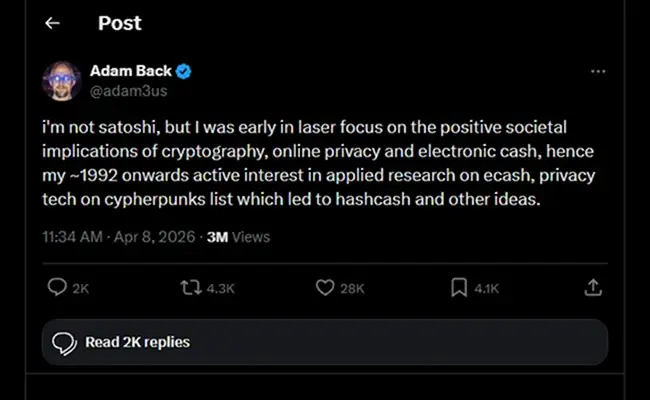
The Back theory shows why Satoshi claims can seem compelling without meeting any real proof standard. Hashcash influenced Bitcoin directly, and Back was active in the right technical communities at the right time. That context is historically accurate. What it does not do is control coins, sign messages, or authenticate private correspondence from 2008 and 2009.
Dorian Nakamoto, Peter Todd, And Public Misidentifications
The Dorian Nakamoto and Peter Todd cases show what happens when a living person is publicly named as Satoshi without decisive evidence. Both denied the identity. Both faced media attention and public scrutiny they had not invited.
The 2024 HBO documentary Money Electric: The Bitcoin Mystery identified Peter Todd as Satoshi, but Todd denied it to CNN. The case rested on interpretation of old forum behavior, not a cryptographic proof capable of settling the question. Dorian Nakamoto, named in a 2014 Newsweek report, denied the claim immediately and has consistently rejected it since. His case became a reference point for how media-driven identification can harm someone who has no connection to the claim.
Craig Wright And The Court Record
Craig Wright is different from most candidates because he made an affirmative claim and faced a formal legal proceeding. In COPA v Wright, the High Court of England and Wales delivered a 2024 judgment finding that Wright was not Satoshi.
That court record does not identify Satoshi. What it does provide is a clear example of what happens when a confident claim is tested under legal scrutiny. A document-heavy narrative and a public campaign were not enough when the evidence did not hold up.
How Can Someone Prove To Be Satoshi Nakamoto?
A convincing Satoshi proof needs to connect a modern claimant to early Bitcoin activity in a way that independent observers can verify. The cleanest proof is cryptographic because it does not depend on personality, memory, or media interpretation.
To understand why cryptographic signing matters here, this guide to public keys explains how key pairs work in plain terms. In short, whoever controls the private key that corresponds to an early Satoshi-linked address can produce a signature that anyone can verify, without revealing the key itself. No candidate has done this publicly.
Strong evidence would require multiple pieces that reinforce each other:
- A signed message from a known early Satoshi-linked key.
- Movement or signing from coins credibly attributed to early Satoshi mining.
- Private correspondence that can be authenticated by both parties.
- Repository, domain, or server records that match the known timeline.
- A coherent explanation for contradictions in public posts and dates.
- Verification by independent technical experts, not only friendly witnesses.
Weaker evidence, such as writing style, timezone patterns, forum gaps, or shared interests, can be useful for historical research. Treated as proof, those clues have repeatedly led to false identifications and real harm to people who denied the claims.
Has Satoshi Nakamoto Ever Sold Any Bitcoin?
This is one of the most common beginner questions about Satoshi. The roughly 1.1 million BTC attributed to early Satoshi mining has never moved, and that silence gets read in several ways.
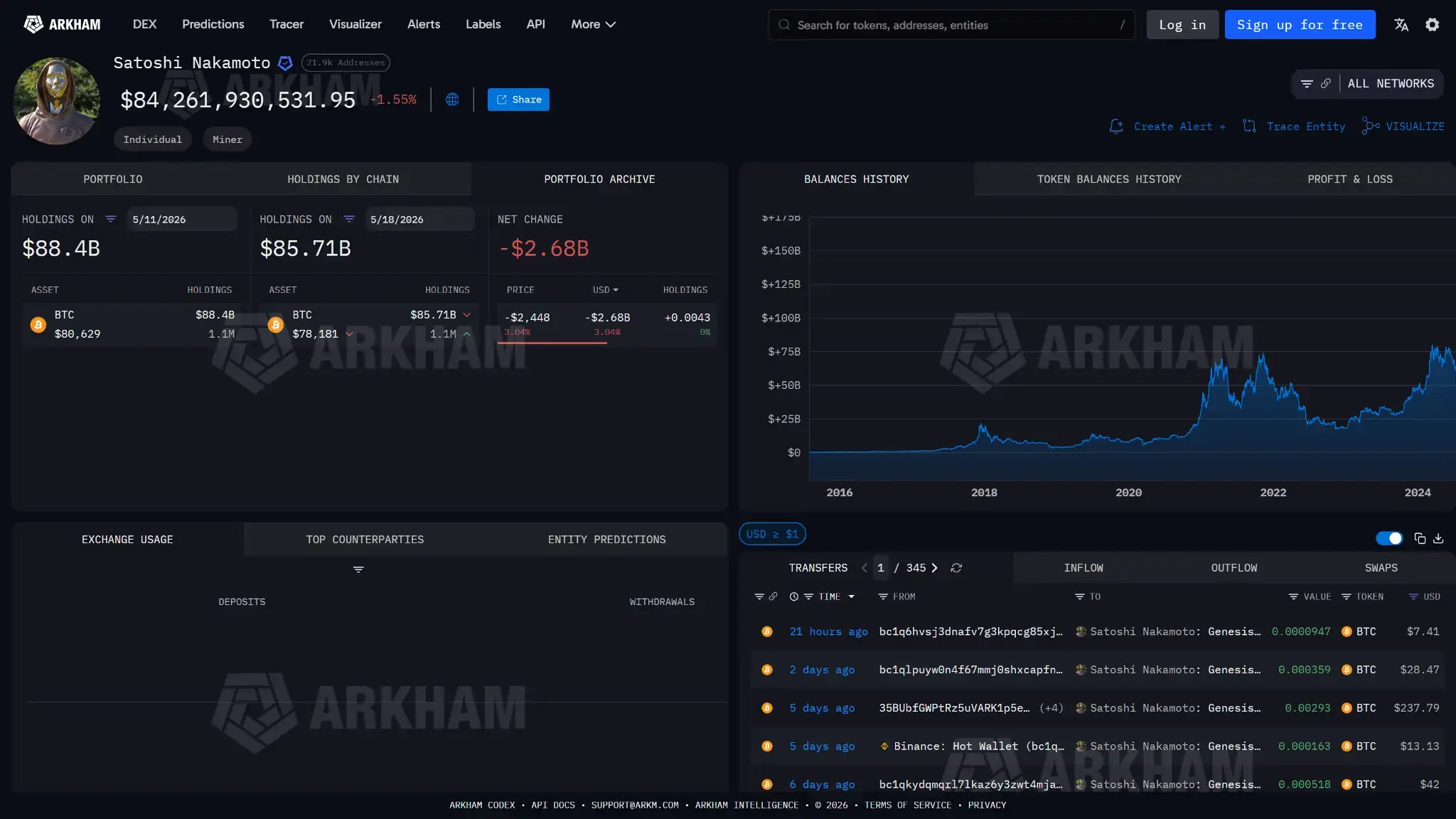
One interpretation is that Satoshi is gone, dead, or has permanently lost access to the keys. Another is that Satoshi is alive and keeping the coins still, either out of principle or to avoid identification. A third possibility is that the keys exist somewhere but no one with access has decided the moment is right.
None of these can be confirmed without a transaction, and a transaction would only confirm key access, not identity. Anyone who obtained Satoshi's private keys through inheritance, theft, or other means could move those coins. Movement would almost certainly trigger significant market reaction, but it would not automatically answer who Satoshi was.
How Many Bitcoins Does Satoshi Have? And What If They Sell Them?
Satoshi's early coins are both historical evidence and a potential market signal. If coins strongly attributed to Satoshi moved, users would not automatically know the mover's legal identity, but markets would likely react sharply regardless.
The common 1.1 million BTC estimate comes from early-chain analysis, particularly Sergio Demian Lerner's 2013 Patoshi research, which estimated that a dominant early miner accumulated roughly that amount and left about 1.1 million BTC unspent. That figure is an attribution model based on mining pattern analysis, not a confirmed balance sheet.
Three points to keep in mind when reading Satoshi wallet claims:
- A moved early coin proves key access, not a legal name.
- A single transaction could be a test, theft, inheritance event, or staged signal.
- Any live dollar estimate should use current market data, not a headline number from a prior year.
How Satoshi's Anonymity Shapes Bitcoin
Satoshi's anonymity still shapes Bitcoin because the network has no founder who can issue product updates, promise bailouts, negotiate with regulators, or settle disputes by authority. The credibility of the system depends on rules that many independent actors enforce simultaneously.
That creates a different kind of trust than most financial products offer. Users do not need to trust Satoshi's current judgment, but they do need to trust that the code, incentives, miners, nodes, exchanges, custodians, and wallets they use behave as designed. Control now sits across several groups:
- Nodes enforce valid rules.
- Miners order transactions into blocks.
- Developers review and ship software changes.
- Users and markets choose which rules to accept.
Bitcoin's growth after Satoshi also illustrates how far the system moved beyond one creator. Mining became a global industry, developers continued through open-source review, and financial products such as Bitcoin ETFs emerged without needing Satoshi's permission.
An anonymous founder also reduces founder risk in a specific practical sense. There is no CEO who can be subpoenaed for every design choice and no living brand figure who can override the protocol. The tradeoff is that identity speculation has never fully stopped and probably will not.
How Does This Compare To Other Crypto Projects?
Most major cryptocurrencies launched with known founders. Ethereum was created by Vitalik Buterin, whose identity has always been public. Ripple (XRP) has a documented founding team. Litecoin was created by Charlie Lee, who publicly sold his holdings in 2017.
Bitcoin's anonymous founding is the outlier, and that has shaped its regulatory position in ways that carry practical consequences. The SEC's approval of spot Bitcoin ETFs in January 2024 did not require identifying Satoshi. No comparable approval process for any other crypto asset has proceeded without a known issuer or founding team on record.
FAQs
Who invented Bitcoin?
Satoshi Nakamoto invented Bitcoin. That name appears on the whitepaper, early software releases, emails, forum posts, and the first network activity, but the real identity behind the name has not been publicly proven.
Who Is Satoshi Nakamoto?
No one knows if Satoshi Nakamoto was one person or a group. The writing and coding record is consistent enough to function as one public identity, but it does not settle the legal identity question.
Why did Satoshi disappear?
Satoshi never gave a full public explanation. The record shows a gradual handoff to other contributors, followed by private messages in 2011 saying Bitcoin was in good hands and that Satoshi had moved on.
Was Wright ruled out as the founder of Bitcoin?
Yes. In 2024, the High Court of England and Wales found in COPA v Wright that Craig Wright was not Satoshi Nakamoto, making it one of the clearest formal rulings on a Satoshi claim.
Is Adam Back the Bitcoin creator?
Adam Back has denied being Satoshi Nakamoto. Recent claims link him through cypherpunk history, Hashcash, timing, and language patterns, but no public cryptographic proof has confirmed the claim.
How much BTC does Satoshi own?
The common estimate is roughly 1 million BTC, based on early mining-pattern analysis rather than a confirmed account statement. The exact amount, current key access, and control all remain unknown.