





- Top up with mobile money as well as crypto
- Balances in EUR, USD, GBP, MXN and BRL
- Unlimited virtual cards to split merchants
KemyCard Overview
- Crypto Card Name
- KemyCard
- Card Type
- Prepaid
- Network
- VisaMastercard
- Digital Wallets
- Apple Pay, Google Pay, Samsung Pay
Additional details
- Availability
- Varies By Jurisdiction
- Rewards
- No rewards.
- Fees
- $15 virtual; $250 physical (DHL Express shipping included)
- Daily Spend / ATM Limit
- $500 per day and $15,000 per month
- Funding Source
- On-chain Wallet
- Virtual Card & Shipping
- Virtual card creation takes a few minutes. Physical card delivery uses DHL Express.
KemyCard Screenshots
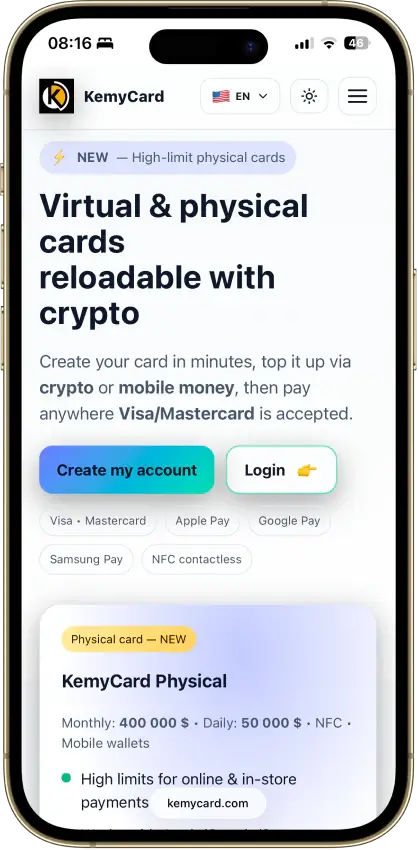
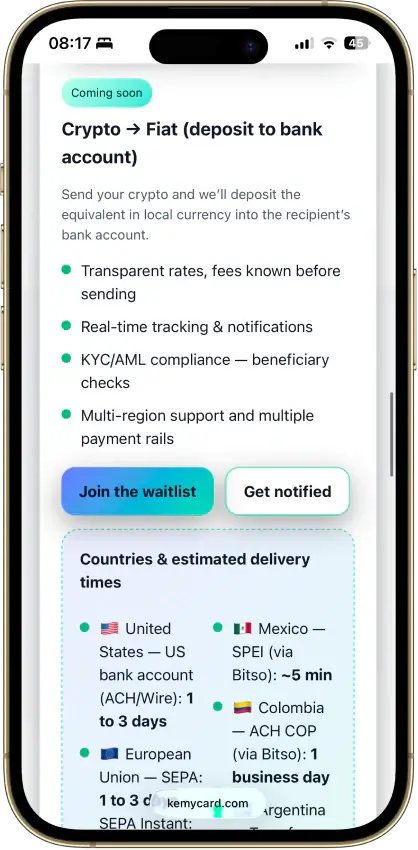
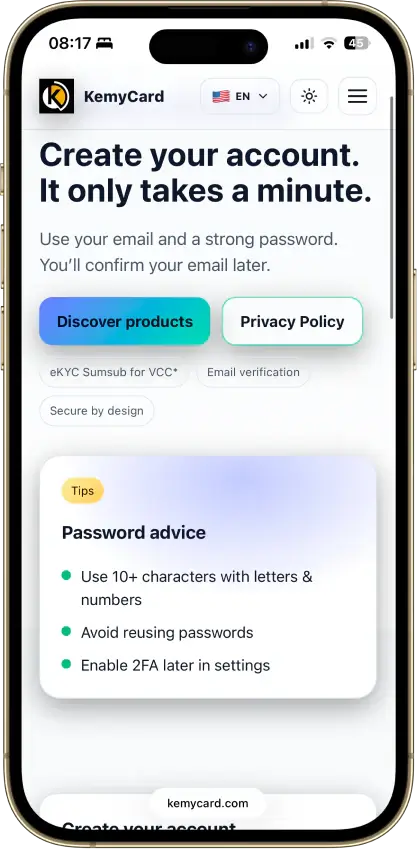
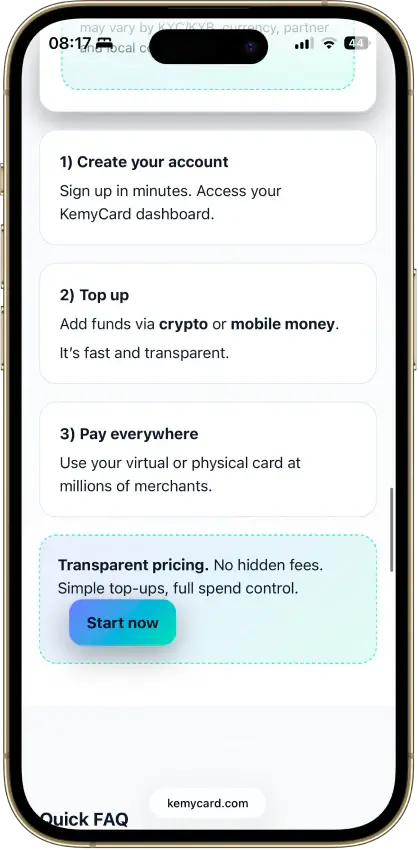
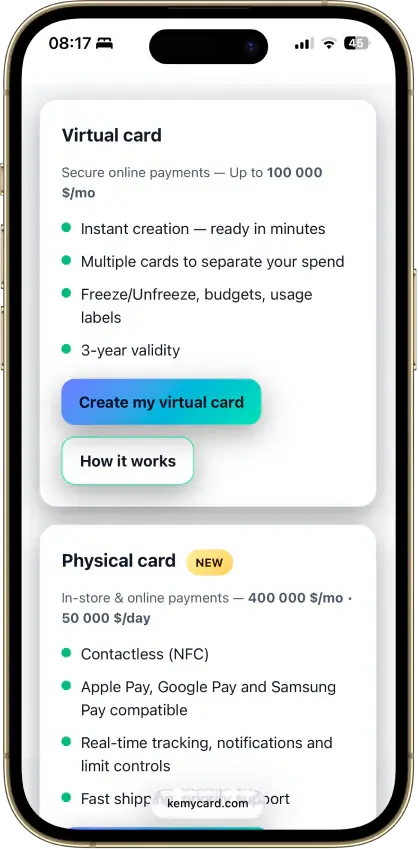
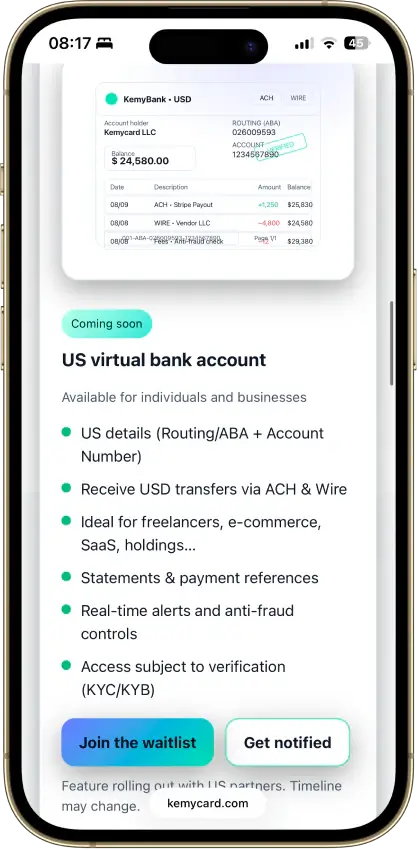
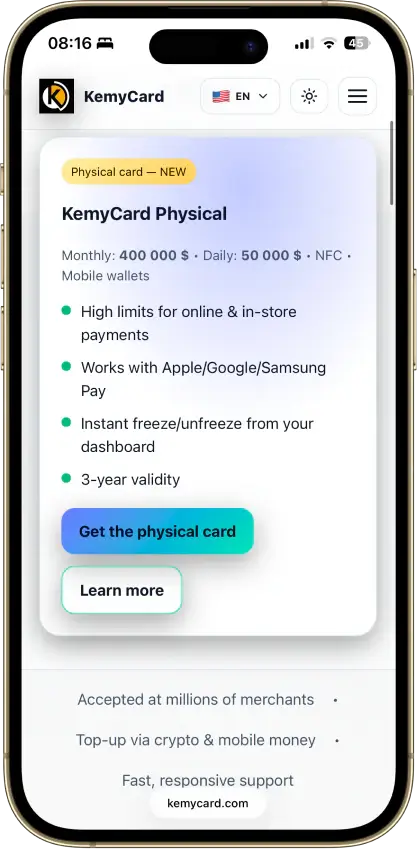
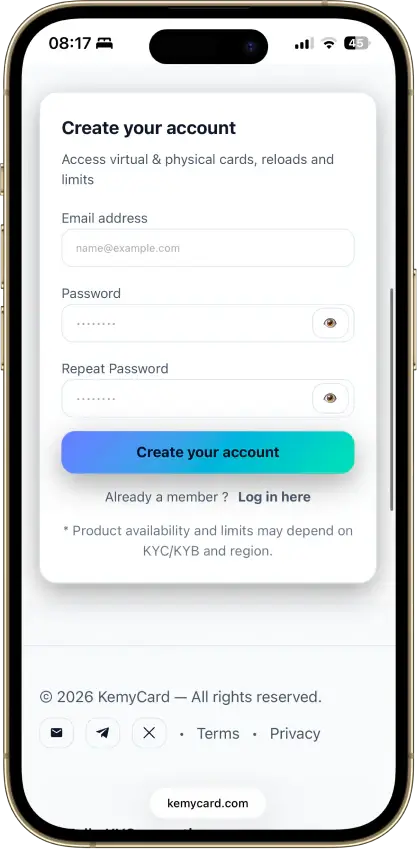
Screenshot 1 of 8
KemyCard Pros and Cons
Pros
- Virtual card issues within minutes
- Apple Pay, Google Pay and Samsung Pay
- High spend limits on the physical card
- Instant freeze and unfreeze controls
- Cards run from a web dashboard or Telegram bot
Cons
- Owners and issuing bank never identified
- Sells full eKYC and "no KYC" at once
- 8% deposit fee, 3.5% plus $1 per purchase
- ATM and FX fees not disclosed
- No cashback or rewards
Who KemyCard Is Best For And Who Should Skip It
Users drawn by the $400,000 physical-card balance ceiling face the sharpest version of the risk: the bigger the balance, the more money is parked with a custodian whose owners and issuing bank are undisclosed. Users chasing the no-KYC pitch are trusting a company that simultaneously claims full eKYC and real-time AML monitoring — whichever claim is true, the other one was marketing.
Everyone else has cheaper, more accountable options. Stablecoin spenders can pay $0 monthly elsewhere. Travelers get no disclosed FX rate here. Cashback is zero. There is no user this card serves better than an alternative with a named issuer and a published fee schedule.
What This Card Actually Is and How Spending Works
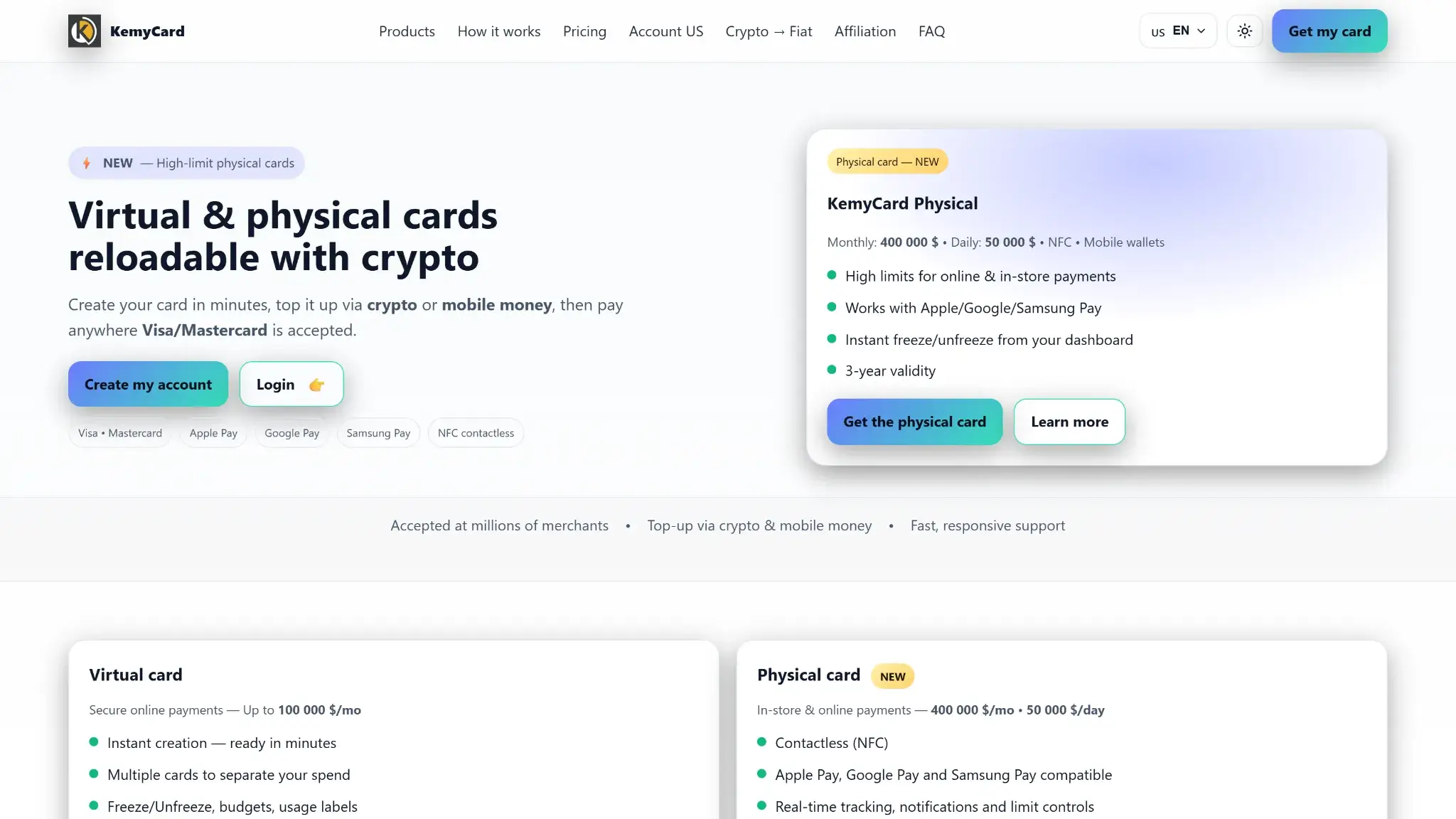
KemyCard is a preload card: fund a balance with crypto or mobile money first, then spend the balance at card terminals and online checkouts. There is no credit line and no linked bank account behind it. Because nothing is auto-sold at the point of sale, conversion (and any taxable disposal) happens once, at load, not on every purchase.
Two separate parties sit behind the product, and only one is identifiable. Kemite Group, LLC of Delaware — a registered entity with a published Dover address — operates the platform, though it names no individuals behind it. The bank that issues the cards and holds cardholder funds is described only as “authorized banking partners” operating under licenses from Visa U.S.A. Inc. and Mastercard International, with no institution named. Established crypto cards name their issuer — Pathward, Cross River, DiPocket — because a named bank gives the reader a regulated counterparty. KemyCard gives the reader nobody to check.
Which network an individual card ships on is also unspecified. The site claims Visa and Mastercard across its products without pinning either to a product tier.
Rewards Mechanics
The realized reward rate is 0% — no cashback, no perks, no rebates, at any tier. The only money KemyCard pays out goes to promoters:
| Element | Value | Notes |
|---|---|---|
| Base rate | 0% | No cashback, perks, or rebates at any tier |
| Referral bounty | $5–$25 per card | Paid for each card a recruit creates |
| Referral override | 1% of recruit top-ups | Paid on that recruit's top-ups |
The bounty structure explains the volume of promotional threads pushing the card, and it pays the person who recruited you, never you.
Fees and Pricing
Take the vendor's worse number. KemyCard's pricing summary lists an 8% deposit fee while a detail section on the same page says 5%, and a company that contradicts itself on its headline fee earns the higher reading. The homepage's “No hidden fees” line sits beside an ATM and FX schedule that does not exist.
| Fee | Amount |
|---|---|
| Deposit (crypto or mobile money) | 8% (5% elsewhere on the same page) |
| Virtual card issuance | $15, valid for three years |
| Physical card issuance | $250, DHL Express shipping included |
| Monthly fee | $2 virtual, $10 physical |
| Card top-up | $1.50 under $100, 1.25% at $100+ |
| Purchase transaction | 3.5% + $1 |
| Failed transaction | $0.80 |
| ATM withdrawal | Not disclosed |
| FX conversion | Not disclosed |
The stack compounds fast. A $500 crypto deposit loses $40 at the door. Moving the remaining $460 onto a fresh virtual card costs $15 issuance plus $5.75 in top-up fees. A single $200 purchase adds $8, and the $2 monthly fee starts immediately. That is roughly $71 in fees to spend $200 — before any ATM cash, currency conversion, or network gas, none of which is priced anywhere a reader can see before paying.
Limits, Purchase and ATM
| Limit | Virtual | Physical |
|---|---|---|
| Per transaction | $10,000 | $25,000 |
| Daily spend | Not disclosed | $50,000 |
| Monthly spend | Not disclosed | $400,000 |
| Balance ceiling | $100,000 | $400,000 |
| ATM daily | — | $500 |
| ATM monthly | — | $15,000 |
| Minimum top-up | $5 | $10 |
These ceilings run far above consumer norms, and on this product they read as exposure. A cardholder using the $400,000 ceiling has $400,000 sitting with a custodian whose issuing bank and owners are undisclosed. Cash access is thin next to the spend limits — $500 a day at ATMs, at a fee KemyCard does not disclose. Refund and reversal timing is not disclosed either, so declines and merchant reversals are impossible to plan around.
Eligibility and Availability
KemyCard is live to new applicants. The site claims availability in 190+ countries with one line of fine print: “A few restrictions apply — sign up to check if your country is supported.” Eligibility is discoverable only after handing over signup details.
The KYC position depends on which part of the company you ask. The website's security section claims full eKYC, meaning automated ID and biometric verification through Sumsub and Veriff with real-time AML monitoring. The same website's Telegram section issues cards with “No KYC — start instantly,” and reseller listings across BlackHatWorld, Bitcointalk, OffshoreCorpTalk, and Telegram sell the card as no-KYC with fake profile details accepted. Both positions cannot be routinely true, and a payments company advertising an identity-free path while claiming AML compliance is advertising AML evasion.
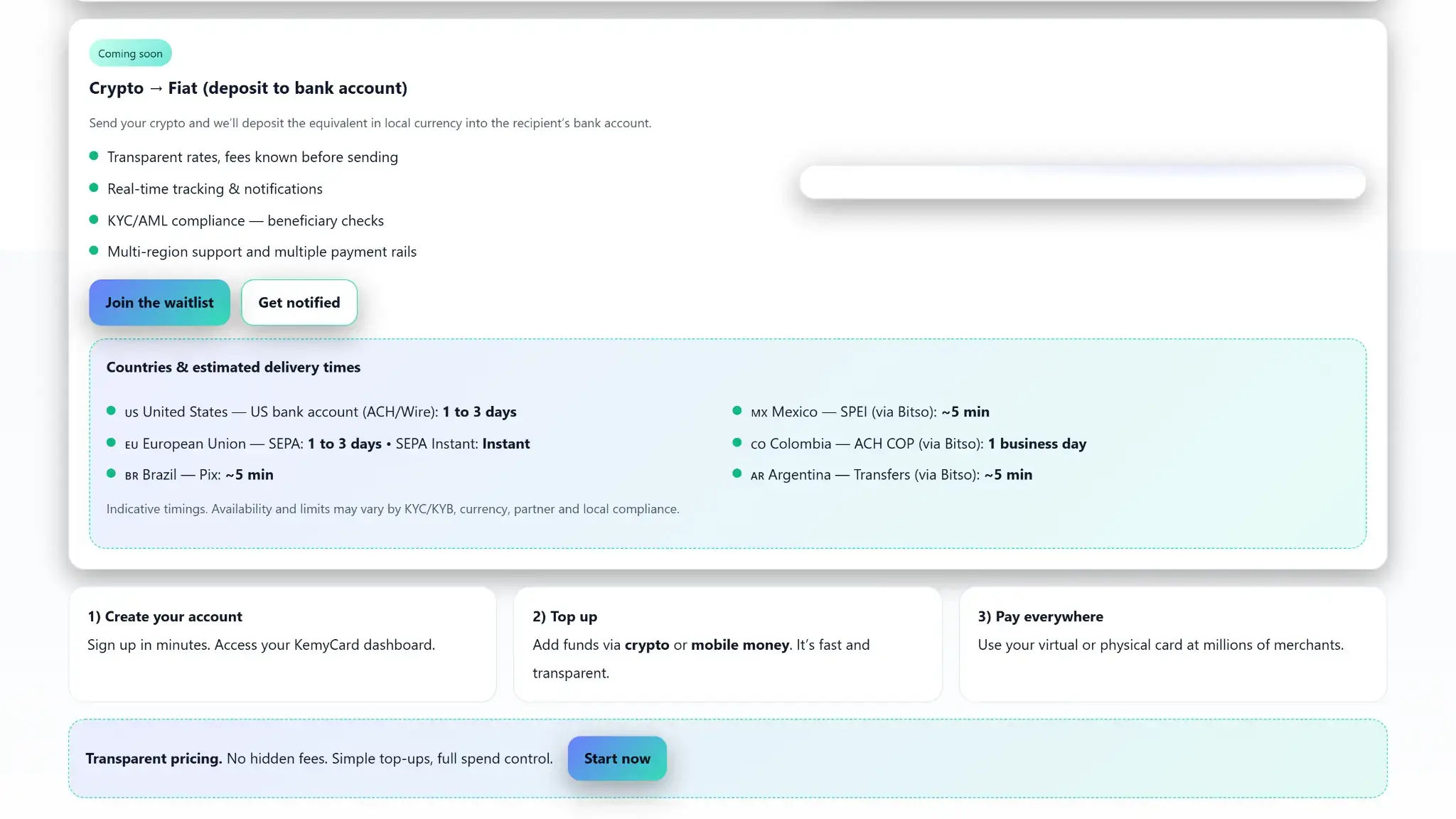
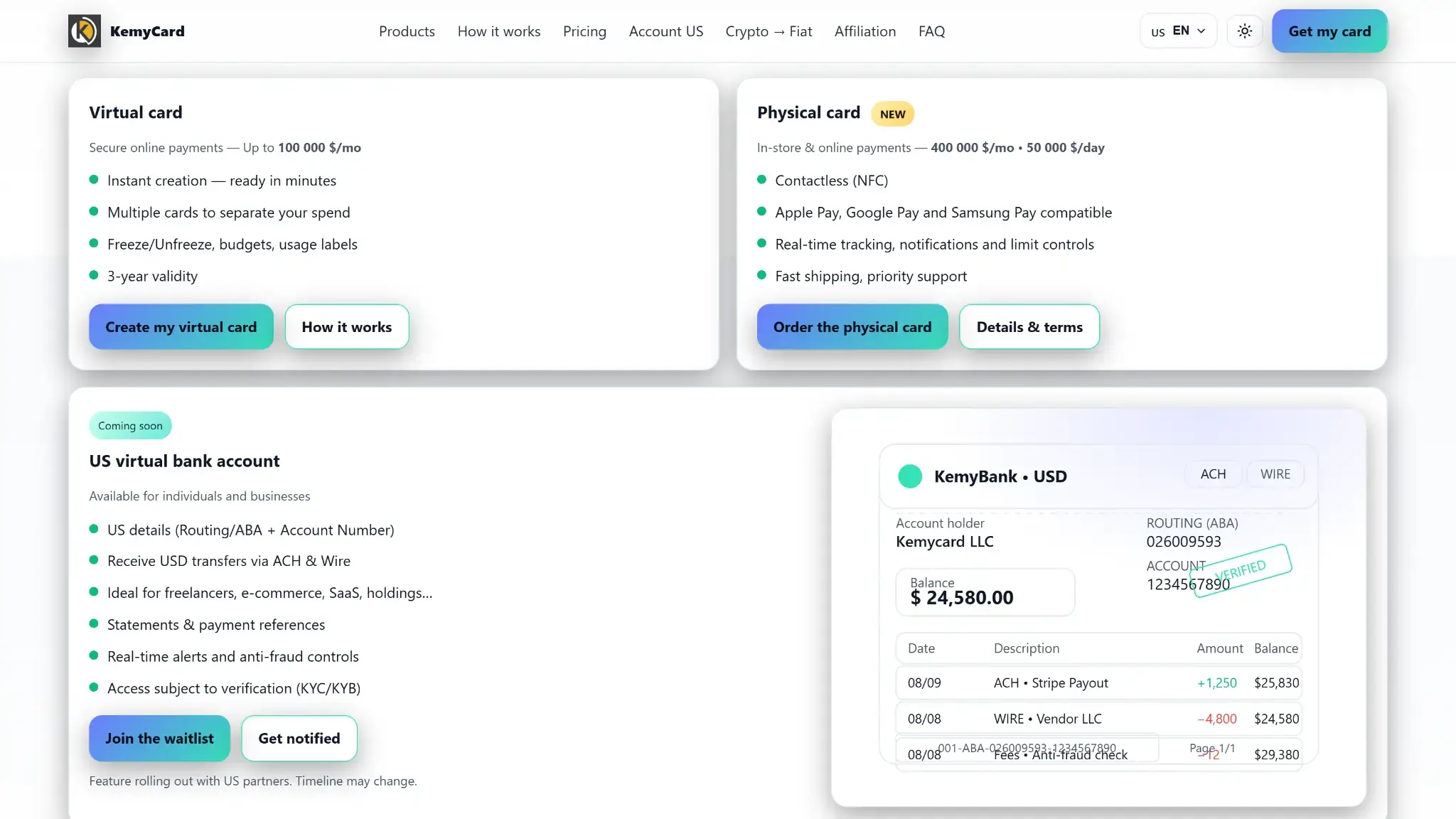
On the US, the card and the bank features are two different questions. The USD virtual account and the ACH, wire, and SEPA payout rails carry a “coming soon” label and are not live. The card itself is a separate product — third-party directories and the reseller ads describe a US BIN obtainable by US residents today. Whether a US applicant can complete signup end-to-end is unconfirmed, and if they can, the card is more reachable for US users than a roadmap banner suggests, not less.
The site also states KemyCard is “a Money Services Business (MSB) licensed by the Financial Crimes Enforcement Network.” FinCEN does not license anyone. MSB registration is a self-filed form under the Bank Secrecy Act that carries no vetting, audit, or endorsement, and even the registration itself is unconfirmed for Kemite Group, LLC. Describing a self-filed registration as a government license misrepresents what it is.
Restricted Countries
KemyCard publishes no restricted-country list. Not on the homepage, not in the terms of service, not on the pricing page. The entire disclosure is “a few restrictions apply.” For a product claiming 190+ countries, that means no reader anywhere can confirm eligibility without creating an account first, and no exclusion list is provided by the company.
Funding Rails
Funding is preload from crypto or mobile money. Third-party reporting names a Cryptomus gateway, but Kemy's own primary pages do not state the processor. The home page lists USDT, USDC, BTC, ETH, and SOL plus “more” without a canonical asset-and-network list, so a depositor has to confirm the chain inside the dashboard before sending — a wrong-network transfer is unrecoverable. Reseller listings name a wider set (LTC, DOGE, TRX, XMR, and BNB among them), none of it confirmed on an official page.
Stablecoins are the cleanest route in, since a 1:1 load avoids a conversion spread on top of the 8% fee. Balances display in EUR, USD, GBP, MXN, and BRL. There is no live off-ramp: the USD account and crypto-to-fiat payouts remain “coming soon,” so money loaded in is either spent through the card or stays put. Deposits are also where funds stall — 2025 Trustpilot reviews describe deposits held in AML review, with KemyCard attributing the holds to its payment processor.
Security, Custody, and Freeze Risk
Recoverability decides this section, and every signal on it runs against the reader.
- The operator's people are undisclosed. Kemite Group, LLC is a registered Delaware entity (registration #20250007719) with a published Dover, DE address, but no founder, executive, or beneficial owner is named anywhere, and domain WHOIS is private.
- The custodian is unverifiable. The site says funds are “held with regulated financial institutions” in segregated accounts with regular audits, and names none of the institutions and no auditor. A claim with no counterparty attached cannot be checked.
- Independent scanners flag the domain. Scamadviser rates kemycard.com “Likely Unsafe,” citing a registrar popular with scammers and mainly negative reviews. Scam-Detector scores it low as well.
- The growth channel sells AML evasion. “No KYC, fake info OK, BIN USA” listings, backed by a per-card bounty, run in the same channels the company's own Telegram bot serves.
- Deposit holds are on record. 2025 Trustpilot complaints describe blocked deposits, disabled cards, and slow resolutions, with the company offering manual credits or replacement cards in its responses.
None of this establishes fraud. What it establishes is a custodial product where the reader cannot identify who holds the money, cannot check the operator's claims, and can point to documented cases of money getting stuck. Fees are non-refundable once service is activated, and there is no published penalty or account-restriction schedule to appeal against.
UX, App, and Support
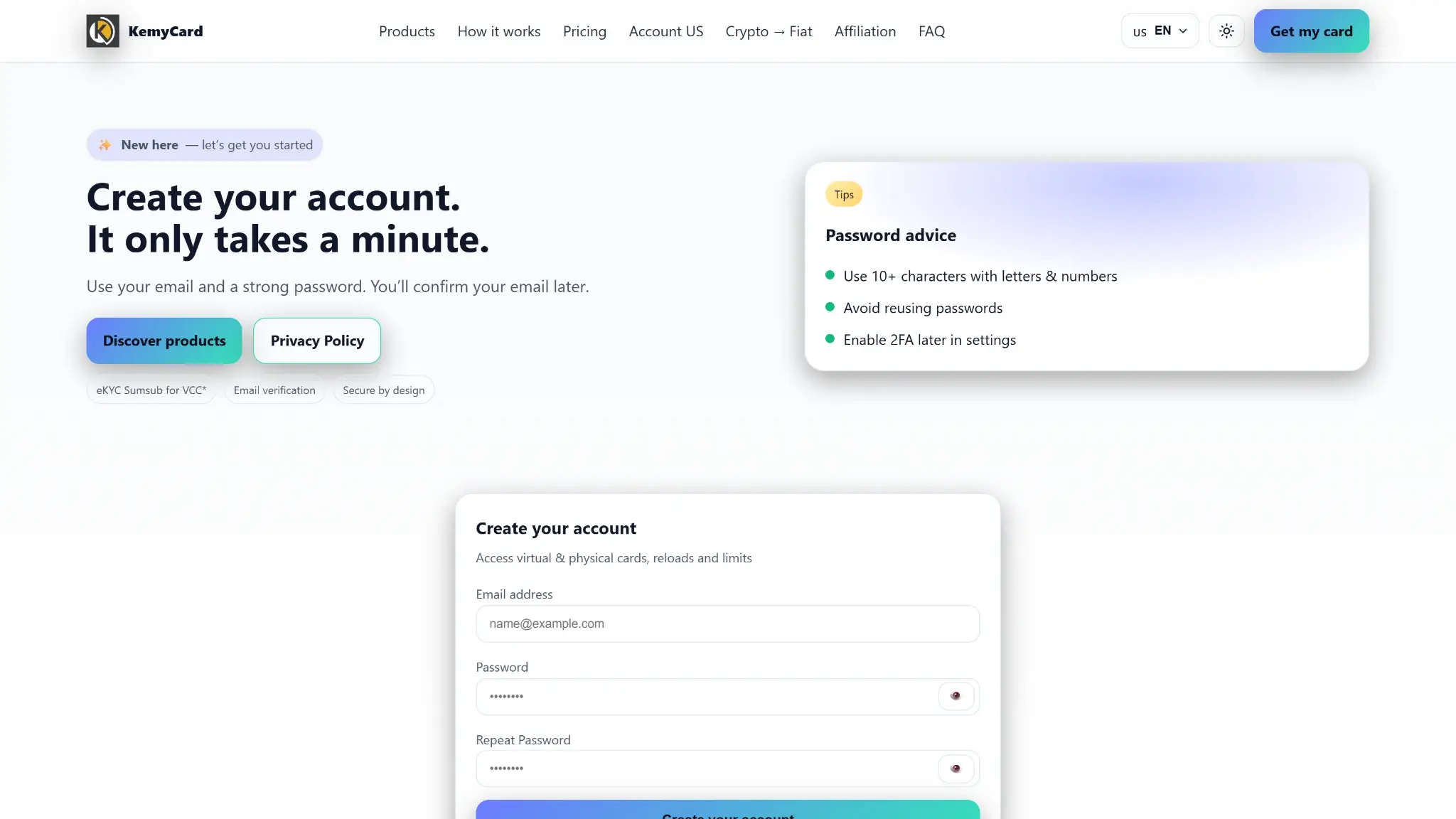
The product runs through a web dashboard and the @KemyCardBot Telegram bot. Controls are decent on paper: instant freeze, unfreeze, and delete, unlimited virtual cards for separating merchants and subscriptions, and wallet provisioning to Apple Pay, Google Pay, and Samsung Pay on the physical card. Physical delivery is quoted at 5–15 business days by DHL Express.
Support is reachable through a help center, live chat with unstated hours, email, and Telegram. What no channel offers is a dispute path: chargeback rights, refund timing, and the escalation route for a frozen balance are all undisclosed. The complaints on record cluster exactly where support has the least reach, in the gap between the payment processor, the unnamed issuer, and the operator.
Tax and Record-Keeping
The preload model keeps taxes simpler than auto-sell cards. Converting crypto to load the balance can be a taxable disposal depending on jurisdiction, and after that, purchases draw on a fiat balance with no per-transaction sale. Stablecoin loads lower the volatility, not the reporting duty. KemyCard discloses nothing about statements, CSV export, or cost-basis records, so cardholders track deposits, conversions, spends, failures, and refunds by hand.
KemyCard Alternatives
-


Kast Card
KAST turns a stablecoin balance into a spendable USD Visa that works in 170+ countries, including the US that most crypto cards skip. Stablecoins load 1:1 with no spread, the virtual card...
-

RedotPay
RedotPay is a stablecoin spend card — preload a balance, then tap a Visa accepted across 100+ countries. It competes on running cost, keeping the recurring fee flat and the FX rate...
-

Bybit Card
Bybit's card is a Mastercard debit that spends from your exchange Funding Account, taking fiat first and selling crypto only when the balance runs short. It competes on a 1% base rate,...
A different card can still make more sense if you care more about stablecoin support, self-custody, rewards, or lower recurring fee drag than raw spend limits.
| Alternative | Better For | Why Someone Would Choose It Instead | Main Trade-Off |
|---|---|---|---|
| KAST Card | Stablecoin spending and travel-friendly mobile-wallet use | Instant virtual card, Apple Pay and Google Pay support, broad country coverage, and local-currency conversion at checkout | Availability and plan economics still vary by jurisdiction |
| RedotPay | Stablecoin-first daily spend | Stablecoin payments sit at the center of the product, with card spend, transfers, and multi-currency app support in one place | Still custodial, and regional access or KYC friction can vary |
| MetaMask Card | Better self-custody fit | Funds stay in the MetaMask wallet until payment, which is a cleaner fit for those who do not want a prepaid custodial balance | Country rollout and compliance checks still limit access |
| Bybit Card | Stronger rewards and lower recurring fee drag | No monthly or annual fee is a cleaner starting point, and cashback offers are stronger than KemyCard’s zero-reward model | Exchange-linked setup and regional availability can be limiting |
KemyCard's main advantage is high stated limits and card-format flexibility. Cheaper funding, rewards, self-custody, or a more transparent fee structure all point to other cards.
Crypto Cards Pillar Scores
- Real-world spend reliability 15% weight Purchase acceptance across everyday merchants, online payments, recurring bills and mobile wallets.Not disclosed
- Funding rails and conversion 12.5% weight Supported assets and networks, deposit reliability, conversion spreads and ease of moving funds onto the card.Not disclosed
- Fees and hidden cost drag 12.5% weight Total cost of issuance, top-ups, purchases, foreign exchange, withdrawals and other charges, including disclosure.Not disclosed
- Security, custody, and freeze risk 12.5% weight Issuer transparency, custody safeguards, account security, audits, insurance and the risk of frozen or withheld balances.Not disclosed
- Availability and setup friction 10% weight Supported countries, eligibility checks, signup requirements and the time needed to obtain a usable card.Not disclosed
- Privacy and data exposure 10% weight Identity requirements, personal data collected or shared, billing details and privacy of funding methods.Not disclosed
- Rewards value after conditions 5% weight Usable cashback and rewards after accounting for eligibility, spending conditions, tiers, caps and payout restrictions.Not disclosed
- Operational convenience and limits 7.5% weight Purchase and funding limits, minimum top-ups, ATM access and flexibility to manage multiple cards.Not disclosed
- App, controls, and virtual card 7.5% weight Dashboard and app usability, virtual card access, freeze controls, mobile wallets and other card-management tools.Not disclosed
- Support, refunds, and chargebacks 5% weight Support responsiveness, dispute handling, refund costs and timelines, account recovery and chargeback access.Not disclosed
- Tax and reporting readiness 2.5% weight Transaction history, exports, conversion records and tax-reporting tools that help users maintain accurate records.Not disclosed
Final Verdict
KemyCard asks holders to hand over up to $400,000 to a company that names no beneficial owners, won't name its issuing bank, contradicts its own compliance claims on its own homepage, and carries a "Likely Unsafe" rating from an independent scanner. That's a Poor score before a single fee is counted. The fees then close the case: 8% on deposit, 3.5% + $1 per purchase, monthly charges, undisclosed ATM and FX costs, and no rewards to offset any of it. The one thing the card offers — very high limits with fast virtual issuance — cuts the wrong way here. It enlarges the exposure instead of the value, since every dollar of that headroom sits with an unaccountable custodian. Until the open questions resolve — a named issuing bank, a confirmed US signup path, the hidden ATM and FX schedule — KemyCard has no place on a recommended list, US or otherwise. If it appears anywhere, it belongs in risk-flagged context only. Resolving those questions could push the score lower. It's hard to see what would push it higher.
Disclaimer: CryptoSlate may receive a commission when you click links on our site and make a purchase or complete an action with a third party. This does not influence our editorial independence, reviews, or ratings, and we always aim to provide accurate, transparent information to our readers.