




- Nasdaq ETF conversion in December 2025
- 0.49% annual management fee
- CME CF New York reference rate
Osprey Bitcoin Trust Overview
- Fund Name
- Osprey Bitcoin Trust
- Ticker
- OBTC
- Listing Exchange
- Nasdaq
- Fund Family / Issuer
- Osprey Funds
- Underlying Asset
- Bitcoin
Additional details
- Exposure
- Spot Bitcoin held by the trust.
- Fund Structure
- Commodity trust, not registered as an investment company under the Investment Company Act of 1940.
- Annual management fee
- 0.49%
- Fee Assessment Base
- Daily net asset value.
- Effective Annual Charge
- 0.49%
- Fee Waiver / Conditions
- The issuer also displays a 0.49% total expense ratio, which describes the same cost rather than a second charge. Under the ETF-conversion terms, the sponsor covers routine administrative and operating expenses, including audit, index-licensing and custody fees. The trust can still bear extraordinary expenses, including taxes and extraordinary legal costs.
- Fee Terms Checked
- Sep 13, 2026
- Benchmark
- CME CF Bitcoin Reference Rate – New York Variant (BRRNY)
- Custody Appointments
- Coinbase Custody Trust Company, LLC; Bitcoin custodian; Preserves recorded ownership but requires gross negligence, willful misconduct or fraud for custody responsibility. Credential exclusions and recovery limits apply, and the trust does not carry Bitcoin insurance.
- Retail Asset Redemption
- Individual shares cannot be redeemed for Bitcoin. Retail holders sell through a broker for cash; authorized participants transact with the trust in baskets.
- 30-day Median Bid/Ask Spread
- 0.43%As of Sep 23, 2026REX/Osprey, issuer; Median Bid-Ask Spread (30 day); Issuer describes NBBO midpoint percentage sampled every ten seconds over 30 calendar days.; Retrieved Sep 28, 2026
- Fund Assets
- USD 78,991,920As of Sep 23, 2026
Issuer-listed Fund Assets
- Issuer-reported inception
- Dec. 19, 2025 on the current issuer page denotes ETF conversion, not original trust formation
- First exchange trading
- Dec. 19, 2025 on Nasdaq, following earlier OTC quotation
- Reporting controls
- Administrator-oversight weakness reported for FY2025 and Q1 2026, still unresolved at June 30, 2026
- Quarterly report reviewed
- Quarter ended June 30, 2026
- Operating-period annual audit reviewed
- Year ended Dec. 31, 2025
- Rating reviewed
- Sep. 25, 2026, CryptoSlate methodology version 2.1, data cutoff Sep. 23
Osprey Bitcoin Trust Screenshots
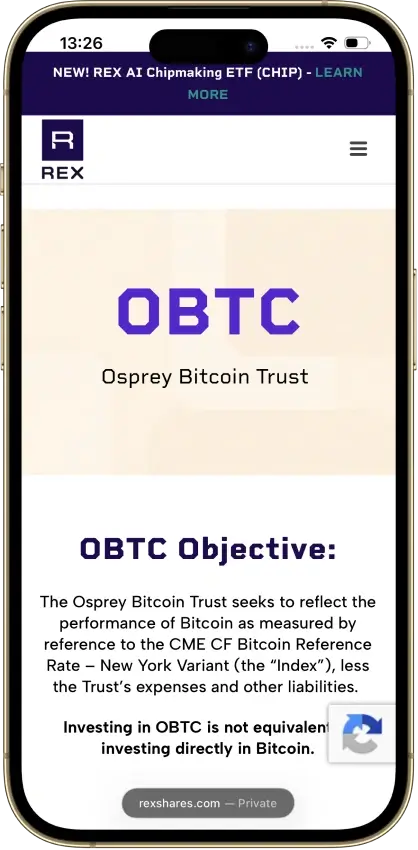
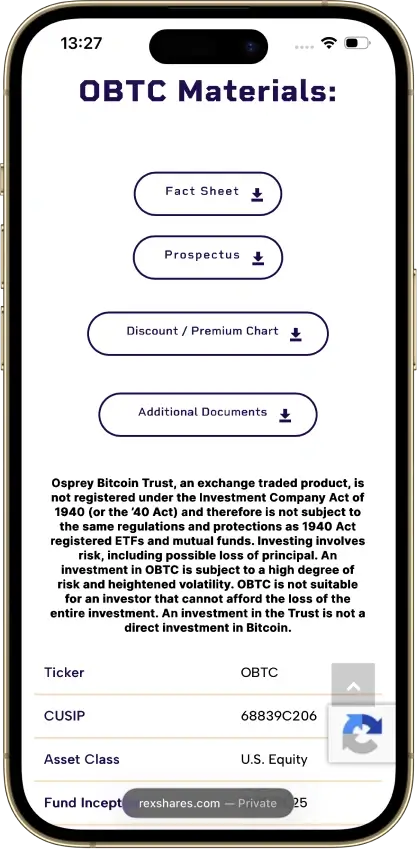
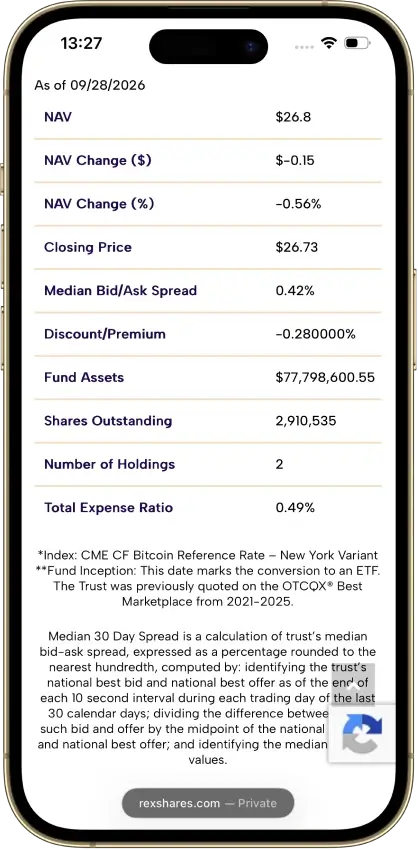
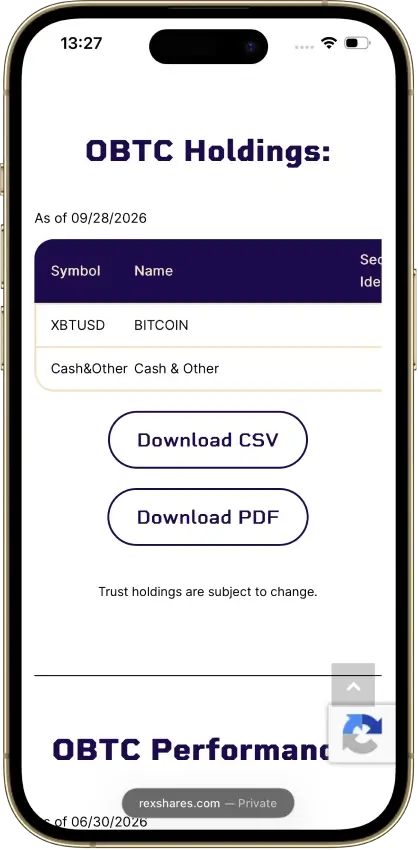
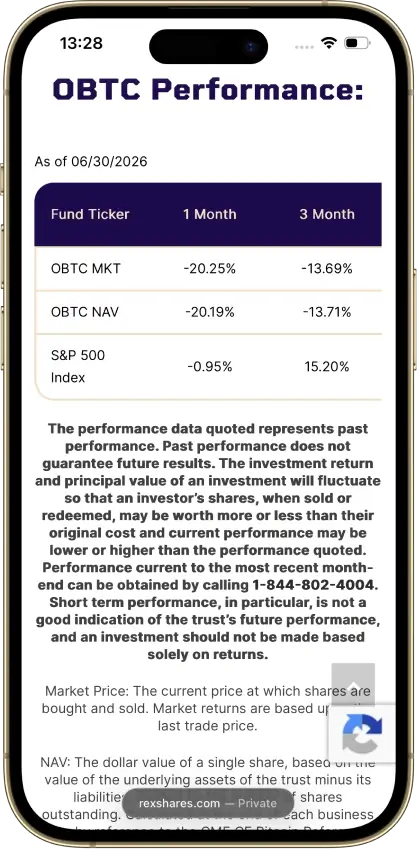
Screenshot 1 of 8
Osprey Bitcoin Trust Pros and Cons
Pros
- Shares backed by spot Bitcoin
- No personal private-key storage
- Public NAV and holdings disclosures
Cons
- Higher annual fee than IBIT and BITB
- Reporting-control weakness disclosed in 2026
- Retail shares cannot be redeemed for coins
Who OBTC Is For
An existing OBTC holder faces a different decision from someone buying a Bitcoin fund for the first time. Keeping the position avoids an immediate sale and replacement purchase, but retains a 0.49% annual management charge. Moving to a cheaper fund introduces transaction costs now in exchange for a lower recurring rate.
For a new position, OBTC has a harder cost case to make. IBIT and BITB also hold spot Bitcoin and charge 0.25% and 0.20%, respectively. A buyer considering OBTC should identify a concrete account or execution advantage that justifies the higher rate.
OBTC is unsuitable for a plan that requires spending or transferring Bitcoin. Its shares provide exposure through a securities account, with the trust arranging storage. The shares remain vulnerable to Bitcoin price declines.
CryptoSlate Rating
OBTC scores 4.9/10 under CryptoSlate’s Bitcoin ETF methodology, version 2.1. This assessment uses public fund terms and reported market indicators, with a September 23, 2026 data cutoff.
| Pillar | Weight | Score | Assessment |
|---|---|---|---|
| Costs | 30% | 5.9/10 | Ongoing charge 0.49%, currently effective at the same rate. The fee amount carries 25% of the overall and fee clarity another 5%. |
| Published spread indicator | 25% | 1.4/10 | Published 30-day median: 0.43%, dated Sep. 23, 2026. |
| Fund scale | 10% | 4.0/10 | $78.99 million in issuer-listed fund assets, dated Sep. 23, 2026. Additional size earns no points above $1 billion. |
| Custody terms | 20% | 7.0/10 | Fund ownership and account entitlement are recorded separately. An applicable safekeeping responsibility clause requires gross negligence or more serious misconduct. |
| Reporting | 15% | 6.7/10 | Current required reports and product disclosures are available. Management reported ineffective disclosure controls at June 30, with an unresolved material weakness. |
OBTC’s 0.49% charge, 0.43% spread and $78.99 million issuer-listed asset base leave substantial room for improvement. Its reporting grade also reflects the unresolved administrator-oversight and tax-lot weakness, counted once. Coinbase’s current agreement preserves recorded ownership but requires gross negligence, willful misconduct or fraud for custody responsibility. Credential exclusions and recovery limits still apply, and the trust does not carry Bitcoin insurance. The reporting weakness does not itself establish missing Bitcoin or fraud.
At a 0.42% spread, OBTC would score 5.0/10; at 0.44%, it would remain 4.9/10.
Custody points compare ownership and responsibility thresholds across all appointed Bitcoin custodians. Lien reach, recovery caps and insurance remain disclosed limitations outside the numeric score. The overall is calculated from unrounded components, and a high grade does not make Bitcoin low risk. Private control testing and tracking are excluded for the whole cohort. Ratings from earlier methodology versions are not directly comparable.
What OBTC Is and How It Works
OBTC shares represent interests in Osprey Bitcoin Trust’s net assets. Bitcoin held by the trust supplies the exposure, while expenses reduce the assets attributable to shareholders. OBTC’s public product page reports net asset value (NAV) per share and the trust’s Bitcoin holdings.
The December 2025 ETF Conversion
December 19, 2025 marks OBTC’s ETF conversion and first Nasdaq trading day. The current product page labels that date “Fund Inception” and explains the conversion in a footnote. The trust existed before then and had OTCQX quotation during 2021–2025.
Older research may describe private placements or OTC-only trading that no longer represents the ETF. The trust’s former valuation benchmark has also been replaced. Check that a document’s effective date and terms cover the converted fund before applying it to a current purchase.
Benchmark and Tracking Comparisons
The current valuation reference is the CME CF Bitcoin Reference Rate – New York Variant. The trust uses it to value its Bitcoin when calculating NAV. NAV per share measures assets after liabilities divided by shares outstanding. The Nasdaq quote reflects prices available in the share market. A premium means the quote is above NAV per share, while a discount means it is below.
To compare OBTC with another ETF, select matching start and end dates after OBTC’s conversion. NAV returns help assess fund-level tracking against the stated reference. Market-price returns also reflect changes in the premium or discount to NAV, so they can differ from NAV returns.
Use the same valuation times as well as the same dates. A continuously traded Bitcoin quote captured later in the day can create an apparent tracking gap that is partly a timing difference.
Is OBTC Safe? Custody and Investment Risks
OBTC remains a speculative Bitcoin investment. It follows a passive investment strategy, with no mandate to cut Bitcoin exposure in anticipation of a downturn. The share structure does not limit how much of the investment can be lost.
Who Holds OBTC’s Bitcoin?
Coinbase Custody Trust Company, LLC is the appointed Bitcoin custodian. The investor’s broker records the share position, while the trust’s custody arrangements govern the underlying coins. A shareholder does not receive a personal Coinbase custody account through an OBTC purchase.
Investors therefore avoid storing Bitcoin private keys themselves, but depend on the trust and its providers performing their duties. Naming a custodian establishes its role. It does not by itself demonstrate that the custodian’s internal controls are effective or guarantee recovery after an operational failure.
Reporting Controls and the 2026 Disclosure
Osprey’s June 22, 2026 auditor-change filing restated an administrator-oversight material weakness already discussed in the FY2025 annual report and Q1 2026 quarterly report. The filing described an audit adjustment to the 2025 financial statements, while stating that the weakness did not result in any material misstatements. In a separate letter, outgoing auditor Grant Thornton agreed with Osprey’s account of the audit firm’s work and departure. For the quarter ended June 30, 2026, management again concluded that disclosure controls were ineffective and the administrator-oversight and tax-lot weakness remained unremediated, without an impact on NAV.
The weakness concerns the reliability of financial reporting. It does not, on its own, establish a loss of Bitcoin in custody. The auditor’s acknowledgment also does not certify that later remediation succeeded. Investors assessing OBTC should check subsequent controls disclosures before treating the problem as resolved.
Fund Structure and Regulatory Status
As a commodity trust, OBTC is not registered under the Investment Company Act of 1940. It does not receive the same regulatory treatment as a fund registered under that Act. Securities-law reporting requirements and prohibitions on fraud still apply to OBTC.
The Nasdaq listing provides a market for the shares. It does not insure their value or remove the operational responsibilities described in the fund documents.
OBTC Fees and Trading Costs
OBTC charges a 0.49% annual management fee, and its current product page displays a 0.49% total expense ratio. These are related descriptions of fund costs, not two separate 0.49% charges to add together. Historical expense ratios from the pre-conversion period should not replace the current published rate.
Under the terms adopted for the ETF conversion, the sponsor covers routine administrative and operating expenses, including audit, index-licensing and custody fees. The trust can still bear extraordinary expenses, including taxes and extraordinary legal costs.
The Dollar Difference Versus IBIT and BITB
Using a constant $10,000 base over one year, OBTC’s 0.49% rate implies $49. IBIT would cost $25 on that basis, while BITB would cost $20. OBTC’s annual rate exceeds IBIT’s by 24 basis points, equivalent to $24 on the fixed base. Against BITB, the gap is 29 basis points, equivalent to $29.
This illustration holds asset value constant and excludes compounding. Transaction costs are also omitted. Actual fund charges depend on each fund’s calculation rules and asset values over time, so these figures cannot predict a shareholder’s bill or return.
For an existing holder, the relevant question is how the expected fee saving over the intended holding period compares with the costs of changing funds. A lower annual rate alone cannot establish that an immediate switch leaves that investor better off.
Buying and Selling OBTC
Find Osprey Bitcoin Trust under OBTC and confirm Nasdaq as the current listing. A broker screen or saved research page that still describes only an OTC instrument needs further checking. The ETF conversion does not guarantee availability in every brokerage account or jurisdiction.
Review the current bid and ask for the intended order size, along with any commission. Compare a share quote with NAV only after checking when each figure was measured. Neither a premium nor a discount guarantees where the next trade will occur.
Retail shareholders ordinarily exit by selling shares through their broker for cash. Authorized participants transact directly with the trust in baskets under the terms set out in the fund documents. That institutional access does not give an individual shareholder a right to exchange OBTC shares for Bitcoin.
Someone moving from OBTC to a wallet they control would need to arrange a separate Bitcoin purchase and transfer. The share sale, coin purchase and custody setup each require their own decisions and can create additional costs.
OBTC Alternatives
IBIT and BITB provide useful comparisons because both offer spot Bitcoin exposure at lower annual rates and use the same valuation reference as OBTC. Their prices, spreads and availability in a particular account still need to be checked separately.
OBTC vs IBIT and BITB
| Feature | OBTC | IBIT | BITB |
|---|---|---|---|
| Fund | Osprey Bitcoin Trust | iShares Bitcoin Trust ETF | Bitwise Bitcoin ETF |
| Annual management or sponsor fee | 0.49% management fee | 0.25% sponsor fee | 0.20% sponsor fee |
| US listing | Nasdaq | Nasdaq | NYSE Arca |
| Exposure | Spot Bitcoin | Spot Bitcoin | Spot Bitcoin |
| Valuation benchmark | CME CF Bitcoin Reference Rate – New York Variant | CME CF Bitcoin Reference Rate – New York Variant | CME CF Bitcoin Reference Rate – New York Variant |
A shared benchmark removes one source of difference when comparing NAV tracking over matching periods. It does not eliminate expenses or make the exchange quotes identical.
The fee differences in the table do not predict the funds’ market-price returns.
References
The rating and supporting public terms were reviewed on Sep. 25, 2026, using methodology version 2.1 and a Sep. 23 data cutoff. The reporting review includes the quarter ended June 30, 2026. This rating expires Nov. 7, 2026 unless refreshed.
Sources include the OBTC product page and June 2026 factsheet, June 2026 quarterly report, September registration amendment and September 18 prospectus. Nasdaq’s listing notice, maintained fund profiles, executed custody documents and the former auditor’s acknowledgment were checked alongside SEC and FINRA investor guidance.
Readers can report outdated OBTC details to CryptoSlate.
This product review provides general information. It does not evaluate the reader’s personal financial circumstances.
Bitcoin ETFs Pillar Scores
- Fund fees 30% weight Ongoing sponsor charge before temporary waivers, fee basis, covered expenses, extra fund costs, and waiver terms.Not disclosed
- Trading spread 25% weight Published 30-day median bid-ask spread, with its source, observation date, and calculation definition recorded.Not disclosed
- Fund size 10% weight Assets attributable to the fund, using a dated figure and a clearly identified asset-value basis.4.0 / 10
- Custody & asset rights 20% weight Fund ownership, separate asset records, and the custodian's contractual responsibility for its own safekeeping failures.7.0 / 10
- Reporting & transparency 15% weight Required reports, public holdings, valuation benchmark, net asset value (NAV), and management's disclosure-control conclusions.Not disclosed
Final Verdict
OBTC’s December 2025 conversion gave existing Osprey trust shares a Nasdaq ETF listing. Coinbase Custody Trust Company, LLC is its appointed Bitcoin custodian. For current holders, the decision is whether the cost of retaining the position is preferable to the costs of moving. OBTC’s 0.49% annual management fee is 24 basis points above IBIT’s 0.25% sponsor fee and 29 basis points above BITB’s 0.20% sponsor fee. New buyers focused on annual fees have cheaper named alternatives, and OBTC’s disclosed reporting-control weakness deserves attention alongside custody and market risk. Check later controls reporting before assuming remediation is complete. OBTC supplies Bitcoin price exposure through shares, while retail holders still lack the ability to withdraw the underlying coins.
Best For
Existing OBTC holders comparing the cost of retaining their position with the costs of moving to another Bitcoin fund.
Avoid If
- You are opening a new Bitcoin fund position and want the lowest annual fee, or you need coins you can transfer to a personal wallet.
Disclaimer: CryptoSlate may receive a commission when you click links on our site and make a purchase or complete an action with a third party. This does not influence our editorial independence, reviews, or ratings, and we always aim to provide accurate, transparent information to our readers.