



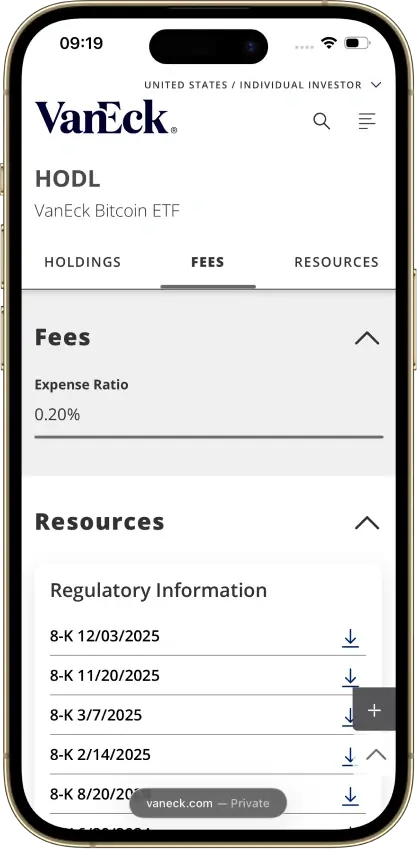
- Current annual sponsor rate of 0.20%
- MarketVector Bitcoin Benchmark Rate
- Gemini and Coinbase custody appointments
VanEck Bitcoin Trust Overview
- Fund Name
- VanEck Bitcoin Trust
- Ticker
- HODL
- Listing Exchange
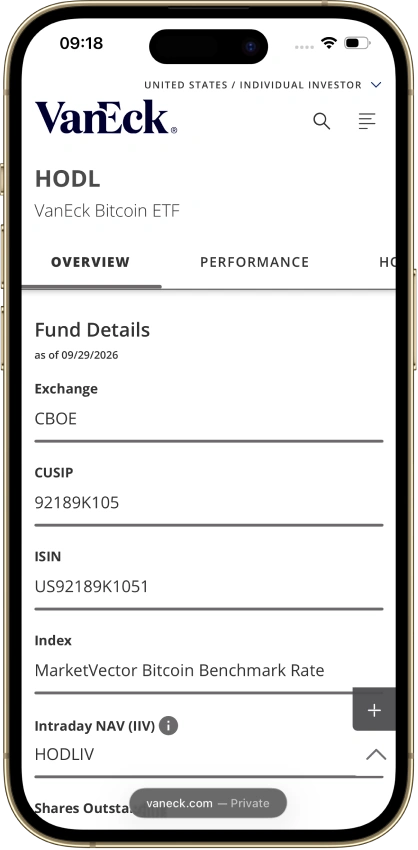
- Cboe BZX
- Fund Family / Issuer
- VanEck
- Underlying Asset
- Bitcoin
Additional details
- Exposure
- Spot Bitcoin owned by the trust.
- Fund Structure
- Commodity trust, not registered as an investment company under the Investment Company Act of 1940.
- Annual sponsor fee
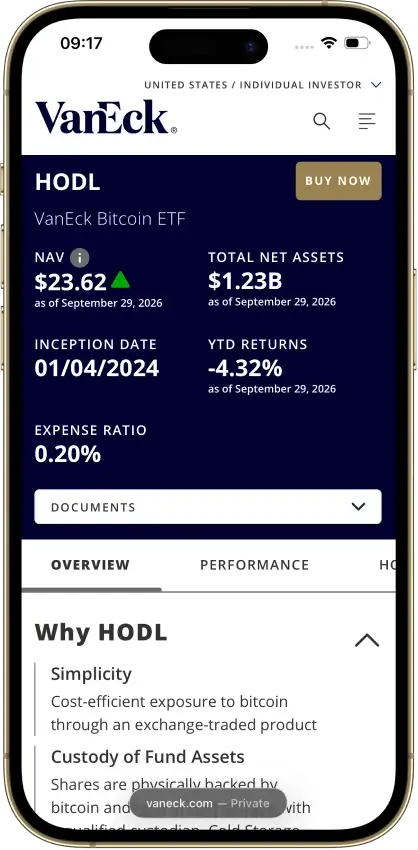
- 0.2%
- Fee Assessment Base
- Average daily net assets.
- Effective Annual Charge
- 0.2%
- Fee Waiver / Conditions
- The temporary sponsor-fee waiver ended on July 31, 2026. The standard 0.20% rate applies from that date, so older zero-fee descriptions and historical net expense figures do not reflect current terms.
- Fee Terms Checked
- Sep 13, 2026
- Benchmark
- MarketVector Bitcoin Benchmark Rate
- Custody Appointments
- Gemini; Primary Bitcoin custodian; Permits negligence-based custody claims. The appointment does not show what percentage of the trust’s Bitcoin it holds.Coinbase; Additional Bitcoin custodian; Coinbase accepts liability for negligent breaches of its custody obligations, subject to contractual limits. Trading balances, security rights and recovery limits require separate consideration.
- Retail Asset Redemption
- Individual shares cannot be redeemed for Bitcoin. Retail investors sell through a broker for cash; authorized participants handle direct share-basket transactions.
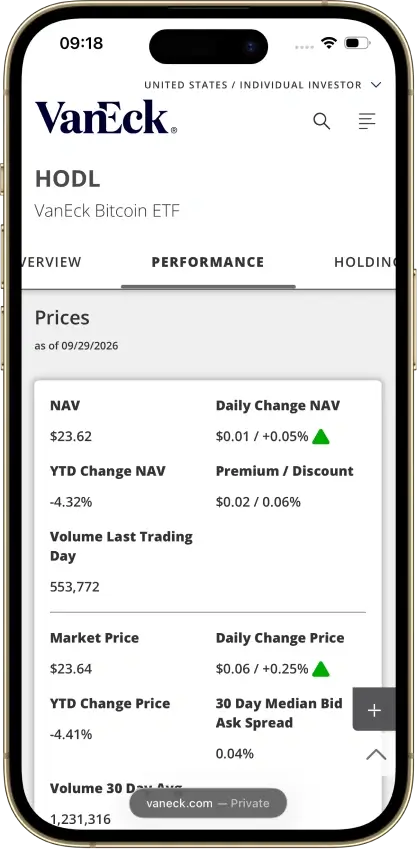
- 30-day Median Bid/Ask Spread
- 0.09%As of Sep 24, 2026Fidelity, public data provider; Median bid/ask spread (30-day); Retrieved Sep 28, 2026
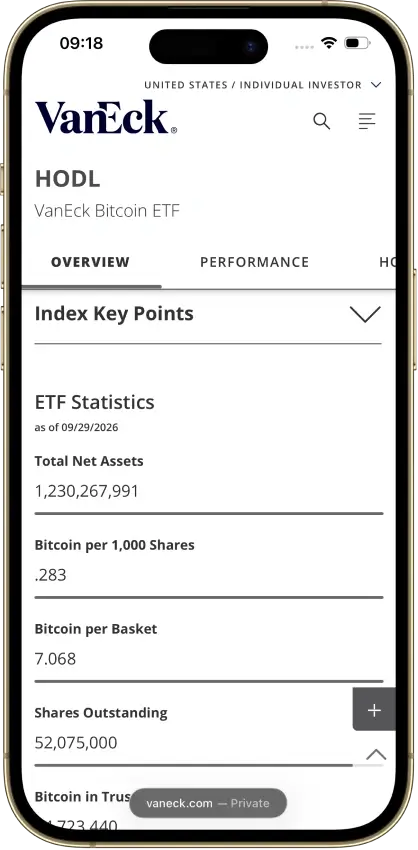
- Fund Assets
- USD 1,244,046,810As of Sep 24, 2026
Net assets, ETF Statistics table
- Issuer-reported inception
- Jan. 4, 2024, seed-basket purchase
- First exchange trading
- Jan. 11, 2024
- Quarterly report reviewed
- Quarter ended June 30, 2026
- Operating-period annual audit reviewed
- Year ended Dec. 31, 2025
- Rating reviewed
- Sep. 25, 2026, CryptoSlate methodology version 2.1, data cutoff Sep. 24
VanEck Bitcoin Trust Screenshots
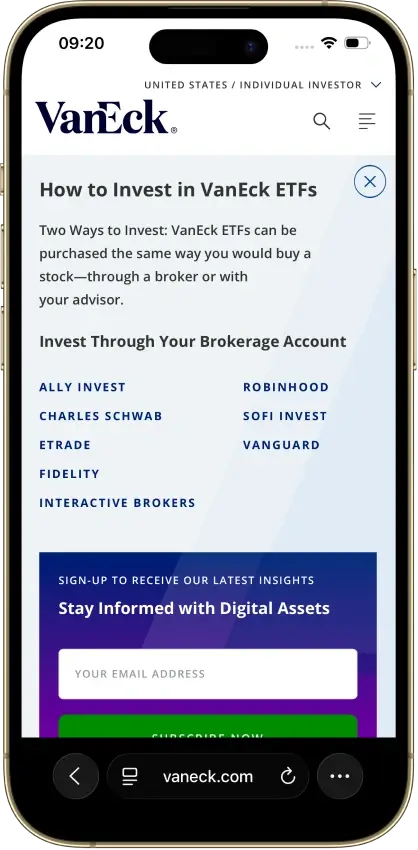
Screenshot 1 of 8
VanEck Bitcoin Trust Pros and Cons
Pros
- Annual sponsor rate below IBIT’s
- Trust’s Bitcoin held by appointed custodians
- Trade shares through a brokerage account
Cons
- Standard sponsor charges now apply
- Fund costs reduce Bitcoin backing per share
- Investors cannot move the underlying coins
Who HODL Is For
Investors who want Bitcoin alongside other brokerage holdings can assess HODL on its current fee and custody terms. VanEck provides the fund, while appointed custodians handle the underlying coins.
The fund remains an investment in Bitcoin’s market value. A preference for VanEck as a provider does not change the need to accept the possibility of substantial price declines. HODL fits the investor who wants that exposure in shares and understands the limits of the format.
CryptoSlate Rating
CryptoSlate rates HODL 8.5/10 under its Bitcoin ETF methodology, version 2.1. Fidelity reports a 0.09% 30-day median bid-ask spread as of Sep. 24, 2026. At a 0.10% spread, the overall rating would be 8.4/10.
| Pillar | Weight | Score | Assessment |
|---|---|---|---|
| Costs | 30% | 8.3/10 | Ongoing charge 0.20%, currently effective at the same rate. The fee amount carries 25% of the overall and fee clarity another 5%. |
| Published spread indicator | 25% | 8.2/10 | Fidelity reports a 0.09% 30-day median bid-ask spread for HODL as of Sep. 24, 2026. |
| Fund scale | 10% | 10.0/10 | $1,244.05 million in reported net assets, dated Sep. 24, 2026. Additional size earns no points above $1 billion. |
| Custody terms | 20% | 7.0/10 | Fund ownership and separate custody entitlements are documented. Coinbase’s terms require gross negligence for unauthorized-access losses, which limits the safekeeping responsibility score. |
| Reporting | 15% | 10.0/10 | Current required reports and product disclosures are available. Management reported effective disclosure controls at June 30, 2026. |
HODL’s standard 0.20% fee applies after its waiver ended on July 31, 2026. VanEck reported net assets above the methodology’s $1 billion size cap on Sep. 24, 2026. Gemini accepts ordinary-negligence liability. Coinbase’s general negligence standard is qualified by a gross-negligence threshold for unauthorized-user and compromised-login losses. Our method applies the weaker qualifying responsibility standard across appointed custodians, giving custody 7.0/10. Clearing and trading balances, security rights and recovery limits require separate consideration.
Custody points compare ownership and responsibility thresholds across all appointed Bitcoin custodians. Lien reach, recovery caps and insurance remain disclosed limitations outside the numeric score. Ratings from earlier methodology versions are not directly comparable.
What HODL Is and How It Works
The trust holds Bitcoin, and each share represents a fractional interest in its net assets. Owning HODL gives an investor exposure to those holdings after fund expenses. It does not put coins into a personal wallet.
HODL’s fund inception date is January 4, 2024, with public exchange trading following on January 11. The US listing is on Cboe BZX. Check the ticker and exchange together when identifying the product in a broker’s search results.
Benchmark and Tracking Comparisons
HODL values its Bitcoin using the MarketVector Bitcoin Benchmark Rate. The trust’s net asset value, or NAV, accounts for its assets and liabilities. NAV per share divides that net amount among the outstanding shares.
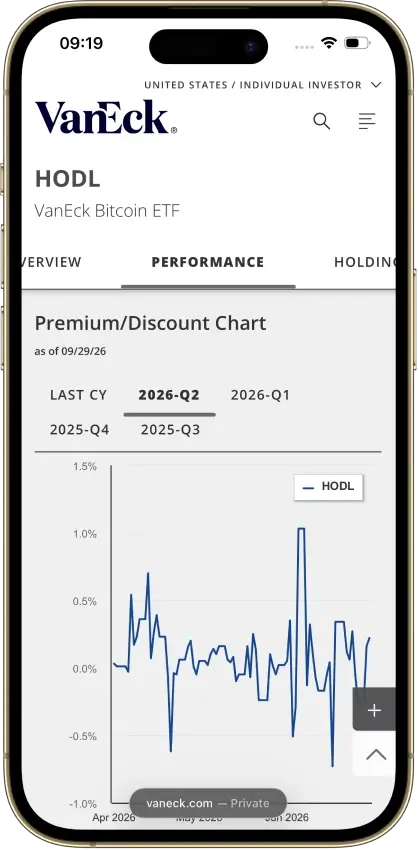
The benchmark price and an exchange quote for HODL perform different jobs. The benchmark supports the fund’s valuation, while a share quote shows the market terms available to a buyer or seller. A traded share price can differ from NAV per share.
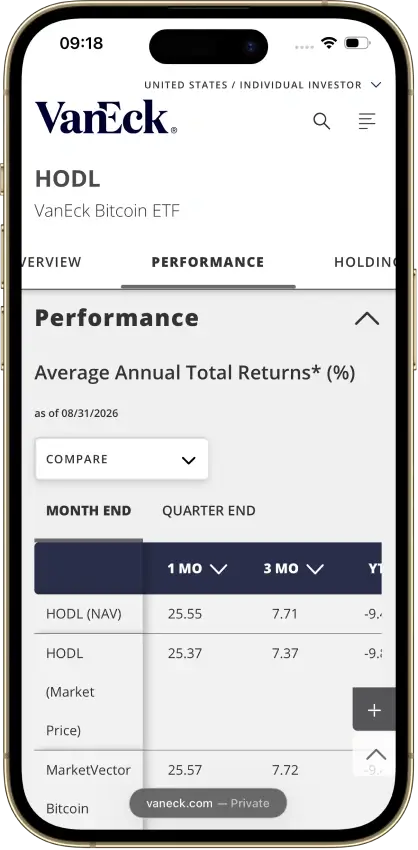
A period in which sponsor charges were waived does not show the continuing effect of the standard rate. Match the dates and the type of return being measured before comparing HODL’s performance with another fund or a Bitcoin price reference.
Is HODL Safe? Custody and Investment Risks
HODL can lose substantial value through a fall in Bitcoin’s price. Custody failures present an additional risk because the trust depends on access to coins held on its behalf. A familiar fund provider cannot remove either source of loss.
Who Holds HODL’s Bitcoin?
Gemini is HODL’s primary Bitcoin custodian, with Coinbase appointed as an additional custodian. Both names belong in an assessment of the arrangement. Describing the fund as Gemini-only would leave out a disclosed service provider.
The appointments do not establish what percentage of the Bitcoin sits with either firm. Holding HODL alongside another fund that uses Coinbase therefore does not, by itself, establish a particular reduction in exposure to that custodian.
The appointed custodians safeguard the keys that control access to the coins. Holding shares removes the investor’s need to handle those keys, but creates reliance on the trust’s service providers. The number of names in the custody arrangements is not a security score.
Fund Structure and Regulatory Status
HODL is a commodity trust and lacks registration as an investment company under the Investment Company Act of 1940. Investors do not receive the protections that come with a fund’s registration under that Act.
The product still has securities-law obligations concerning its offering and ongoing disclosures, and antifraud rules apply. These requirements support access to information about the investment. They provide no assurance that an investor will recover money lost through Bitcoin price movements or a failure involving fund assets.
HODL Fees and Trading Costs
The current annual sponsor rate is 0.20%. VanEck’s current product page and independent fund comparisons report that rate. An investor also needs to account for the cost of buying and selling the shares.
Paying expenses from the trust’s holdings leaves less Bitcoin supporting each share. An increase in Bitcoin’s dollar value can still produce a gain for the shareholder. Coin backing and the account’s dollar return are different quantities.
Reading Past Fee-Waiver Information
VanEck previously waived sponsor charges under temporary arrangements. HODL should now be assessed using its current 0.20% rate. A dated promotion is insufficient to establish what an investor will bear today.
A reported net expense figure may describe a past accounting period. For historical tracking, use the fee terms that applied during that period, including any waiver. Applying today’s 0.20% rate to the whole period could misstate how much of the return difference came from fees.
A $10,000 Fee Comparison
If the investment stayed worth $10,000 for a full year, HODL’s 0.20% rate would correspond to $20. At that value, iShares Bitcoin Trust ETF (IBIT) would incur $25 at 0.25%, and Grayscale Bitcoin Mini Trust ETF (ticker BTC) $15 at 0.15%. The assumed holding therefore costs $5 less to maintain in HODL than in IBIT, and $5 more than in BTC, before trading costs.
The actual fee amount varies with the value of the investment. These figures exclude trading costs and market movements.
Buying and Selling HODL
Search for VanEck Bitcoin ETF under HODL and verify that the result is the US Cboe BZX security. The broker’s product access and your account permissions determine whether you can place the order. A listing on a public information page is not confirmation of individual eligibility.
Checking the Quote
Compare the quote’s timestamp with the valuation time shown for NAV per share. A premium puts the quoted share price above that net asset value, while a discount puts it below. Comparing observations from different times can give a misleading picture of the difference.
The spread is relevant even when a fund has a modest annual rate. An investor who changes positions repeatedly incurs transaction costs each time.
Receiving Sale Proceeds
Retail investors normally sell HODL shares through their broker and receive cash proceeds. Authorized participants handle the trust’s direct share-basket transactions. Ordinary shareholders have no right to take delivery of Bitcoin from the trust.
Someone planning to use a Bitcoin wallet with personal control of custody would need a separate purchase of withdrawable coins.
HODL Alternatives
IBIT and Grayscale BTC put HODL’s standard fee into perspective. All three hold spot Bitcoin, but their annual sponsor rates differ. The table records their published terms.
HODL vs IBIT and BTC
| Feature | HODL | IBIT | Grayscale BTC |
|---|---|---|---|
| Fund family | VanEck | BlackRock / iShares | Grayscale |
| US listing | Cboe BZX | Nasdaq | NYSE Arca |
| Annual sponsor rate | 0.20% | 0.25% | 0.15% |
| Underlying asset | Spot Bitcoin | Spot Bitcoin | Spot Bitcoin |
Grayscale BTC has the lowest annual rate in this comparison. An investor choosing HODL over it should weigh the provider and custody arrangements against the extra recurring charge.
An investor who needs to spend Bitcoin or choose where the actual coins are held should assess direct ownership separately. Adding several Bitcoin funds can spread a position among fund providers while leaving the investment concentrated in Bitcoin’s price.
References
This review uses CryptoSlate’s Bitcoin ETF methodology, version 2.1. Market figures are dated beside the figures they describe. The reporting review includes the quarter ended June 30, 2026.
Fee, custody and fund assets were checked against VanEck and SEC materials on Sep. 25, 2026.
The review is based on public evidence, without a test trade or access to the fund’s private custody operations. Subsequent changes can affect the terms described here. Please flag an outdated detail to the editorial team.
This assessment is general information and does not take account of personal financial circumstances.
Bitcoin ETFs Pillar Scores
- Fund fees 30% weight Ongoing sponsor charge before temporary waivers, fee basis, covered expenses, extra fund costs, and waiver terms.Not disclosed
- Trading spread 25% weight Published 30-day median bid-ask spread, with its source, observation date, and calculation definition recorded.Not disclosed
- Fund size 10% weight Assets attributable to the fund, using a dated figure and a clearly identified asset-value basis.10.0 / 10
- Custody & asset rights 20% weight Fund ownership, separate asset records, and the custodian's contractual responsibility for its own safekeeping failures.7.0 / 10
- Reporting & transparency 15% weight Required reports, public holdings, valuation benchmark, net asset value (NAV), and management's disclosure-control conclusions.10.0 / 10
Final Verdict
HODL offers VanEck’s spot Bitcoin exposure at a current annual sponsor rate of 0.20%. It sits between IBIT and Grayscale BTC on that measure, with modest five-dollar differences in either direction on an assumed $10,000 holding. Current terms and the price of the trade deserve more weight than older zero-fee descriptions. Its custody arrangements include Gemini and Coinbase, so the fund should not be selected on an assumption of exclusive Gemini custody. HODL can serve investors who want a brokerage position and accept continuing Bitcoin risk. It gives ordinary shareholders a security to trade, with no right to collect the coins held for the trust.
Best For
Investors considering VanEck for a brokerage Bitcoin allocation who accept its current fee and custody arrangements.
Avoid If
- You need withdrawable coins or are choosing HODL on the assumption that its sponsor fee is still waived.
Disclaimer: CryptoSlate may receive a commission when you click links on our site and make a purchase or complete an action with a third party. This does not influence our editorial independence, reviews, or ratings, and we always aim to provide accurate, transparent information to our readers.