




- Bitcoin trust operating since 2013
- NYSE Arca-listed Bitcoin exposure
- CoinDesk Bitcoin Benchmark Rate pricing
Grayscale Bitcoin Trust Overview
- Fund Name
- Grayscale Bitcoin Trust
- Ticker
- GBTC
- Listing Exchange
- NYSE Arca
- Fund Family / Issuer
- Grayscale
- Underlying Asset
- Bitcoin
Additional details
- Exposure
- Trust shares backed by spot Bitcoin.
- Fund Structure
- Commodity trust, not registered as an investment company under the Investment Company Act of 1940.
- Annual sponsor fee
- 1.5%
- Fee Assessment Base
- Assets less liabilities, as defined for the sponsor fee.
- Effective Annual Charge
- 1.5%
- Fee Terms Checked
- Sep 13, 2026
- Benchmark
- CoinDesk Bitcoin Benchmark Rate
Effective from Apr 1, 2026
- Custody Appointments
- Coinbase; Primary Bitcoin custodian; Preserves recorded fund ownership and provides negligence-based custody responsibility. Setoff clause refers to Sponsor Assets as defined in the Settlement and Transfer Agreement, but that definition is absent from the publicly filed terms, leaving the scope unclear.Anchorage Digital; Additional Bitcoin custodian; Grayscale says the additional custodian holds a portion of the assets, without specifying the amount. Recovery limits apply under its terms.
- Retail Asset Redemption
- Individual retail shares cannot be redeemed for Bitcoin. Investors sell through a broker for cash; authorized participants use a separate basket creation and redemption process.
- 30-day Median Bid/Ask Spread
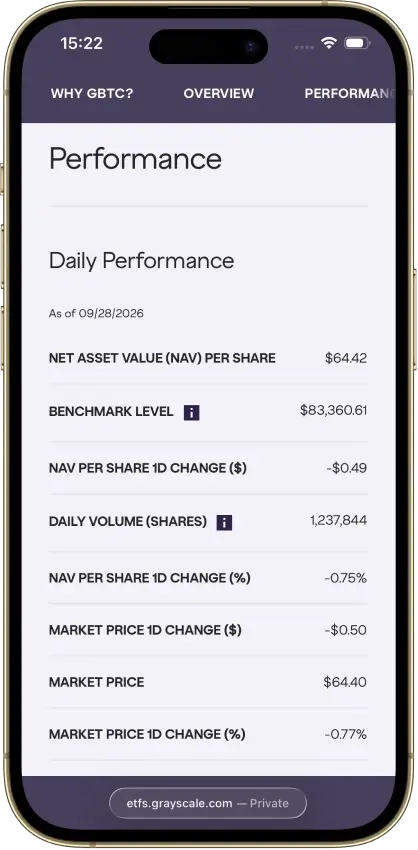
- 0.02%As of Sep 24, 2026Grayscale, issuer; 30D MEDIAN BID/ASK SPREAD (%); Issuer describes NBBO midpoint percentage sampled every ten seconds over 30 calendar days.; Retrieved Sep 28, 2026
- Fund Assets
- USD 10,741,945,047As of Sep 24, 2026
Non-GAAP AUM using investor NAVGrayscale, issuer; Non-GAAP AUM using investor NAV; Separate GAAP AUM: $10,742,761,024.; Retrieved Sep 28, 2026
- Issuer-reported inception
- Sep. 25, 2013, commencement of operations. Trust formed Sep. 13
- First exchange trading
- NYSE Arca uplisting on Jan. 11, 2024
- Quarterly report reviewed
- Quarter ended June 30, 2026
- Operating-period annual audit reviewed
- Year ended Dec. 31, 2025
- Rating reviewed
- Sep. 25, 2026, CryptoSlate methodology version 2.1, data cutoff Sep. 24
Grayscale Bitcoin Trust Screenshots
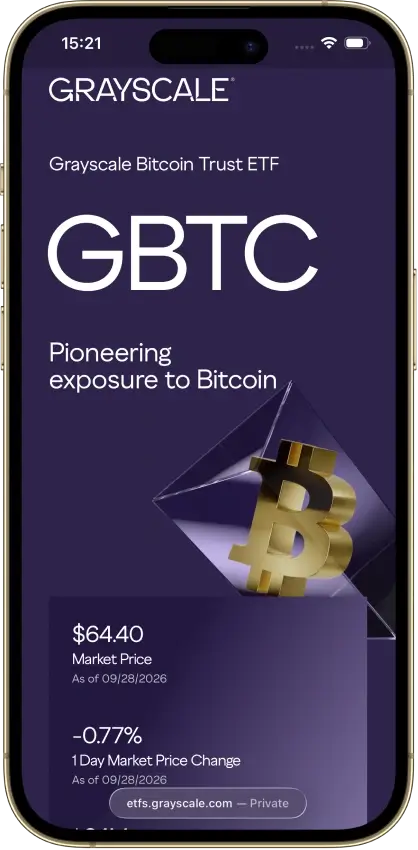
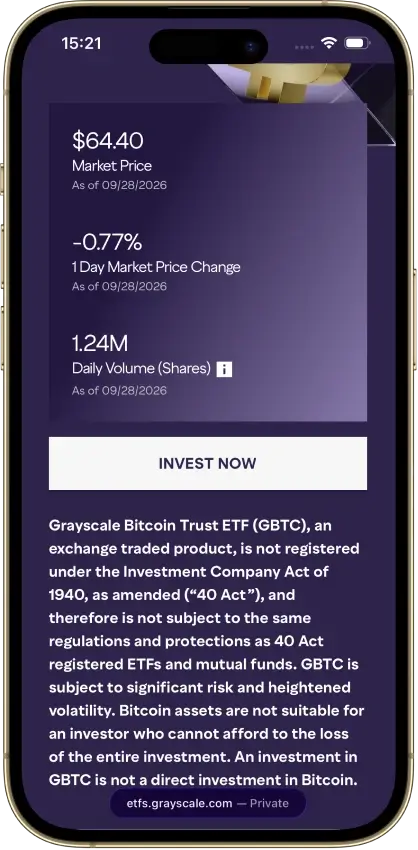
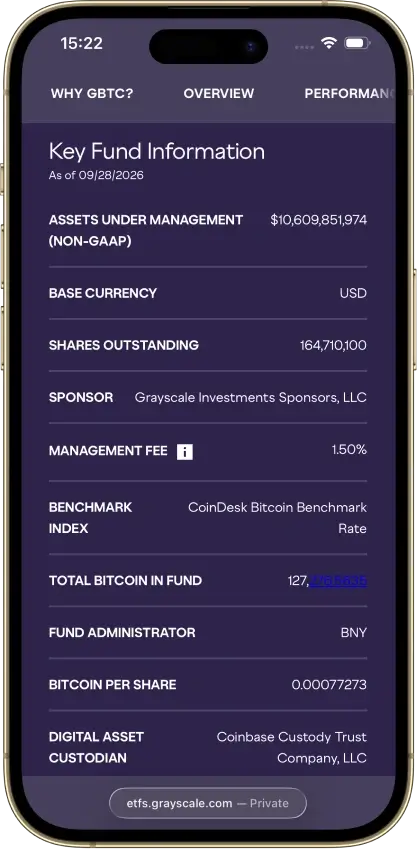
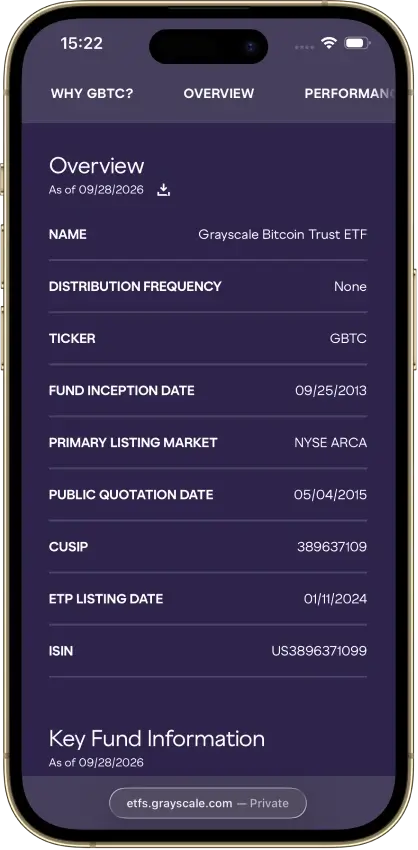
Screenshot 1 of 8
Grayscale Bitcoin Trust Pros and Cons
Pros
- Brokerage access without managing Bitcoin keys
- Published fund financial statements
- Direct Bitcoin holdings within the trust
Cons
- Higher annual rate than BTC and IBIT
- Fund expenses erode coin backing per share
- Shares cannot fund a Bitcoin wallet directly
Who GBTC Is For
GBTC deserves attention from investors who already hold it and want to reassess the ongoing cost. A familiar ticker can remain in an account long after competing products become available. Reviewing that position starts with the annual charge and the alternatives the account can actually buy.
A new investor has less reason to treat GBTC as the default. Grayscale’s separate Bitcoin Mini Trust ETF, ticker BTC, charges 0.15% annually, while BlackRock’s IBIT charges 0.25%. GBTC’s 1.50% rate means a substantially higher annual fund charge for exposure to the same underlying asset.
The fund can suit an investor who wants a security held alongside other brokerage investments and accepts that cost. Someone seeking transferable Bitcoin for use outside a brokerage account needs to consider direct ownership instead.
CryptoSlate Rating
GBTC scores 7.4/10 under CryptoSlate’s Bitcoin ETF methodology, version 2.1. This assessment uses public fund terms and reported market indicators, with a September 24, 2026 data cutoff.
| Pillar | Weight | Score | Assessment |
|---|---|---|---|
| Costs | 30% | 1.7/10 | Ongoing charge 1.50%, currently effective at the same rate. The fee amount carries 25% of the overall and fee clarity another 5%. |
| Published spread indicator | 25% | 9.6/10 | Published 30-day median: 0.02%, dated Sep. 24, 2026. |
| Fund scale | 10% | 10.0/10 | $10,741.95 million in reported fund assets, dated Sep. 24, 2026. Additional size earns no points above $1 billion. |
| Custody terms | 20% | 10.0/10 | Fund ownership and account entitlement are recorded separately. Ordinary negligence supports a claim under the assessed safekeeping terms. |
| Reporting | 15% | 10.0/10 | Current required reports and product disclosures are available. Management reported effective disclosure controls at June 30, 2026. |
GBTC’s 1.50% ongoing charge receives zero in the fee-amount component, which carries 25% of the overall. The 0.02% spread, fund scale and documented ownership and negligence-based custody responsibility earn separate credit. Coinbase’s setoff clause refers to Sponsor Assets as defined in its Settlement and Transfer Agreement, but that definition is absent from the publicly filed terms, leaving the scope unclear. That ambiguity and Anchorage’s recovery limits remain relevant even with a top grade for the two scored custody protections.
Moving the selected spread by 0.01 percentage point in either direction gives an overall range of 7.4–7.5/10. This is a calculation sensitivity, not a forecast or confidence interval.
Custody points compare ownership and responsibility thresholds across all appointed Bitcoin custodians. Lien reach, recovery caps and insurance remain disclosed limitations outside the numeric score. The overall is calculated from unrounded components, and a high grade does not make Bitcoin low risk. Private control testing and tracking are excluded for the whole cohort. Ratings from earlier methodology versions are not directly comparable.
What GBTC Is and How It Works
GBTC holds Bitcoin in a trust. Shareholders own a proportional interest in the trust’s net assets, whose value changes with Bitcoin’s price and the expenses charged to the fund. The trust’s holdings provide spot exposure without using futures contracts.
The 2013 Trust and the 2024 ETF Listing
Operations began on September 25, 2013. The January 11, 2024 NYSE Arca uplisting marks a later stage in GBTC’s history. These dates describe different events, so a profile showing a 2013 inception does not conflict with a 2024 ETF launch date.
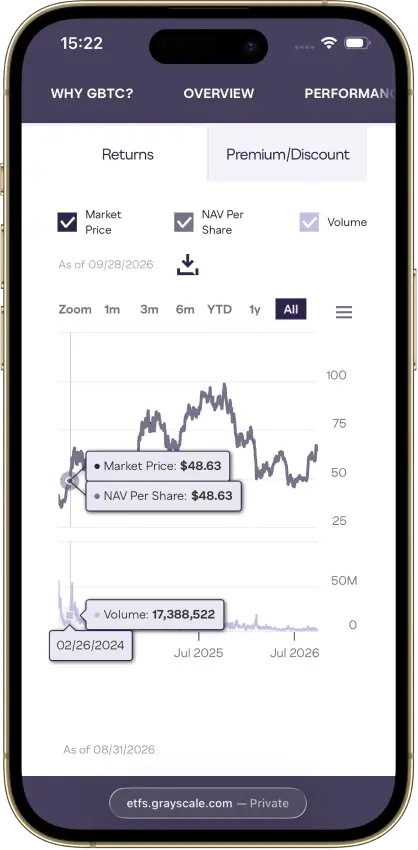
A chart beginning in 2013 covers years before GBTC’s current exchange listing. Fund age alone cannot tell an investor what spread is available on a current order or whether another Bitcoin ETF offers better execution.
Grayscale also created the separate Bitcoin Mini Trust ETF through a GBTC spin-off in 2024. The two tickers now identify different securities with different annual charges. Buying GBTC today does not buy a position in the cheaper BTC fund.
Benchmark and Tracking Comparisons
GBTC currently uses the CoinDesk Bitcoin Benchmark Rate for its net asset value, or NAV. The price at which an investor can buy or sell shares is set in the market and can differ from NAV. The benchmark changed from the CoinDesk Bitcoin Price Index (XBX) on April 1, 2026. Comparisons spanning that date must account for the change in reference series.
A meaningful tracking comparison uses the same observation period and distinguishes changes in NAV from changes in traded share prices.
Is GBTC Safe? Custody and Investment Risks
GBTC remains exposed to sharp Bitcoin price falls. Its age does not protect an investor’s capital, and a regulated listing does not make the underlying asset stable. A loss of access to the trust’s Bitcoin could also harm shareholders independently of a market decline.
Who Holds GBTC’s Bitcoin?
Coinbase is the primary Bitcoin custodian and Anchorage Digital is an additional provider. Grayscale’s product page says the additional custodian holds a portion of the assets, without specifying the amount. That disclosure does not establish an equal split or a measured reduction in custody risk.
Custody agreements limit liability and do not assure full recovery if assets are lost.
The fund arrangement removes the shareholder’s need to store the private keys that authorize coin transfers. Responsibility for safeguarding the assets sits within the trust’s service arrangements. Investors still bear the consequences if those arrangements fail.
A brokerage statement confirms a shareholding. It does not give that shareholder access to the trust’s wallets or the ability to move the underlying coins.
Fund Structure and Regulatory Status
GBTC is a Delaware statutory trust and is not registered as an investment company under the Investment Company Act of 1940. That limits the statutory fund protections an investor can expect.
Securities offering and reporting requirements still apply, along with antifraud rules. The public filings let investors examine the fund’s arrangements and financial reports. Disclosure requirements offer no assurance against asset losses or a falling share price.
GBTC Fees and Trading Costs
GBTC’s annual sponsor fee is 1.50%. This recurring charge is paid from trust assets and is separate from costs arising when an investor places a trade.
How Much the Annual Fee Difference Adds Up To
At a constant $10,000 holding value, GBTC’s 1.50% rate corresponds to $150 over a year. The equivalent figures are $25 for IBIT and $15 for BTC. GBTC therefore costs $125 more than IBIT and $135 more than BTC in this illustration of annual fund charges.
Actual amounts change with the holding’s value. The calculation excludes trading costs and taxes, and it is not an estimate of what a particular investor would save by switching. Existing holders need to assess the consequences of selling as well as the charge on a replacement fund.
Fund expenses consume some of the Bitcoin supporting each share. That reduction can occur even while the share price rises because Bitcoin has gained value. A positive investment return does not mean the annual fee had no effect.
Buying and Selling GBTC
Confirm both the GBTC ticker and the full Grayscale Bitcoin Trust ETF name before placing an order. The similar BTC ticker belongs to the separate Mini Trust. Availability varies by broker and account, so a fund appearing in a public comparison does not establish that you can trade it.
Compare the Exposure, Not Just the Share Price
The dollar price of one share is not a measure of a fund’s annual cost. Different funds can divide their Bitcoin holdings into different numbers of shares. A lower share price does not by itself buy more Bitcoin exposure for the same investment.
Read the current quote alongside the time attached to the latest NAV. A premium is a market price above NAV, while a discount is a price below it. An old NAV and a fresh quote do not describe the same market moment.
Selling Shares and Receiving Proceeds
An ordinary investor exits GBTC by selling shares through a broker and receiving cash proceeds. Direct dealings with the trust use share baskets and are reserved for authorized participants. Retail ownership does not provide a right to exchange individual shares for Bitcoin.
For an investor whose eventual goal is a personally controlled Bitcoin wallet, the sale proceeds would still need to fund a separate coin purchase. That extra transaction belongs in the decision about which form of Bitcoin exposure to hold.
GBTC Alternatives
The nearest comparison by fund family is BTC, while IBIT provides a separate issuer choice. Both have much lower annual sponsor rates than GBTC. The comparison below concerns fund terms and does not rank current spreads or realized returns.
GBTC vs IBIT and BTC
| Feature | GBTC | IBIT | BTC |
|---|---|---|---|
| Fund family | Grayscale | BlackRock / iShares | Grayscale |
| US listing | NYSE Arca | Nasdaq | NYSE Arca |
| Annual sponsor rate | 1.50% | 0.25% | 0.15% |
| Underlying exposure | Spot Bitcoin | Spot Bitcoin | Spot Bitcoin |
BTC is the more useful starting comparison for someone who wants to retain a Grayscale fund while reducing the annual rate. IBIT broadens the provider comparison. Neither choice makes Bitcoin exposure suitable for someone unwilling to accept large price declines.
Holding both GBTC and BTC leaves both positions dependent on Bitcoin. The underlying asset exposure remains concentrated even though the account shows two fund names.
References
The rating and supporting public terms were reviewed on Sep. 25, 2026, using methodology version 2.1 and a Sep. 24 data cutoff. The reporting review includes the quarter ended June 30, 2026. Scores are due for a monthly refresh and expire for current recommendation use after Nov. 8, 2026 unless reviewed again.
Research checked Sep. 25, 2026 using Grayscale’s fund information and filings, NYSE’s listing notice, and investor guidance from the SEC and FINRA.
Terms may change after the research date. Readers can report a correction to CryptoSlate if a detail needs attention.
The assessment provides general editorial information without a recommendation based on personal financial circumstances.
Bitcoin ETFs Pillar Scores
- Fund fees 30% weight Ongoing sponsor charge before temporary waivers, fee basis, covered expenses, extra fund costs, and waiver terms.Not disclosed
- Trading spread 25% weight Published 30-day median bid-ask spread, with its source, observation date, and calculation definition recorded.Not disclosed
- Fund size 10% weight Assets attributable to the fund, using a dated figure and a clearly identified asset-value basis.10.0 / 10
- Custody & asset rights 20% weight Fund ownership, separate asset records, and the custodian's contractual responsibility for its own safekeeping failures.10.0 / 10
- Reporting & transparency 15% weight Required reports, public holdings, valuation benchmark, net asset value (NAV), and management's disclosure-control conclusions.10.0 / 10
Final Verdict
GBTC provides Bitcoin exposure through an established trust with NYSE Arca trading, but its 1.50% annual sponsor rate is difficult to justify on cost grounds against BTC at 0.15% or IBIT at 0.25%. The longer history helps explain why investors may already hold it. It does not establish an advantage for a new allocation. Existing holders should compare the recurring charge with the implications of changing their position. New investors should give the lower-cost alternatives serious consideration before choosing GBTC. All three remain speculative Bitcoin investments, and GBTC gives an ordinary shareholder no coins to spend or withdraw.
Best For
Investors retaining an existing GBTC position after comparing the ongoing fee and the consequences of a sale.
Avoid If
- A low annual fund charge is your priority or you need Bitcoin that you can transfer yourself.
Disclaimer: CryptoSlate may receive a commission when you click links on our site and make a purchase or complete an action with a third party. This does not influence our editorial independence, reviews, or ratings, and we always aim to provide accurate, transparent information to our readers.