



- Invesco and Galaxy fund partnership
- Lukka principal-market Bitcoin pricing
- Coinbase appointed for Bitcoin custody
Invesco Galaxy Bitcoin ETF Overview
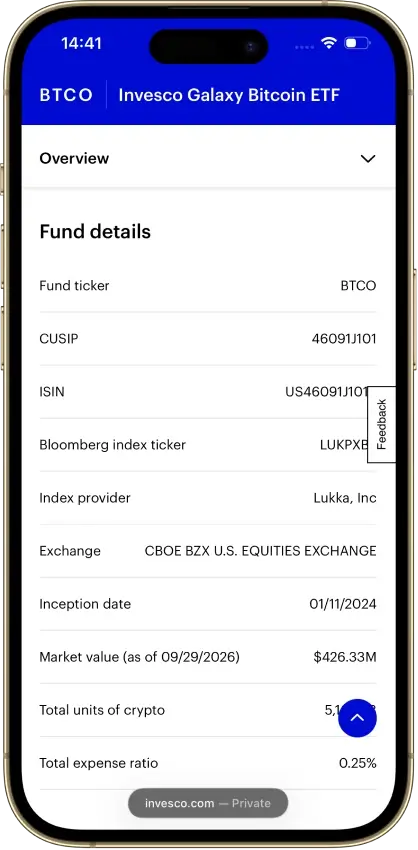
- Fund Name
- Invesco Galaxy Bitcoin ETF
- Ticker
- BTCO
- Listing Exchange
- Cboe BZX
- Fund Family / Issuer
- Invesco / Galaxy
- Underlying Asset
- Bitcoin
Additional details
- Exposure
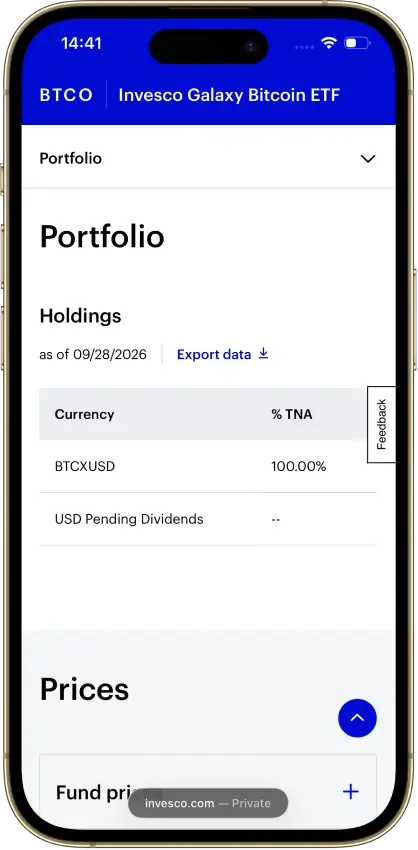
- Spot Bitcoin held by the trust.
- Fund Structure
- Exchange-traded commodity trust, not registered as an investment company under the Investment Company Act of 1940.
- Annual sponsor fee
- 0.25%
- Fee Assessment Base
- Daily total net assets.
- Effective Annual Charge
- 0.25%
- Fee Terms Checked
- Sep 13, 2026
- Benchmark
- Lukka Prime Bitcoin Reference Rate
- Custody Appointments
- Coinbase Custody Trust Company, LLC; Bitcoin custodian; The fund’s Coinbase agreement permits negligence-based custody claims, with segregated account entitlement. Liability caps and trade-credit security rights can limit the fund’s recovery.
- Retail Asset Redemption
- Individual shares cannot be redeemed for Bitcoin delivered to your wallet. Shareholders exit by selling through a broker; authorized participants use a separate creation and redemption process.
- 30-day Median Bid/Ask Spread
- 0.06%As of Sep 11, 2026Invesco, issuer; Median bid/ask spread; Issuer describes NBBO midpoint percentage sampled every ten seconds over 30 calendar days.; Retrieved Sep 11, 2026
- Fund Assets
- USD 394,160,000As of Sep 11, 2026
Issuer fund market value
- Issuer-reported inception
- Jan. 11, 2024, exchange launch. Initial seeding occurred Dec. 20, 2023
- First exchange trading
- Jan. 11, 2024
- Quarterly report reviewed
- Quarter ended June 30, 2026
- Operating-period annual audit reviewed
- Year ended Dec. 31, 2025
- Rating reviewed
- Sep. 14, 2026, CryptoSlate methodology version 2.1, data cutoff Sep. 11
Invesco Galaxy Bitcoin ETF Screenshots
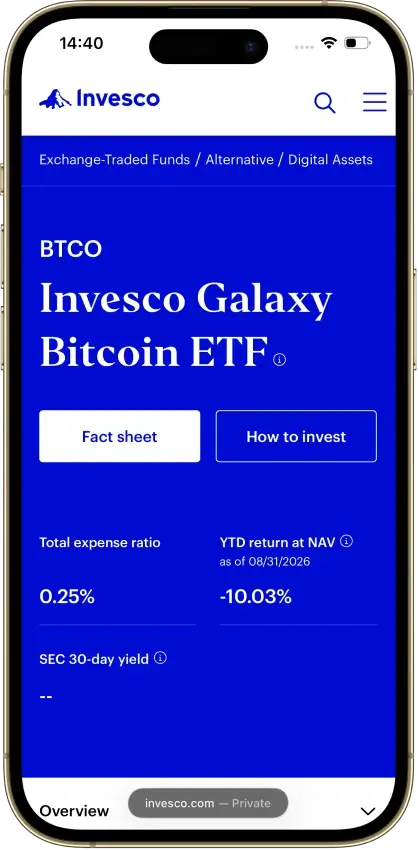
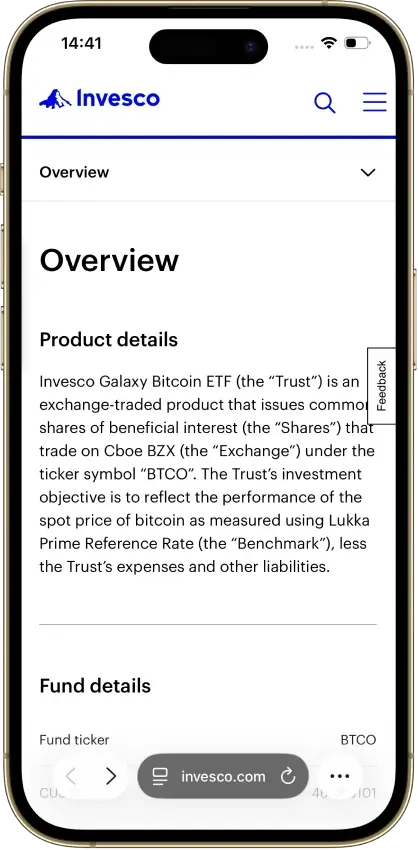
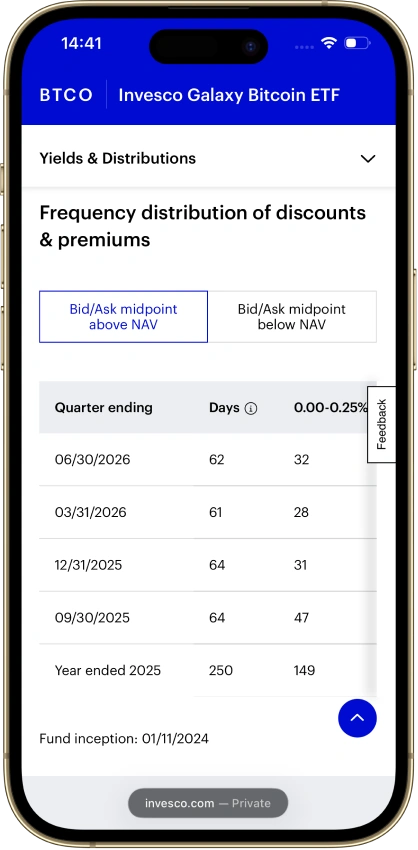
Screenshot 1 of 8
Invesco Galaxy Bitcoin ETF Pros and Cons
Pros
- Hold Bitcoin exposure in a securities account
- Fund arranges third-party Bitcoin custody
- Bitcoin backing avoids a futures strategy
Cons
- Sponsor charge reduces returns over time
- Shares cannot be exchanged for personal coins
- Brokerage availability depends on the account
Who BTCO Is For
BTCO suits investors adding Bitcoin price exposure to a securities portfolio. Someone comparing funds from familiar asset managers can assess the Invesco and Galaxy partnership alongside the fee and valuation method. The fund name alone gives no reason to expect better returns.
The practical benefit is avoiding a separate process for purchasing and safeguarding coins. If your broker supports BTCO, the position can sit beside the securities you already hold.
Owning BTCO also means accepting Bitcoin’s market risk. Holding another fund that owns the same asset would not diversify that underlying exposure. BTCO is unsuitable for money whose value you need to keep stable.
CryptoSlate Rating
BTCO scores 8.7/10 based on its costs, 30-day median spread, custody terms, reporting and fund size.
| Pillar | Weight | Score | Assessment |
|---|---|---|---|
| Costs | 30% | 7.9/10 | BTCO charges a 0.25% annual sponsor fee, with the rate and covered expenses explained in fund documents. |
| Published spread indicator | 25% | 8.8/10 | Invesco’s 30-day median bid-ask spread was 0.06% as of Sep. 11, 2026. |
| Fund scale | 10% | 6.0/10 | Invesco reported $394.16 million in fund assets as of Sep. 11, 2026. |
| Custody terms | 20% | 10.0/10 | Fund ownership and account entitlement are recorded separately. Ordinary negligence supports a claim under the assessed safekeeping terms. |
| Reporting | 15% | 10.0/10 | Current required reports, holdings and valuation disclosures are public. Management reported effective disclosure controls as of June 30, 2026. |
BTCO’s reported assets fall between $100 million and $500 million. Its 0.25% fee and 0.06% spread reduce their respective component scores continuously. The Coinbase agreement for this fund permits negligence-based custody claims, with segregated account entitlement. That contractual threshold earns credit even though liability caps and trade-credit security rights can limit the fund’s recovery.
Moving the selected spread by 0.01 percentage point in either direction gives an overall range of 8.6–8.7/10. This is a calculation sensitivity, not a forecast or confidence interval. Fidelity’s alternative 0.09% figure would give 8.5/10. The 8.7/10 rating uses Invesco’s 0.06% figure and the September 11, 2026 assessment cutoff.
Custody points compare ownership and responsibility thresholds across all appointed Bitcoin custodians. Lien reach, recovery caps and insurance remain disclosed limitations outside the numeric score. The overall is calculated from unrounded components, and a high grade does not make Bitcoin low risk.
What BTCO Is and How It Works
The BTCO trust owns Bitcoin and issues shares representing interests in its assets. It aims to reflect the asset’s spot price, measured by its benchmark, after expenses and liabilities. It does not use a Bitcoin futures strategy.
The investor owns the security in a brokerage account. That gives exposure to the value of the trust’s holdings without a personal Bitcoin balance the shareholder can send to a wallet.
Benchmark and Tracking Comparisons
BTCO uses the Lukka Prime Bitcoin Reference Rate. Lukka selects a principal market from eligible exchanges. The method takes an exit price from that market, without averaging prices across exchanges.
Bitcoin prices can differ by venue and observation time. A broker’s share quote, BTCO’s net asset value and a Bitcoin price feed may therefore show different figures. To compare BTCO’s performance with its benchmark, use returns measured over the same period.
Is BTCO Safe? Custody and Investment Risks
BTCO remains exposed to sharp Bitcoin price declines. Professional custody removes the shareholder’s storage task, but it does not make the underlying investment stable or guarantee recovery from an operational failure.
Who Holds BTCO’s Bitcoin?
Coinbase Custody Trust Company, LLC is the fund’s named Bitcoin custodian. This is a service arrangement for the trust. Buying BTCO does not open a personal Coinbase account or give the shareholder access to its custody systems.
You rely on the fund’s providers to safeguard its Bitcoin. The prospectus says bitcoin in the custody vault is held in segregated wallets, while bitcoin temporarily in the prime broker’s trading balance can be held in omnibus accounts. Outsourcing storage comes with the risk of loss or disruption if those systems fail. Investors who want to manage their own Bitcoin private keys need a different ownership arrangement.
Fund Structure and Regulatory Status
BTCO’s legal structure is an exchange-traded commodity trust, although its name uses ETF. It operates outside investment-company registration under the Investment Company Act of 1940. Investors should not assume it has every protection that applies to a conventional stock or bond ETF.
The offering and the listed securities are still subject to securities laws. A listed fund can comply with its reporting obligations and still lose value.
BTCO Fees and Trading Costs
The annual sponsor rate is 0.25%. Invesco’s fund material and Schwab’s fund data also report a 0.25% expense ratio. Both figures describe the ongoing fund charge only.
For scale, 0.25% of an unchanged $8,000 investment is $20 over a year. This illustration excludes trading costs and assumes a constant value. Actual costs vary as the holding’s value changes, so $20 is not a fixed annual bill for an $8,000 purchase.
Comparing the Cost of a Trade
Check the live bid and ask for the trade you intend to make. A small difference in annual fund rates can be outweighed by transaction costs, especially over a short holding period. A commission-free brokerage order can still involve a spread.
Buying and Selling BTCO
Confirm the full name, Invesco Galaxy Bitcoin ETF, and its US Cboe BZX listing in your brokerage search. Then check whether your particular account can hold it and which trading sessions and order types the broker supports.
Understanding the Quoted Price
Net asset value (NAV) measures what the trust owns after subtracting liabilities, divided by the number of shares. BTCO’s exchange price can sit above NAV at a premium or below it at a discount.
Pay attention to timestamps when comparing those figures. A prior valuation and a newer market quote may reflect different Bitcoin prices. The benchmark is a valuation input, not a promise that your order will execute at that price.
Leaving the Position
An ordinary shareholder exits by selling BTCO shares through a broker. Direct creation and redemption with the trust are reserved for authorized participants, financial firms operating under agreements with the fund. Those arrangements do not provide a retail route to withdraw Bitcoin.
If you later want coins for payments or personal storage, you would need to sell BTCO and buy Bitcoin in separate transactions. A service that permits withdrawals to a wallet you control would be relevant to that different use.
BTCO Alternatives
IBIT and FBTC provide useful comparisons because all three funds charge a 0.25% annual sponsor rate. Their named benchmarks and fund relationships differ. None lets an ordinary shareholder redeem individual shares for spendable Bitcoin.
BTCO vs IBIT and FBTC
| Feature | BTCO | IBIT | FBTC |
|---|---|---|---|
| Fund family | Invesco / Galaxy | BlackRock / iShares | Fidelity |
| US listing | Cboe BZX | Nasdaq | Cboe BZX |
| Annual sponsor fee | 0.25% | 0.25% | 0.25% |
| Bitcoin benchmark | Lukka Prime Bitcoin Reference Rate | CME CF Bitcoin Reference Rate – New York Variant | Fidelity Bitcoin Reference Rate |
Equal sponsor rates leave no fee saving from choosing BTCO over these two peers. Their benchmarks differ; fund size, bid-ask spread, custody terms and the cost of the actual trade also shape the choice.
Buying Bitcoin directly is a separate alternative for someone who wants transferable coins. It brings its own purchasing and storage responsibilities, including the need to choose how the keys are held.
References
Market figures in this review are as of Sep. 11, 2026. The reporting discussion also draws on the quarter ended June 30, 2026.
Sources include the BTCO prospectus, June 2026 quarterly report, 2025 annual report, Invesco fund page, and Lukka benchmark explanation.
For corrections, contact CryptoSlate.
This review is general information and does not provide personal investment advice.
Bitcoin ETFs Pillar Scores
- Fund fees 30% weight Ongoing sponsor charge before temporary waivers, fee basis, covered expenses, extra fund costs, and waiver terms.Not disclosed
- Trading spread 25% weight Published 30-day median bid-ask spread, with its source, observation date, and calculation definition recorded.Not disclosed
- Fund size 10% weight Assets attributable to the fund, using a dated figure and a clearly identified asset-value basis.6.0 / 10
- Custody & asset rights 20% weight Fund ownership, separate asset records, and the custodian's contractual responsibility for its own safekeeping failures.10.0 / 10
- Reporting & transparency 15% weight Required reports, public holdings, valuation benchmark, net asset value (NAV), and management's disclosure-control conclusions.10.0 / 10
Final Verdict
BTCO is worth comparing when you want an Invesco and Galaxy fund for Bitcoin exposure through a broker. The trust holds the asset, Coinbase provides Bitcoin custody, and the Lukka reference rate supplies its valuation benchmark. These features give investors specific arrangements to evaluate without having to manage coins themselves. Its 0.25% annual sponsor fee matches IBIT and FBTC, so the decision needs more than a fee comparison. Account access and trading costs matter, while Bitcoin price risk remains substantial. Investors seeking spendable coins or personal custody should look beyond BTCO shares.
Best For
Investors comparing an Invesco and Galaxy spot Bitcoin fund with other funds available through their broker.
Avoid If
- You need spendable Bitcoin, control of its storage, or an investment intended to preserve capital.
Disclaimer: CryptoSlate may receive a commission when you click links on our site and make a purchase or complete an action with a third party. This does not influence our editorial independence, reviews, or ratings, and we always aim to provide accurate, transparent information to our readers.