
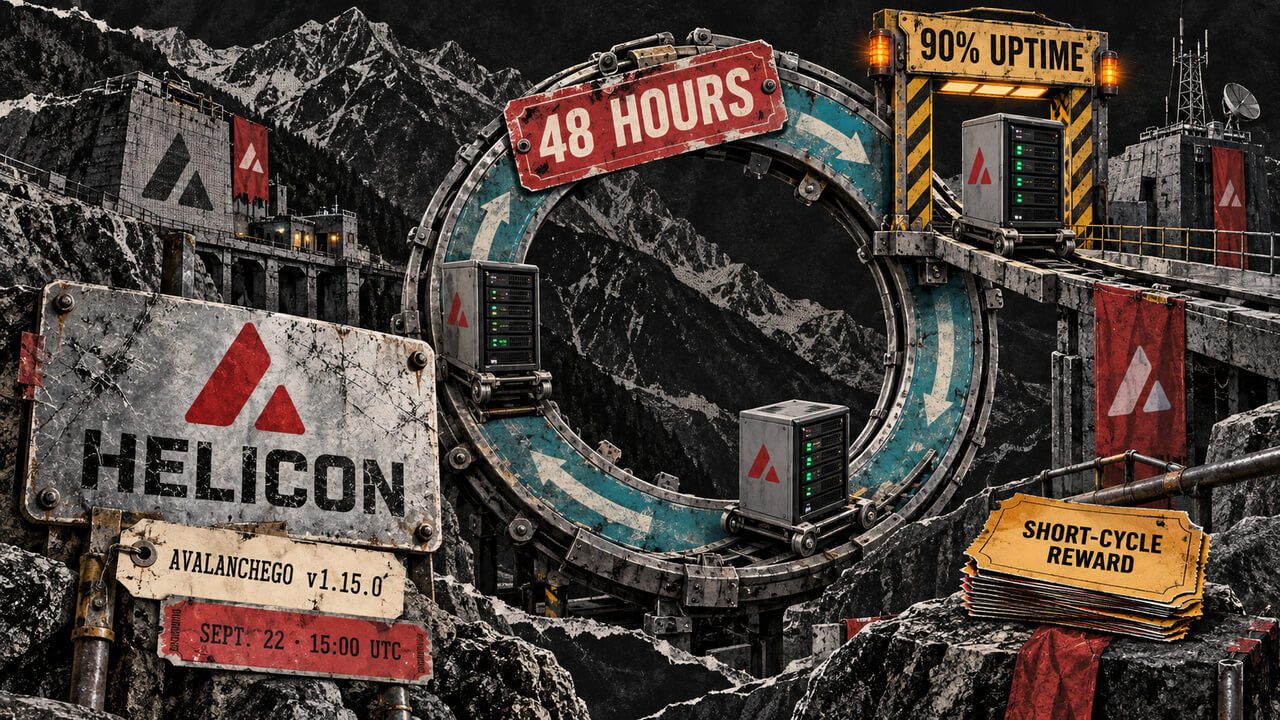

Quick Take
- Helicon cuts validator commitments to 48 hours, adds auto-renewal, and activates Sept. 22.
- Shorter cycles improve flexibility, but new periods need 90% uptime to earn rewards and renew.
- Short cycles bring lower modeled returns, while missed uptime ends renewal and loses rewards.


Avalanche’s Helicon upgrade is scheduled to give validators shorter, auto-renewing commitments while raising the uptime cutoff for rewards and reducing returns at the shortest durations.
The network upgrade is set to activate on Avalanche Mainnet on Sept. 22 at 15:00 UTC. Validators must install AvalancheGo v1.15.0 beforehand to remain compatible with the upgraded chain.
What changes for validators
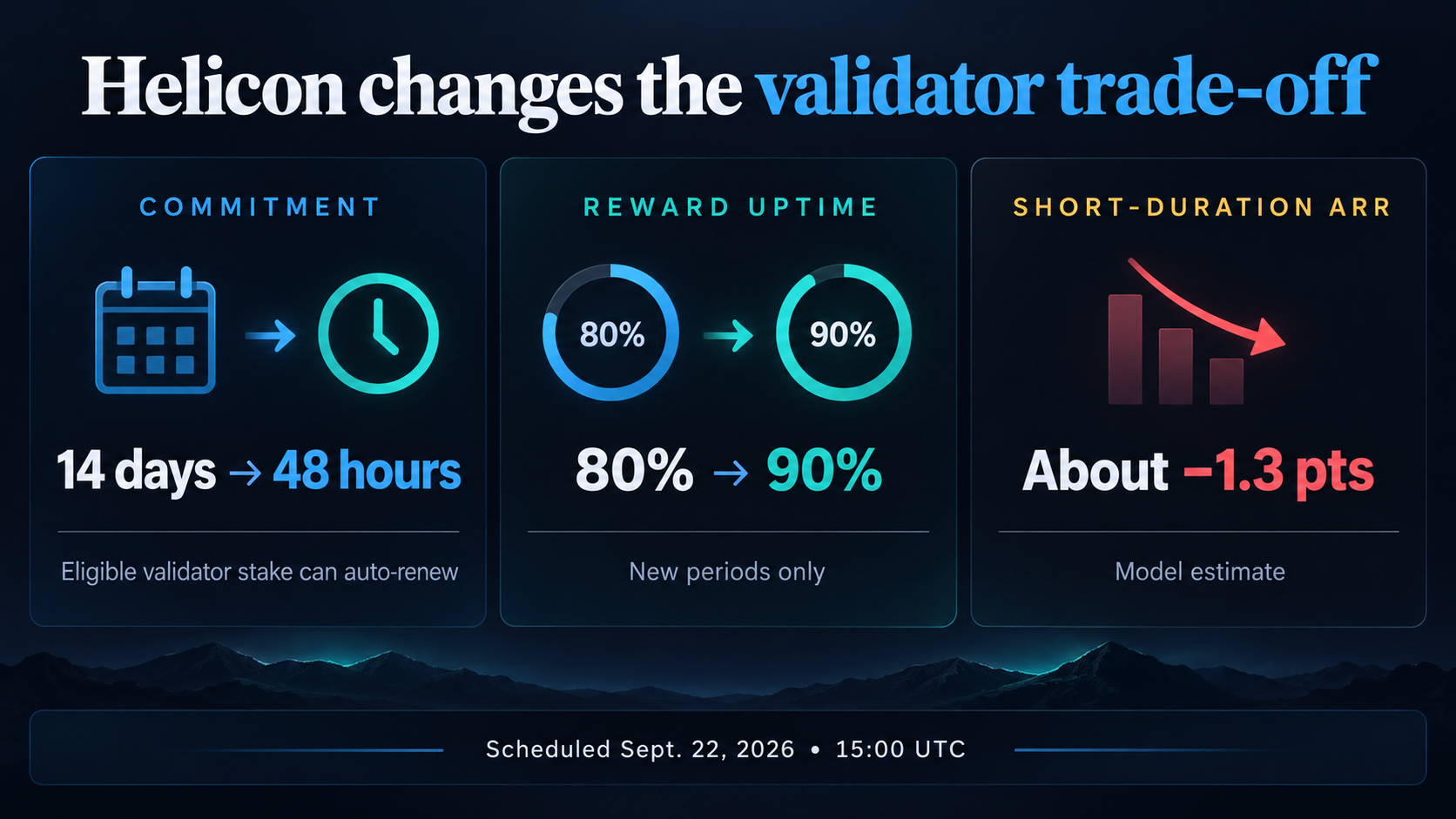
Helicon will cut the minimum Primary Network validation period from 336 hours to 48 hours. It will also let eligible validators automatically begin another cycle when the current one ends, reducing manual signing work and potential reward gaps from repeatedly leaving and rejoining the validator set.
Operators can choose how much of each cycle’s reward to compound into the next one and can update the configuration for a future cycle. That creates a way to combine brief capital commitments with continuous validation, instead of choosing between a long lockup and repeated manual restaking.
The feature applies only to the validator’s own stake. Delegations will not auto-renew, and each delegation must fit inside one validator cycle because the validator is not guaranteed to continue beyond that boundary.
Validation periods that start on or after Helicon activation must achieve at least 90% uptime to earn rewards, up from 80%. The rule is not retroactive: periods that began before activation remain subject to the existing 80% requirement even if they extend beyond Sept. 22.
Avalanche's uptime measurement will not change, and rewards will remain all or nothing. Falling below the applicable threshold forfeits the full reward for that period, though the validator’s principal is not slashed.
For a validator using auto-renewal, missing the threshold has an additional consequence. The position will not roll into another cycle, and the validator will exit. Its principal and rewards accrued in earlier cycles are returned, but the failed cycle’s reward is lost.
Short cycles reduce how long capital is committed, while the higher threshold raises the operational reliability required to collect each cycle’s reward and continue automatically. For operators, that links continuity to cycle-by-cycle performance without changing how Avalanche measures peer responsiveness or adding a partial-reward buffer.
How short-duration Avalanche rewards change
Helicon will also begin a 90-day adjustment to Avalanche’s reward curve. The protocol’s minimum consumption rate, an input that helps determine staking rewards, is scheduled to decline linearly from 10% to 7.5%. The maximum rate at the one-year duration will remain unchanged.
Avalanche’s modeling estimates that this adjustment will reduce the annualized reward rate at the shortest duration by about 1.3% after the phase-in. The exact realized yield will remain variable because it depends on factors including AVAX supply, duration, and compounding choices.
The same modeling projects annual AVAX inflation falling by roughly 0.5% to 1% and the stake-weighted average duration increasing by about two months. Those outcomes are estimates depending on how validators and delegators respond.
The mechanical trade-off is more certain: Helicon makes short, renewable validator commitments easier to use, but sets a lower reward at the short end while preserving the one-year rate and demands more reliable uptime for new validation periods.

Avalanche is +5.09% over the past 24 hours and currently sits at rank #26 by market cap.
Mentioned in this article
Editorial credits