
Quick Take
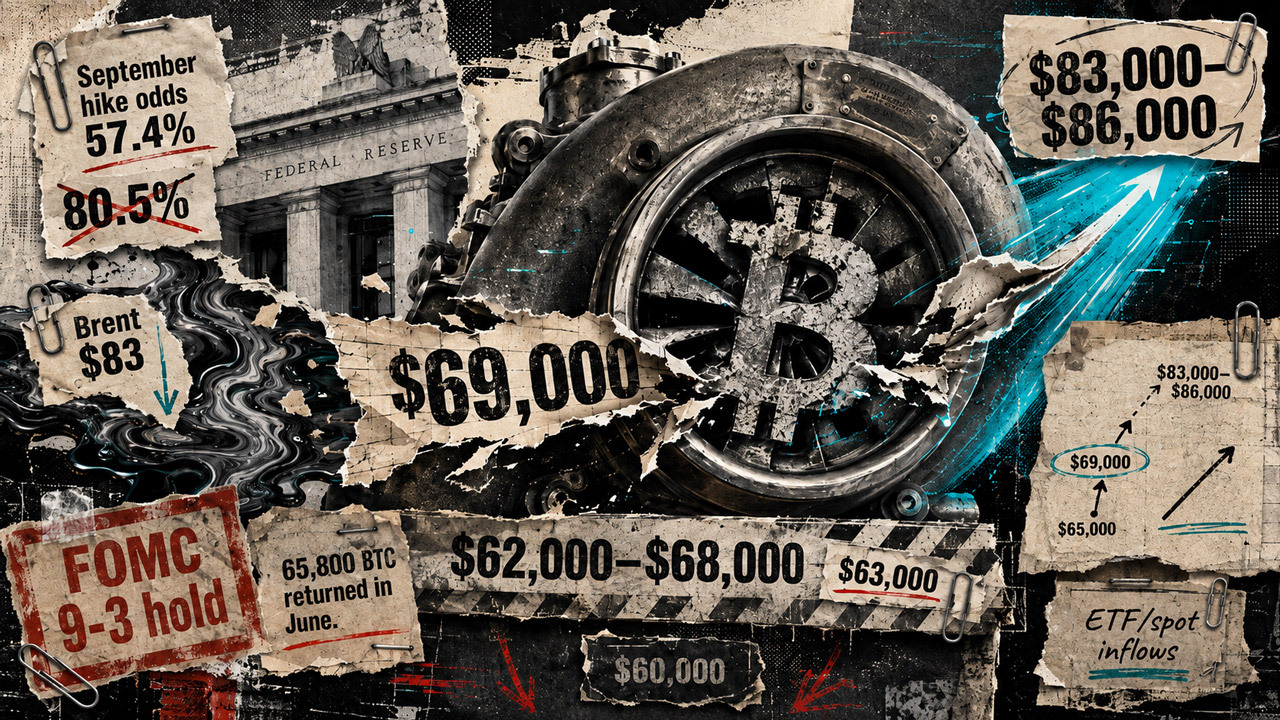
- Bitcoin is still trapped between $62,000 and $68,000, with $69,000 marked as the key breakout level.
- A reclaim there, backed by spot inflows, could open a thinner supply zone toward $83,000 to $86,000.
- Friday's jobs report and oil moves may shift rate odds, but BTC still lacks the buyers needed to confirm the move.


A Bitcoin breakout attempt briefly pushed price above $65,000 on Aug. 5, but failed to sustain the move, even as Fed funds futures put the odds of a September rate hike at 57.4% as of Aug. 5, down from 80.5% a week earlier.
Brent crude fell more than 5% on Aug. 4, settling near $79 on hopes of a Hormuz de-escalation deal.
Lower hike odds and cheaper oil usually ease two of the macro pressures that have capped crypto all year. Bitcoin has held inside the same $62,000 to $68,000 range for weeks, and Friday's July jobs report is the market's next chance to settle the question.
A hike is still the base case, barely
A week earlier, futures assigned 22.9% odds to a half-point September hike, 57.6% to a quarter-point hike and just 19.5% to a hold, for combined hike odds of 80.5%.
The half-point scenario has since disappeared entirely, and hike odds have fallen to 57.4%. A hike remains the base case, though it is no longer the near-certainty it was a week ago.
The FOMC held its target at 3.50% to 3.75% by a 9-3 vote, with three officials pushing for an immediate quarter-point hike. The statement called growth solid and inflation elevated.
Manufacturing accelerated to 55.6 in July, its strongest reading since May 2022. Production jumped to 58.5, factory employment expanded for the first time in 33 months, and input prices held elevated at 71.1.
Services activity stayed healthy at 54.1, with new orders climbing to 57.2, but the employment component fell into contraction at 47.4 while prices reached 70.3.
JOLTS data showed a slowly easing labor market, with openings near 7.4 million, hires near 5.3 million, and layoffs holding steady.
June's headline PCE fell 0.1% month over month, and core PCE rose just 0.1%, though annual rates stayed well above target at 3.7% and 3.3%.
| Signal | Latest reading | What it tells the Fed | Bitcoin implication |
|---|---|---|---|
| September hike odds | 57.4%, down from 80.5% | Traders cut tightening conviction | Macro pressure eased, but not enough |
| FOMC vote | 9-3 hold | Three officials wanted a hike now | Fed is still hawkish under the surface |
| Manufacturing PMI | 55.6 | Growth is accelerating | Harder to justify a clean pause |
| Manufacturing prices | 71.1 | Input inflation remains elevated | Keeps rate-risk alive |
| Services PMI | 54.1 | Demand remains healthy | Economy is not clearly slowing |
| Services prices | 70.3 | Cost pressure remains sticky | Inflation risk has not disappeared |
| JOLTS openings | ~7.4 million | Labor is cooling slowly | Not weak enough by itself |
| Core PCE | +0.1% m/m, 3.3% y/y | Monthly relief, annual pressure | Helpful, but not decisive |
Friday's jobs report and the oil situation
The July Employment Situation lands Friday at 8:30 a.m. ET, and economists expect roughly 80,000 new jobs, up from June's 57,000, with unemployment holding near 4.2%.
A Bitcoin breakout would be most credible after a Goldilocks print: moderate hiring, softer wage growth, stable unemployment, and no sharp upward revisions to prior months.
A hot report with strong wage growth would rebuild the case for a September hike and hurt Bitcoin's setup, while a weak report carries its own risk.
If payrolls collapse enough to eliminate the odds of a hike, Bitcoin could rally briefly as yields fall, then give those gains back once the same weak data starts to read as a growth shock.
Brent settled near $83 on Aug. 5, as traders priced progress toward a deal easing tension around the Strait of Hormuz. Iran has denied that direct US talks are underway, and the physical picture on the water has barely moved.
Only eight vessels transited Hormuz on Aug. 4, compared with roughly 130 to 140 daily transits before the war began.
A real reopening would ease energy inflation, give Treasury yields room to fall and remove one argument for another Fed hike. A collapse in the talks could send oil's war premium right back into the price, and with it, the case for tightening.
| Catalyst | Bullish version for BTC | Bearish version for BTC | Why it matters |
|---|---|---|---|
| Payrolls | Moderate job growth near expectations | Hiring beats strongly | Hot labor rebuilds hike odds |
| Wages | Softer wage growth | Wage growth accelerates | Wage inflation keeps Fed pressure alive |
| Unemployment | Stable near 4.2% | Sharp jump or surprise decline | Too weak can signal recession; too strong supports hikes |
| Prior revisions | No major upward revisions | Prior months revised higher | Stronger labor trend reopens tightening risk |
| Hormuz traffic | Vessel flows normalize | Traffic remains far below pre-war levels | Energy inflation risk stays alive |
| Oil price | Brent holds near current levels or falls | War premium returns | Oil feeds inflation expectations |
| Treasury yields | 10-year falls below 4.45% | 10-year stays near 4.6% or rises | Bitcoin needs bond-market confirmation |
| ETF flows | Inflows return | Outflows continue | Macro relief needs actual buyers |
The important levels
Glassnode's latest weekly report describes Bitcoin as the asset that sat out this week's broader rally. Stocks and gold hit record highs, oil fell sharply, and BTC stayed essentially flat, trailing the S&P 500 by more than 4% in Glassnode's own comparison.
The firm's Seller Exhaustion Constant has moved into the region associated with past market bottoms, but it remains roughly 33% above the floor reached in every prior bear market in Glassnode's sample.
US-traded spot Bitcoin ETFs returned about 65,800 BTC in June, their worst month in Glassnode's dataset, and corporate treasury buying fell short of offsetting it.
Options show upside implied volatility has fallen near 23%, the lowest level in Glassnode's series, meaning traders have stopped paying up for upside bets.
Similar volatility compressions have historically broken upward, and almost every past instance had real ETF and spot demand already running underneath it, the ingredient this setup still lacks.
Glassnode's price map shows that around $63,000 sits the center of the market's heaviest demand shelf and its most important immediate support. The wider $62,000 to $68,000 band holds more supply than any other price range on Glassnode's map, the cost-basis cluster Bitcoin has been stuck inside for weeks.
A Bitcoin breakout above $65,000 would improve short-term momentum without changing the broader regime.
The real structural line sits at $69,000, the Short-Term Holder Cost Basis where recent buyers reach breakeven and often start selling.
A decisive Bitcoin breakout above that level, backed by real spot inflows, opens the thinner supply zone toward $83,000 to $86,000. Losing the $62,000 to $68,000 cluster on higher exchange deposits would undo the current setup, putting $60,000 back in view as the next psychological level.
| Level | Role | What would confirm it | What it means |
|---|---|---|---|
| $60,000 | Psychological downside level | Break below $62,000 shelf | Current constructive setup fails |
| $62,000 | Lower edge of cost-basis cluster | Loss with rising exchange deposits | Bearish invalidation zone |
| $63,000 | Demand-shelf center | Buyers defend it on volatility | Immediate support |
| $65,000 | Tactical momentum level | Sustained close above it | Short-term tone improves |
| $68,000 | Upper edge of congestion band | Breakout attempt approaches regime line | Still not structural confirmation |
| $69,000 | Short-Term Holder Cost Basis | Reclaim with ETF/spot inflows | Market structure changes |
| $83,000–$86,000 | Next major supply wall | Follow-through above $69,000 | Larger upside target |
Which direction the Bitcoin breakout takes from here
The bull case needs several pieces to line up. Payrolls cool moderately on Friday without collapsing, wage growth softens, and September hike odds drop below 50%, making a hold the market's new base case.
Hormuz vessel traffic climbs back toward pre-war levels, and the 10-year yield finally follows FedWatch odds lower, moving back under the 4.45% ceiling Glassnode has flagged. ETF inflows turn positive alongside all of that, and Bitcoin clears $65,000, reclaims $69,000 and opens the thinner zone toward $83,000 to $86,000.
The bear case has the opposite chain reaction. Hiring and wages beat expectations Friday, services prices stay hot, and hike odds climb back toward last week's levels.
Hormuz talks break down or oil rebounds, restoring the inflation premium markets just priced away. ETF outflows continue, and Bitcoin tests the $63,000 demand center, then the bottom of the cost-basis cluster near $62,000. A confirmed break below that shelf puts $60,000 back in play.
Friday can move the rate market on its own, but pushing Bitcoin through $69,000 still needs buyers who have not shown up yet.

Bitcoin is -0.78% over the past 24 hours and currently sits at rank #1 by market cap.
Mentioned in this article

Editorial credits