
Will Trump pardon SBF by July 31?
Market resolution
Polymarket reports No as the winning outcome for the Will Trump pardon SBF by July 31 prediction market with a final probability of 100%. The market closed on Jul 31, 2026, 19:59 UTC. Final reported trading volume was $943.47K.
Final probabilities, volume, and open interest are sourced from Polymarket and were last synced at Aug 1, 2026 7:27 am.
 Trump out as President before 2027?
  Will Trump acquire Greenland before 2027?
 SBF’s Pending Petition Preserves a Sliver Against Political Closure
The petition supplies a procedural path to clemency, yet Trump’s public refusal and the Senate’s intervention make using that power unusually costly. The remaining probability depends on whether Trump’s demonstrated willingness to grant crypto-linked clemency can overcome his specific commitment on Bankman-Fried.

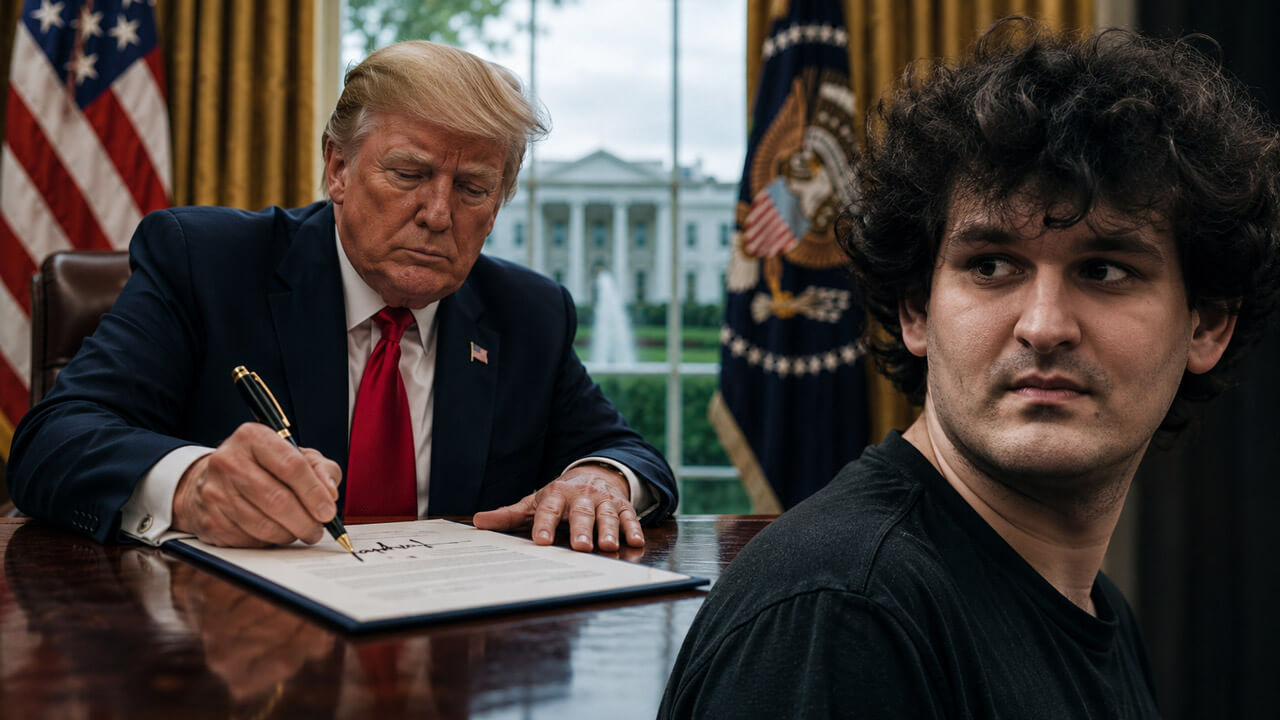
The 0.3% Yes price encodes a specific hierarchy: formal eligibility keeps the outcome possible, while presidential intent and political incentives make action before July 31 difficult to sustain. The pending petition explains why the probability has not reached zero. Trump’s direct refusal, the severity of Bankman-Fried’s conviction, and a Senate resolution opposing clemency explain why that petition carries little weight in the current price.
The petition preserves a path without signaling presidential support
The Justice Department’s Office of the Pardon Attorney listed its case-status data as current through July 13, 2026, and Bankman-Fried’s request was reported as pending in DOJ records. DOJ defines that status as a case under review. This confirms that a live administrative route exists, which matters because the market’s rules count a pardon, commutation, or reprieve.
Pending status offers limited evidence about the eventual decision. The DOJ cautions that clemency review can take months or years, while this contract requires action by July 31. The market’s inference is therefore that administrative viability supplies tail probability without creating a near-term catalyst. A status change to “granted,” an entry in the DOJ’s presidential clemency list, or a White House announcement would directly challenge that interpretation. Continued pending status through the final days would weaken the petition’s already limited relevance.
Trump’s personal refusal dominates the administrative record
Trump said on January 8-9 that he would not pardon Bankman-Fried, according to CoinDesk, and the White House reiterated in February that he had no intention of doing so. Those statements came from the only official who can produce the qualifying executive action. They therefore carry more causal weight than the existence of an application being processed by DOJ staff.
The hidden assumption is that Trump’s public commitment will hold through the deadline. Presidents can reverse stated positions, and a clemency petition does not require a favorable recommendation from the Pardon Attorney before presidential action. Even so, reversing a named refusal would demand a new political rationale. A fresh Trump statement reopening consideration, confirmation of direct White House review, or public advocacy from influential administration allies would be hypothetical catalysts capable of changing that assumption. Repetition of the refusal would reinforce it.
The sentence makes clemency politically harder to frame
Bankman-Fried was sentenced in March 2024 to 25 years in prison and ordered to forfeit more than $11 billion after his conviction for fraud schemes involving FTX and Alameda Research. The scale of the punishment matters because clemency would be attached to a major financial-fraud case with identifiable customer and investor losses described by federal prosecutors.
This creates a framing problem for any reversal. A full pardon could be portrayed as erasing accountability, while a commutation would still shorten a lengthy sentence imposed less than three years ago. The market rules broaden the qualifying routes, but each route carries the same immediate political association with Bankman-Fried. Evidence that could weaken this barrier would include an official reassessment of the sentence, a successful legal development affecting the conviction, or a White House argument distinguishing sentence relief from exoneration. No such development appears in the supplied record.
The Senate resolution raises the cost of changing course
On July 15, the Senate agreed to S. Res. 772, expressing that Bankman-Fried should under no circumstances receive executive clemency, including a pardon or commutation. The resolution is a statement of Senate sentiment rather than a legal restriction on presidential power. Its effect is political: it gives opponents an immediate institutional response if Trump changes course and makes a quiet grant harder to defend.
Timing amplifies its importance. The Senate acted roughly two weeks before the resolution deadline, leaving little opportunity for the political pressure to fade. Withdrawal, repudiation by senior senators, or evidence that the White House rejected the resolution’s premise would weaken this signal. Absent such developments, it reinforces Trump’s earlier refusal close to the decision window.
Trump’s clemency record supplies the strongest counter-signal
DOJ records show that Trump granted clemency to crypto-linked figure Changpeng Zhao in October 2025. That establishes willingness to intervene in a prominent case connected to the digital-asset industry. It prevents the SBF outcome from being treated as institutionally impossible and supports the residual Yes probability.
The analogy has a clear failure point: the supplied record contains a specific Trump refusal for Bankman-Fried and subsequent Senate opposition. The market is inferring that individual political treatment outweighs a general pattern of aggressive clemency use. With about $816,890 in volume, $393,930 in open interest, $81,160 in liquidity, and 930 traders, the near-zero price has persisted amid substantial engagement. Those figures cannot verify the thesis, but they indicate that the hierarchy is more than an isolated quote. A named reversal from Trump remains the event most capable of reorganizing it before the deadline.
Sources
Market details
- Resolution criteria
- This market will resolve to "Yes" if Sam Bankman-Fried receives a presidential pardon, commutation, or reprieve from Donald Trump by July 31, 2026, 11:59 PM ET. Otherwise, this market will resolve to "No".
- Platform
-


- Category
- Crypto › Trump
- Close date
- July 31, 2026, 7:59 PM UTC
- Market rules summary
- Binary market. Payout is 1 USDC for a winning outcome, 0 USDC for a losing outcome. View full rules
Frequently asked questions
What was the final result of the Will Trump pardon SBF by July 31 prediction market?
Polymarket reports No as the winning outcome for the Will Trump pardon SBF by July 31 prediction market with a final probability of 100%. The final market snapshot includes $943.47K volume and $14.42K open interest. CryptoSlate last synced the final market data at Aug 1, 2026, 06:27 UTC.
How does the Will Trump pardon SBF by July 31 prediction market resolve?
This market will resolve to "Yes" if Sam Bankman-Fried receives a presidential pardon, commutation, or reprieve from Donald Trump by July 31, 2026, 11:59 PM ET. Otherwise, this market will resolve to "No". Binary market. Payout is 1 USDC for a winning outcome, 0 USDC for a losing outcome.
Related Trump markets
Trump out as President before 2027? Will Trump acquire Greenland before 2027?  What price will Solana hit in September?