
World Cup Winner
Ended Jul 20, 2026, 00:00 UTC

55 more outcomes Other final results
- GermanyNo
- PortugalNo
- NetherlandsNo
- ItalyNo
- USANo
- UruguayNo
- MexicoNo
- BelgiumNo
- ColombiaNo
- PeruNo
- JapanNo
- NorwayNo
- CanadaNo
- OtherNo
- TunisiaNo
- EcuadorNo
- ParaguayNo
- New ZealandNo
- AustraliaNo
- IranNo
- UzbekistanNo
- South KoreaNo
- JordanNo
- MoroccoNo
- South AfricaNo
- SenegalNo
- Ivory CoastNo
- GhanaNo
- EgyptNo
- AlgeriaNo
- Cape VerdeNo
- QatarNo
- Saudi ArabiaNo
- ScotlandNo
- SwitzerlandNo
- AustriaNo
- CroatiaNo
- HaitiNo
- CuraçaoNo
- PanamaNo
- SwedenNo
- Congo DRNo
- IraqNo
- Bosnia-HerzegovinaNo
- CzechiaNo
- TurkiyeNo
- Team AGNo
- Team AHNo
- Team AINo
- Team AJNo
- Team AKNo
- Team ALNo
- Team AMNo
- Team ANNo
- Team AONo
























Market resolution
Polymarket reports Spain as the winning outcome for the World Cup Winner prediction market with a final probability of 100%. The market closed on Jul 20, 2026, 00:00 UTC. Final reported trading volume was $4.33B.
Final probabilities, volume, and open interest are sourced from Polymarket and were last synced at Jul 20, 2026 2:47 am.
Argentina’s sudden surge leaves Spain’s World Cup lead strangely intact
The sharp change in Argentina’s price has created a two-team hierarchy without weakening Spain’s quote. That divergence makes data alignment, missing outcomes, and the durability of current exposure as important to the interpretation as any football explanation absent from the supplied record.


The central signal is the coexistence of Argentina’s 31.2-percentage-point daily increase and Spain’s 0.2-point rise. Spain still leads at 58.4% against Argentina’s 41.7%, yet the favorite did not surrender ground during the challenger’s surge. The most defensible inference is that Argentina attracted a large reassessment while Spain continued to function as the market’s anchor. The supplied evidence cannot identify the football event, information release, or positioning change behind that reassessment.
Argentina’s surge preserved Spain as the pricing anchor
A direct shift from Spain toward Argentina would usually produce opposing moves over a common measurement window. The reported changes instead add 31.4 percentage points between them. That makes a simple head-to-head migration an incomplete causal explanation.
Several scenarios could produce the divergence, although each remains an inference. Argentina may have gained at the expense of outcomes omitted from the supplied snapshot. The underlying markets may have been measured from different starting conditions. A temporary order-book dislocation or stale reference price could also exaggerate the 24-hour comparison. Spain’s small increase matters because it indicates continued demand for the favorite even as Argentina’s price reset sharply higher.
Near-complete pricing carries an unproven two-team assumption
The two quoted prices total 100.1%, a gap small enough to be consistent with rounding or trading frictions. Read alone, that total creates the impression that Spain and Argentina exhaust the realistic winner set. The rules introduce a complication: this is described as a multi-outcome event in which each option is represented by the Yes price of its underlying market.
The supplied context lists only Spain and Argentina, so it cannot establish whether every national team is represented in the snapshot. That distinction changes the causal story. If these are the only active outcomes, Argentina’s daily move requires a timing or data explanation. If additional teams exist outside the excerpt, the move could represent a broad transfer of probability from the rest of the field while Spain held firm. Any claim that the market has reduced the tournament to two contenders therefore depends on an unverified completeness assumption.
Turnover records activity while current exposure tests durability
The $4.28 billion in volume shows extensive cumulative trading, but it offers limited evidence about who currently bears the outcome risk. Open interest is $61.4 million, roughly one-seventieth of reported volume, while available liquidity is $18.77 million. Those ratios suggest substantial historical turnover relative to current exposure and immediately available depth.
This matters for interpreting Argentina’s jump. High lifetime volume can include repeated entry, exit, and repositioning. Confirmation would come from the higher probability persisting alongside growth in open interest and liquidity. A reversal without corresponding changes in those measures would support the competing explanation that the move reflected short-lived positioning or a snapshot anomaly.
Football evidence must catch up with the 31-point move
The supplied record contains no squad announcements, injuries, lineup changes, recent results, tactical developments, or competition performance that could substantiate such a large football-driven reassessment. Assigning the move to team quality would therefore go beyond the available evidence.
Future catalysts are clearer, even though their effects are hypothetical. Official squad selections could change assumptions about player availability and depth. Confirmed injuries or recoveries could alter expected knockout performance. Tournament draw information, starting lineups, group-stage results, and advancement through elimination rounds would progressively replace broad expectations with observed competitive evidence. A credible team-specific development followed by sustained price movement, higher open interest, and deeper liquidity would strengthen the football-information thesis.
Spain’s stable price remains the strongest counter-signal
The main challenge to treating Argentina’s surge as a decisive change in competitive standing is Spain’s resilience. Spain gained slightly during the same reported period and retains the higher price. That pattern supports an interpretation in which Argentina joined the top tier without displacing the existing favorite.
The July 20, 2026 close and winner-based resolution leave the hierarchy exposed to concrete tournament events. Repricing would become easier to interpret once both teams face the same observable catalyst, such as confirmed availability news or match results. Until then, the price hierarchy supports Spain as the anchor and Argentina as the rapidly elevated challenger, while the cause of Argentina’s move remains unverified by the supplied football evidence.
Sources
Market details
- Resolution criteria
- This market will resolve according to the national team that wins the 2026 FIFA World Cup.
- Platform
-


- Category
- Sports › World Cup
- Close date
- July 20, 2026, 12:00 AM UTC
- Market rules summary
- Multi-outcome Polymarket event. Each listed option is represented by its Yes price on the underlying market. View full rules
Market news
 CryptoSlate 1 week ago Why Circle is spending $400M to fix the last mile holding stablecoins back from real-world payouts
  CryptoSlate 4 weeks ago Justin Sun keeps World Liberty fight public as its $4 billion stablecoin bank awaits final approval
  CryptoSlate 1 month ago Trump-linked World Liberty Financial wins OCC bank approval as $112 million DeFi position sits near liquidation
  CryptoSlate 1 month ago Bearish One of Worldcoin’s largest corporate holders now sits on a $207M loss after losing its primary source of cash
  CryptoSlate 2 months ago DeFi’s next institutional hurdle is deciding who can be trusted to price real-world assets
  CryptoSlate 2 months ago Most world cup traders won less than $5 on Polymarket while FIVE wallets walked away with millions
 Frequently asked questions
What was the final result of the World Cup Winner prediction market?
Polymarket reports Spain as the winning outcome for the World Cup Winner prediction market with a final probability of 100%. The final market snapshot includes $4.33B volume and $70.58M open interest. CryptoSlate last synced the final market data at Jul 20, 2026, 01:47 UTC.
How does the World Cup Winner prediction market resolve?
This market will resolve according to the national team that wins the 2026 FIFA World Cup. Multi-outcome Polymarket event. Each listed option is represented by its Yes price on the underlying market.
Related World Cup markets
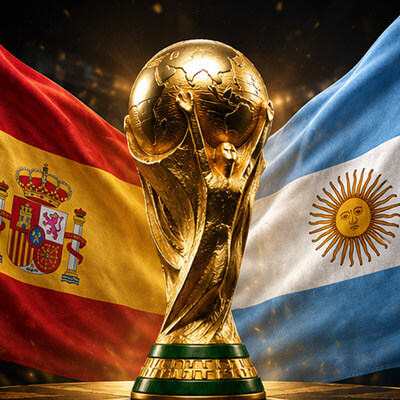 Spain vs. Argentina
  France vs. England
  England vs. Argentina