
Quick Take
- SGP-0002 would double annual disinflation from 15% to 30%, while SGP-0003 would burn resource fees.
- The proposals target a 1.5% terminal rate and could reduce issuance while tying fees to requested network resources.
- Both cleared 15% stake support, but discussion ends Aug. 22 before separate votes and any feature-gate changes.


Two Solana supply reforms are now on a live governance clock. SGP-0002 would cut future issuance, and SGP-0003 would burn resource fees in full. Both moved into discussion after the governance interface marked their 15% stake-support thresholds as met.
The official records for the Solana supply reforms, SGP-0002 and SGP-0003, place the end of both discussion periods at Aug. 22, 15:13 UTC. A governance vote comes next. Implementation and feature-gating would follow any successful vote before the economics could change on-chain.
When checked, the live records showed Helius and Jupiter as the largest named supporters of both proposals, backing them with 16 million SOL and 12.47 million SOL, respectively. Those stakes move the proposals through discussion; the binding governance decision comes later.
Helius CEO Mert Mumtaz separately called the milestone the first step on the road to discussion and a final on-chain vote.
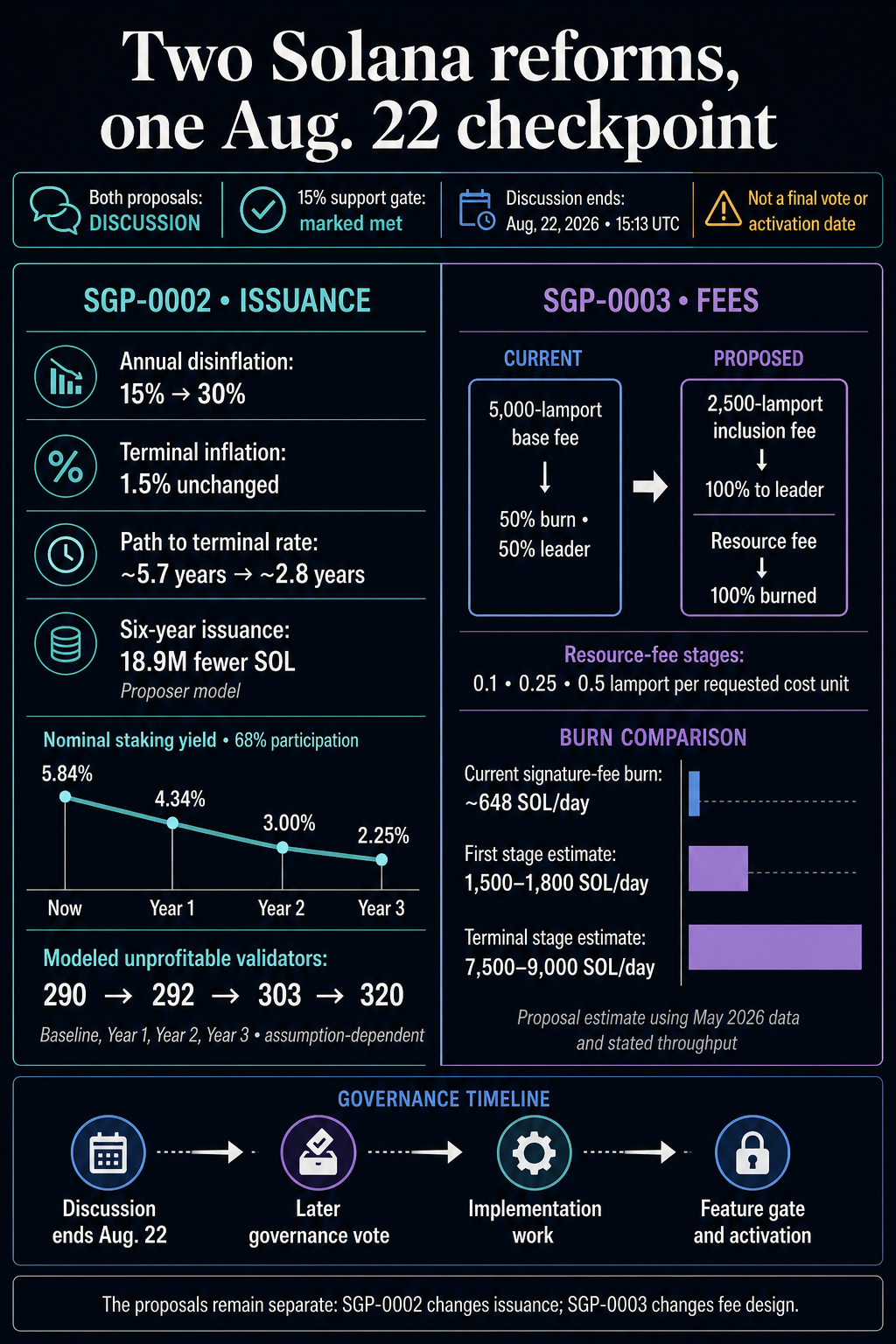
Solana supply reforms: SGP-0002 speeds up disinflation
SGP-0002 takes aim at issuance by doubling Solana's annual disinflation rate from 15% to 30%. The 1.5% terminal target and existing reward mechanism stay in place.
According to the authors' model, the network reaches 1.5% inflation in about 2.8 years, cutting nearly three years from the current 5.7-year path. Across six years, the model yields about 18.9 million fewer SOL, or 2.6% less issuance. Both numbers remain modeled outcomes built on the proposal's assumptions.
Staking yield falls with the issuance curve. Under the authors' 68% staking-participation scenario, the yield begins at 5.84%, then drops to 4.34% after one year, 3% after two years and 2.25% after three years. Commissions, MEV and block rewards sit outside that calculation.
Margins tighten at the edge of the validator set. The same cost model counts 290 unprofitable validators at baseline, rising to 292 after one year, 303 after two years and 320 after three years. Those totals swing with SOL's price, operating expenses, commissions and voting costs. The terminal rate remains 1.5%, so SGP-0002 concentrates that pressure into an earlier window.
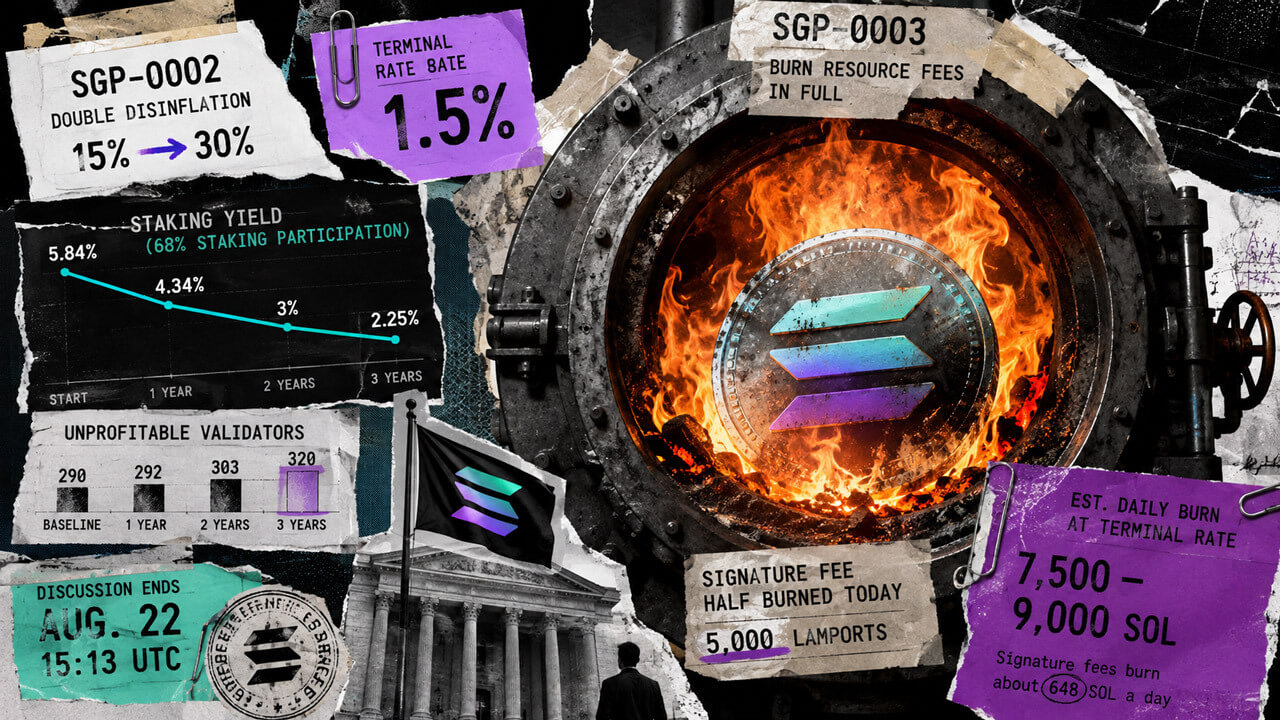
SGP-0003 ties burns to resource use
SGP-0003 rewires the fee split. Today, each signature carries a 5,000-lamport base fee, half burned and half paid to the block leader. The proposal would replace that with a 2,500-lamport inclusion fee paid entirely to the leader and a separate, usage-based resource fee burned in full. Priority fees would keep flowing to the leader.
The resource charge would step through 0.1, 0.25 and 0.5 lamport per requested cost unit. Using May 2026 network data and the stated throughput, the authors estimate daily burns of 1,500 to 1,800 SOL at the first rate, then 7,500 to 9,000 SOL at the terminal rate. Signature fees currently burn about 648 SOL a day.
At the terminal rate, efficient and accurately budgeted transactions could cost less. Resource-heavy or loosely budgeted ones could pay more, shifting more of the fee burden onto the computing resources they request.
Mentioned in this article


Editorial credits