
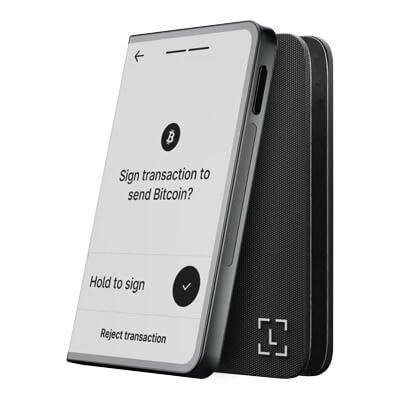
Ledger Stax combines a curved touchscreen, mobile Bluetooth and Qi charging. Its included Recovery Key backs up the recovery phrase, not an extra passphrase. Coin apps need separate updates.
Ledger Stax vs Flex: Which Touchscreen Wallet Should You Buy?
Stax’s larger curved screen and Qi charging cost an extra advertised $150. Flex keeps touchscreen approval, mobile Bluetooth and the same included backup card. The upgrade makes sense only if you will use the physical extras.
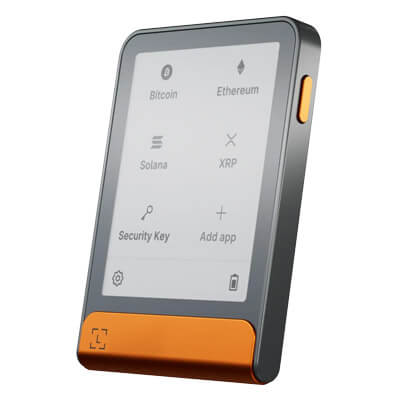
Ledger Flex offers touchscreen approval and mobile Bluetooth, with USB-C charging. Its included Recovery Key backs up the recovery phrase, not an extra passphrase. Signing coverage varies by app.
Affiliate Disclosure
Some links in this comparison are affiliate links. CryptoSlate may earn a commission if you sign up through these links. Our ratings remain editorially independent.
Overview
These devices share the same Secure Element model and recovery options. Compare screen size, charging and package contents first, then confirm that your chosen wallet app supports the device.
Ledger Stax Ledger Flex
Signing Hardware
ST33K1M5 Secure Element and separate touchscreen
ST33K1M5 Secure Element and separate touchscreen
Display Size And Type
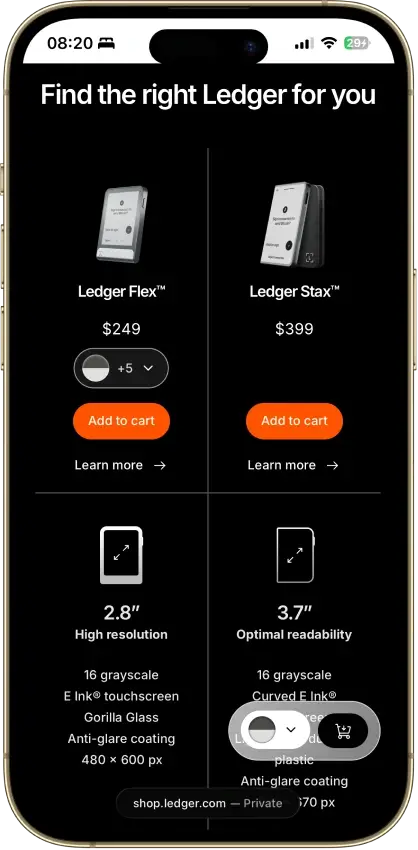
3.7-inch curved E Ink
2.8-inch flat E Ink
Display Material
Plastic with anti-glare coating
Gorilla Glass with anti-glare coating
Size And Weight
85 × 54 × 6 mm, 44.2 g
78.4 × 56.5 × 7.7 mm, 57.5 g
Charging
USB-C and Qi wireless charging
USB-C charging
Included Backup Card
Recovery Key card
Recovery Key card
Mobile Connection
Bluetooth for compatible iOS and Android devices
Bluetooth for compatible iOS and Android devices
Advertised USD Price, September 12, 2026
$399
$249
Best Fit
Owners prioritizing a larger screen and Qi charging
Buyers prioritizing the lower touchscreen entry cost
Ledger Flex wins overview
Comparison scope: Ledger Stax and Ledger Flex, exact current devices. Specifications and advertised US-dollar prices checked September 12, 2026. No physical-device, transaction, recovery or checkout test was performed. Firmware versions below identify fixes for particular disclosures, not the latest releases.
Screenshots
Ledger Stax screenshots
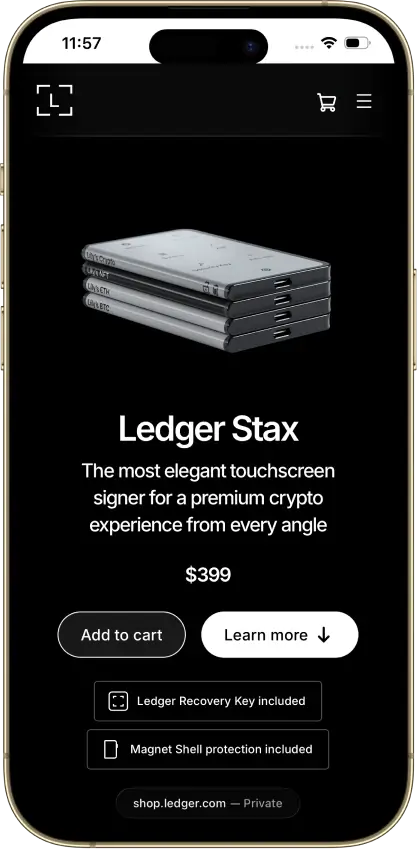
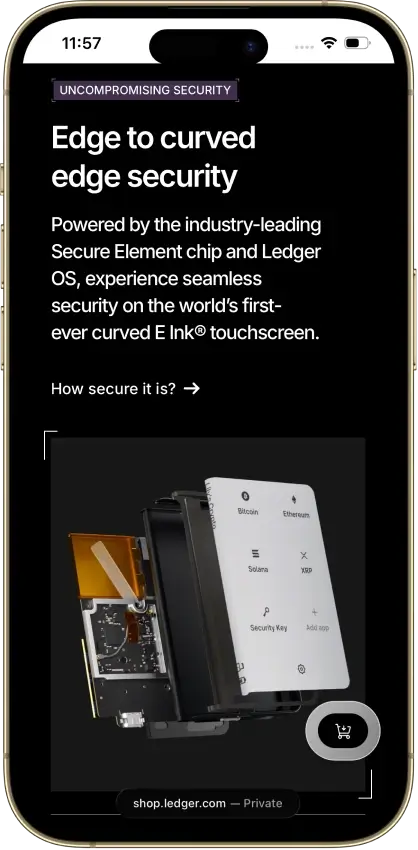
Screenshot 1 of 4
Ledger Flex screenshots
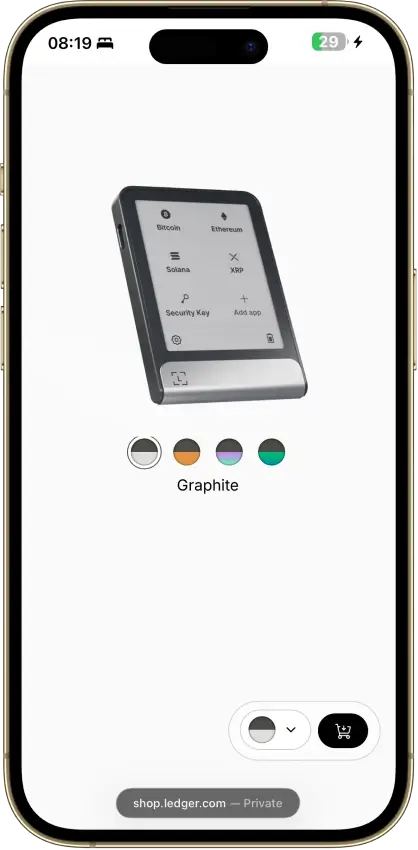
Screenshot 1 of 4
Winners By Category
Stax wins on display size and wireless charging. Flex wins on advertised purchase price. Shared hardware does not prove equal resistance to every attack, and neither device earns a privacy or lifespan win here.
Ledger Stax Ledger Flex
Both use on-device signing and let owners choose offline backups or optional provider-assisted recovery.
ST33K1M5 on-device signing, 24-word phrase, optional Ledger Recover
ST33K1M5 on-device signing, 24-word phrase, optional Ledger Recover
Both rely on correct coin-app interpretation as well as a hardware-controlled screen.
Secure Element controls the screen, Clear Signing and Transaction Check, MCU fix at 1.6.2
Secure Element controls the screen, Clear Signing and Transaction Check, MCU fix at 1.2.2
Both include the same Recovery Key option, with an additional passphrase requiring a separate record.
Recovery Key card, three paper recovery sheets, optional Recover
Recovery Key card, one paper recovery sheet, optional Recover
Documented Bitcoin, Ethereum and Solana access and Phantom connection methods overlap, without proving every integration identical.
500-plus assets in Ledger Wallet, Phantom Bluetooth and cable connections
500-plus assets in Ledger Wallet, Phantom Bluetooth and cable connections
Its larger screen and Qi charging suit owners who want those features, with a higher purchase price and plastic display.
3.7-inch curved E Ink, 44.2 g, 6 mm, Qi and USB-C charging, Magnet Shell included
2.8-inch flat E Ink under Gorilla Glass, 57.5 g, 7.7 mm, USB-C charging
Its advertised device price is $150 lower, while connected-service costs still depend on the transaction.
$399 advertised, same purchase, swap and staking providers
$249 advertised, same purchase, swap and staking providers
Both use Ledger's companion and optional providers, and no equivalent-session data-collection test establishes an advantage.
Same Ledger Wallet policy, Transaction Check and provider recipients
Same Ledger Wallet policy, Transaction Check and provider recipients
Both need firmware and coin-app maintenance, with no measured lifespan or future-support advantage on either side.
Shipping since May 2024, separate firmware and coin-app updates, no disclosed support end date
Launched July 2024, separate firmware and coin-app updates, no disclosed support end date
The named physical advantages are separate from app compatibility, signing safety and provider fees. Do not read a lower hardware price as lower future swap or staking costs.
Custody And Key Control
Both use on-device signing and let owners choose offline backups or optional provider-assisted recovery.
Ledger Stax Ledger Flex
Signing Chip
ST33K1M5 Secure Element
ST33K1M5 Secure Element
Ordinary Signing And Optional Recover
Owner approval, with separate optional recovery service
Owner approval, with separate optional recovery service
Tie
Stax and Flex give their owners the same documented choice between locally controlled signing and optional provider-assisted backup. Choose between these two devices for their physical operation and cost, while making the recovery decision on its own terms.
Where Signing Happens
Stax and Flex use the ST33K1M5 Secure Element to perform private signing operations. A phone or computer prepares the request, and the hardware provides a separate screen for checking it. CC EAL6+ certifies the chip, without certifying the complete system of websites, apps and recovery arrangements connected to it.
The user chooses a device PIN and retains responsibility for the recovery secrets. Neither buying Stax nor choosing Flex appoints Ledger to approve ordinary transactions for you. The optional Ledger Recover service changes the backup arrangement through participating providers, so it needs a separate decision from choosing the physical device.
Keeping Access Beyond One Device
Each wallet starts with a 24-word BIP39 recovery phrase. If Ledger became unavailable, that phrase provides a recovery option through another compatible wallet. Any replacement wallet must support your accounts and, if used, the additional passphrase. The phrase and included Recovery Key must never be handed to a support agent.
An extra passphrase derives different accounts and must be recorded separately from the PIN. Two devices restored from the same recovery material can access the same accounts, so a stolen backup compromises both.
Security And Transaction Signing
Both rely on correct coin-app interpretation as well as a hardware-controlled screen.
Ledger Stax Ledger Flex
Hardware-Controlled Display
Supported transaction details on the device
Supported transaction details on the device
Overall Attack Resistance
No comparative result establishing an advantage
No comparative result establishing an advantage
No clear winner
Neither model has a demonstrated overall security advantage. Their common signing controls and software dependencies make the intended wallet connection and app-update routine important alongside the display you prefer.
Trusted Screens Still Need Correct Software
The Secure Element controls the display on both devices. Clear Signing can present readable transaction information when the app and interaction support it. That makes the device screen useful for checking an approval, but the relevant coin app must first interpret the request correctly.
Transaction Check uses providers including Blockaid for simulation and risk information. Its April 2025 Ethereum launch covered Stax and Flex. Blockaid describes the delivery of results to the device screen without measuring detection rates. Before relying on this check, confirm that it covers your intended transaction type and wallet interface.
Neither screen specification measures how reliably a person will catch a deceptive request or whether an app interprets it correctly.
Device And App Disclosures
Ledger's January 2025 MCU-update disclosure covered both models. Malformed update parameters could render a device unusable. The stated fixed versions were Stax 1.6.2 and Flex 1.2.2. VulnCheck later cataloged this vulnerability as CVE-2025-15645, citing Ledger's bulletin. Ledger said funds were not at risk, which is the vendor's assessment rather than a separate VulnCheck reproduction.
August 2026 disclosures concerned software compiled into coin apps. Ledger described command interleaving that could change signing parameters during an on-screen review when a vulnerable app accepted the extra commands. According to Decrypt, OneKey's Anzen team recreated an Ethereum-app exploit in laboratory conditions. Ledger introduced Ethereum safeguards in version 1.22.2, then released SDK 26.6.1 and rebuilt apps.
Ethereum 1.22.3 also fixed two separately disclosed issues. One required a compromised phone or computer and a transaction-description format that supported an unusually large batch of operations. It could show one operation while authorizing the full batch. The disclosed demonstration used a private fork with one owner, without real funds or a public-network broadcast. The other could substitute a token permission for a swap payment, limited to the already-approved asset, amount and provider deposit address. Spending that permission required a later transaction.
The bulletins credit both external bug-bounty submissions and Ledger's internal security reviews. Update installed apps as well as device firmware. These disclosures concern particular apps and versions. For the command-interleaving and swap-permission flaws, Ledger said it had no evidence of exploitation against users.
Code And Connections
Ledger publishes companion and application components, while some low-level Secure Element firmware remains closed. Stax's higher price does not change that source-availability boundary. USB-C, Bluetooth and the companion software remain parts of the signing workflow on these connected devices. NFC serves backup and authentication functions, not a universal tap-to-pay connection.
Recovery And Backup
Both include the same Recovery Key option, with an additional passphrase requiring a separate record.
Ledger Stax Ledger Flex
Included Recovery Key
Offline encrypted phrase backup with its own PIN
Offline encrypted phrase backup with its own PIN
Additional Passphrase
Not preserved by Recovery Key
Not preserved by Recovery Key
Tie
The included card, written phrase and optional Recover service provide comparable choices on Stax and Flex. Someone worried about losing a device should organize the backups first, since paying for Stax does not add a record of a forgotten passphrase.
Phrase, Card And Passphrase
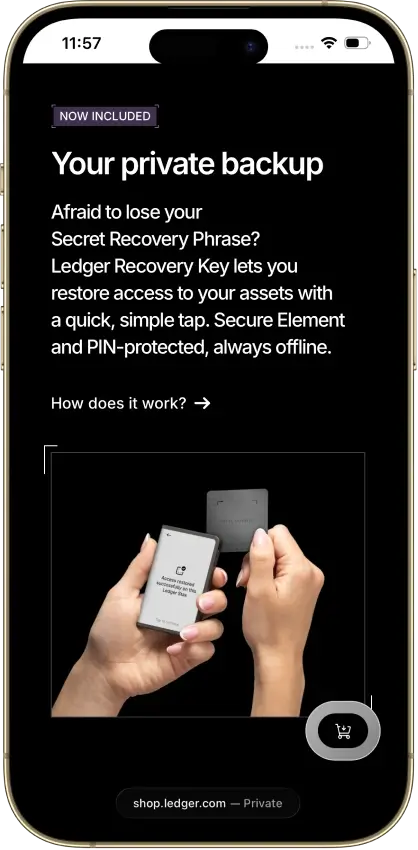
Both packages include an NFC Recovery Key card holding an encrypted copy of the 24-word phrase offline. Choose a separate PIN of four to eight digits for the card. Entering it incorrectly three times deletes that card's backup. The signer also has a three-attempt reset limit, but its PIN is separate.
Ledger advises retaining the written phrase even when using the card. Stax includes three paper recovery sheets, while Flex includes one. Storing the signer, card and phrase separately reduces the chance of losing all three in one incident.
Recovery Key does not include an additional passphrase. Restoring passphrase-protected accounts also requires the original extra secret. A passphrase's spelling and capitalization matter, and adding one creates new accounts that initially contain no funds. Existing balances stay at their original addresses until transferred.
Recovery Key has no ongoing usage subscription and can restore either model. It cannot independently approve ordinary payments. To replace a lost or damaged signer, select restoration during device setup, enter the card's PIN and tap it to the new Stax or Flex.
A forgotten device PIN requires a reset and restoration from an intact backup. A stolen phone alone does not replace the device approval step. If the recovery phrase is exposed, restoring it on new hardware leaves the same accounts compromised.
Optional Identity-Based Recovery
Ledger Recover is a different product with a paid subscription and identity checks. With the user's approval, encrypted backup material is divided among Ledger, Coincover and EscrowTech. Restoration requires two of the three fragments and the service's verification process.
Both devices support Recover, subject to its current eligibility requirements. The service restores access on a Ledger device but does not disclose the original plaintext recovery phrase on request. Owners using an additional passphrase must still maintain that secret separately.
Networks, Assets, And dApp Access
Documented Bitcoin, Ethereum and Solana access and Phantom connection methods overlap, without proving every integration identical.
Ledger Stax Ledger Flex
Named Native Assets
BTC, ETH, SOL and XRP through Ledger Wallet
BTC, ETH, SOL and XRP through Ledger Wallet
Phantom Connections
Mobile Bluetooth and extension cable
Mobile Bluetooth and extension cable
Tie
The documented mainstream assets and Phantom connection methods do not supply a reason to pay more for Stax. Check a specialist integration's exact model list before purchasing, since shared ecosystem branding does not guarantee identical support for every use.
Assets Through The Chosen Interface
The Stax and Flex specification pages, checked September 12, list 500-plus assets in Ledger Wallet. Named examples include XRP alongside Bitcoin, Ethereum and Solana. Ledger separately lists thousands accessible through compatible third-party wallets. Those descriptions cover different interfaces and should not be merged into a claim that every asset has every function natively.
Asset support depends on the combination of network, installed device app and wallet interface. Sending, staking, swapping and displaying a token can require different integrations.
Mobile And Browser Connections
Phantom explicitly lists both Stax and Flex for Bluetooth connections through its mobile app and cable connections through its extension. This gives users of those particular connections a documented choice between the two signers. It does not establish universal support for every network or action available elsewhere in Phantom.
Ledger also provides a browser integration with Ethereum and Solana provider components. Required connection APIs are unavailable in mobile browsers, excluding them from this integration. Native Ledger Wallet mobile use and Phantom's mobile Bluetooth route are separate implementations, so the web limitation should not be extended to them.
Platforms, Hardware, And Daily Use
Stax's larger screen and Qi charging suit owners who want those features, with a higher purchase price and plastic display.
Ledger Stax Ledger Flex
Display Size
3.7-inch curved E Ink
2.8-inch flat E Ink
Charging
USB-C and Qi wireless
USB-C only
Stax wins for the specific larger-screen and wireless-charging workflow, with its lighter, thinner body as another physical difference. Flex remains a touchscreen option for the same companion platforms at a lower price, and its glass display should be considered separately from untested durability claims.
Choosing The Display And Charging Method
Stax's curved display measures 3.7 inches and uses E Ink beneath anti-glare plastic. Flex pairs its flat 2.8-inch E Ink display with anti-glare Gorilla Glass. Ledger also describes Flex as 2.84 inches in its lineup table, using more precise measurement for the same device.
The Ledger Stax curved screen has 400 × 670 pixels, compared with Flex's 480 × 600. Its larger diagonal does not mean a higher pixel count.
At 44.2 g and 6 mm thick, Stax is lighter and thinner than the 57.5 g, 7.7 mm Flex. Stax is also taller. Its magnets permit stacking and the curved edge can show a device name. Flex's magnets attach compatible accessories.
Stax accepts Qi wireless charging and USB-C power, while Flex charges through USB-C. A Magnet Shell is included with Stax. Flex's protective accessories are sold separately in the standard lineup.
Setup, Platforms And Support
Ledger Wallet, formerly Ledger Live, supports compatible Windows, macOS and Linux computers plus iOS and Android phones. Setup includes choosing a PIN, recording the recovery phrase, installing coin apps and adding accounts.
The Ledger Flex touchscreen lets you review transactions on the hardware before approval, at a lower price than Stax. Stax is the more relevant upgrade for someone who specifically wants the additional screen area or already uses a Qi charging surface.
Both purchases use Ledger's support and seller terms. Check the contract applying to your order before assuming a warranty or return period is universal. The terms distinguish consumer and business customers, and a hardware-replacement remedy does not recover a lost backup secret.
Swaps, Staking, And Costs
Flex's advertised device price is $150 lower, while connected-service costs still depend on the transaction.
Ledger Stax Ledger Flex
September 12 Advertised Price
$399
$249
Protective Accessory In Standard Box
Magnet Shell included
Sold separately
Flex has the lower advertised hardware entry cost by $150, while retaining the included Recovery Key and access to the companion's supported services. That purchase saving does not predict which live exchange quote or staking arrangement will cost less in future.
The Advertised Purchase Difference
Ledger's US-dollar lineup advertises Stax at $399 and Flex at $249, checked September 12, 2026. That puts Flex's advertised entry cost $150 below Stax's. Regional checkout totals can differ from these list prices.
Taxes and delivery charges can change your checkout total. Ledger's sales terms identify Global-e US Inc. for US orders. Compare the package contents as well as the total, since Stax includes its Magnet Shell and Flex's standard price does not include a protective accessory.
Connected Services Charge Separately
Purchase services such as MoonPay and Transak have their own payment methods, fees and identity requirements. Ledger's buy feature is distinct from its exchange integrations. Country availability follows the selected provider's rules regardless of which device you buy.
For some integrated swaps, the input asset is sent to a provider that executes the exchange and returns the output. During that step, completion depends on the provider. The output quote includes certain service charges, while sending the pay-in requires a separate network fee. Slippage tolerance concerns the permitted exchange-rate movement, not another fixed charge.
Staking choices include supported ETH and SOL arrangements, with route-specific validator, pool or contract dependencies. Fees and withdrawal conditions belong to the selected route. Hardware signing does not remove slashing exposure where it applies or make malicious staking permissions harmless.
Privacy And Data Collection
Both use Ledger's companion and optional providers, and no equivalent-session data-collection test establishes an advantage.
Ledger Stax Ledger Flex
Companion Privacy Controls
Ledger Wallet settings and provider terms
Ledger Wallet settings and provider terms
Measured Data Exposure
No equivalent-session comparison
No equivalent-session comparison
No clear winner
The common companion, seller and optional services make feature selection more relevant than screen choice to these disclosed data flows. Ranking the devices for privacy would require measuring the information sent during equivalent use.
Companion And Provider Information
The same Ledger Wallet companion connects both devices. Ledger's March 2026 privacy policy distinguishes information that can identify someone directly, such as an email address, from identifiers such as an IP or wallet address. It provides consent controls through application settings, with separate controls for website cookies and marketing emails.
Transaction Check introduces Blockaid into supported screening requests. A fiat purchase or provider-assisted recovery introduces additional recipients and identity requirements. The feature you select determines which providers receive data.
Requesting deletion of personal data is also different from removing a transaction from a public blockchain. Ledger's policy describes deletion rights subject to retention obligations. Check the feature and recipient involved when adjusting settings or making a request.
Purchase Records And Targeted Scams
Customer information was exposed in Ledger's 2020 breach and a separate 2026 incident involving commerce provider Global-e. BleepingComputer's January report describes names and contact details belonging to some Ledger buyers. The companies gave different scope clarifications: Ledger said the incident did not affect its systems, and Global-e said it did not expose payment information or account credentials.
Exposed order details can help someone tailor a convincing support impersonation. Knowing which Ledger you bought does not make a caller safe to trust with recovery material.
Updates, Longevity, And Ecosystem
Both need firmware and coin-app maintenance, with no measured lifespan or future-support advantage on either side.
Ledger Stax Ledger Flex
Maintenance
Device firmware and coin apps updated separately
Device firmware and coin apps updated separately
Guaranteed Support End Date
No fixed date disclosed
No fixed date disclosed
No clear winner
Both products have documented software-maintenance paths, with separate attention required for firmware and coin apps. Their materials and charging specifications do not establish which device will remain usable longer, so replacement planning should include accessible recovery material.
Ledger's May 28, 2024 announcement confirmed that Stax preorders had begun shipping. Flex launched on July 26, 2024. The product pages and sales terms checked on September 12 do not give a fixed software-support end date for either device.
Device firmware and installed coin apps need separate updates on both models. The January 2025 MCU bulletin gave different fixed versions for the two models, showing why the exact device matters. The shared SDK disclosure shows why a current device OS alone does not prove that every installed app contains its fixes.
Ledger's security bulletins name the affected apps and the versions that fix them.
In December 2023, malicious Connect Kit code reached websites that connected to wallets. Phished publishing access enabled the compromised library's distribution, leading to deceptive requests and fund drains. Ledger replaced the package. That history concerns software distribution and connected applications, not a measured lifespan difference between these devices.
Qi charging gives Stax another way to recharge. The specifications alone cannot predict how long either battery or device will remain usable.
Final Verdict
Both wallets score 8.0/10, so the overall rating is a tie. Flex is our value pick for touchscreen signing at the lower advertised price. Choose Stax if its larger curved display and Qi charging are worth the extra $150 to you.
Affiliate Disclosure
Some links in this comparison are affiliate links. CryptoSlate may earn a commission if you sign up through these links. Our ratings remain editorially independent.
Stax’s 8.0 is a publisher-approved editorial rating added September 17, 2026, not a calculated pillar score. Flex retains its existing 8.0 rating. The tie badges reflect those equal review scores. Our Flex value recommendation concerns purchase price, not a higher rating or proven security advantage. Both need firmware and coin-app maintenance.
Ledger Stax vs Flex FAQs
Is Ledger Stax safer than Ledger Flex?
Neither model has a demonstrated overall safety advantage. Both combine a Secure Element with a hardware-controlled screen, but apps still interpret the transaction being approved. Shared Ledger software disclosures demonstrate why updates matter. Stax's larger display is a physical preference, not proof that it prevents more attacks than Flex.
Is Ledger Stax worth the extra cost over Ledger Flex?
Stax costs an additional $150 at the advertised $399 and $249 prices checked September 12, 2026. It adds a larger curved screen, Qi charging and an included Magnet Shell. Flex is the lower-cost recommendation if its flat touchscreen already suits you. Compare actual regional checkout totals before deciding how much the upgrades cost.
Do Ledger Stax and Ledger Flex work with iPhones?
Both support Bluetooth connections with compatible iOS phones through Ledger Wallet. Phantom also lists Stax and Flex for its mobile Bluetooth route. This does not mean every mobile browser can connect directly: Ledger's separate web-provider integration excludes mobile browsers. Confirm the particular application and signing action you intend to use.
Can Ledger Stax and Ledger Flex restore the same wallet?
Their documented recovery options support restoring from the same recovery material, including the compatible Recovery Key card. Accounts protected by an additional passphrase also require that exact secret, which the card does not contain. Restoring the same backup creates access to existing accounts, not a separate wallet with independent recovery risk.
Do Ledger Stax and Ledger Flex support the same assets?
Ledger lists Bitcoin, Ethereum, Solana and XRP among the assets available through its companion for both devices. It separately counts thousands through third-party wallets. Those figures describe different interfaces rather than universal feature parity. For a specialist asset, confirm support for your exact signer before committing to a particular wallet interface.
Do Ledger Stax and Ledger Flex require a subscription or KYC?
Basic signing and the included Recovery Key do not require a Ledger Recover subscription. Recover is optional, paid and identity-verified. Fiat and other connected providers can impose their own identity checks and eligibility conditions. Buying either device therefore does not make all of its optional services subscription-free or free of know-your-customer requirements.
Can Ledger Stax and Ledger Flex charge wirelessly?
Stax can recharge over Qi or a USB-C connection. Flex charges through USB-C and does not support Qi. Their Bluetooth connections and NFC backup or authentication functions are separate from charging. Stax's standard box includes a USB-C cable and Magnet Shell, but its listed contents do not include a Qi charger.

Both boxes include Recovery Key, and neither card preserves an additional passphrase. Paying for Stax changes the handling and charging experience, not that recovery requirement. Its larger diagonal also does not mean a higher total pixel count.