


Quick Take
- Strategy accounted for over 20% of STRC's weekly trading volume during most of September, according to Keyrock.
- Its $1.45 billion in preferred-share repurchases raises questions about how much liquidity comes from independent investors.
- With just $547 million in buyback capacity remaining, STRC faces a test of whether trading demand can survive reduced issuer support.


Strategy's $1.45 billion preferred-share buyback program is supporting a substantial share of trading in one of its key Bitcoin financing instruments.
According to a Keyrock research report, Strategy's repurchases accounted for more than 20% of weekly trading volume in its variable-rate preferred stock, STRC, during almost every week of September.
The company's share reached about 28% the week of Sept. 8 before falling to just under 20% in early October.
The findings raise questions about how much of STRC's market liquidity comes from independent investors and how trading conditions might change if Strategy reduces its purchases.
That question is becoming increasingly relevant as the Michael Saylor-founded company approaches the limit of its repurchase authorization.
Strategy had spent approximately $1.45 billion of its $2 billion authorization as of Oct. 4, leaving $547.2 million available. The program has helped support STRC as its shares recovered from the mid-$70s in June to approximately $99.50, approaching the security's $100 reference price.
However, the repurchases are discretionary, and Strategy can modify, suspend, or terminate the program.
For a company seeking to establish preferred securities as a recurring funding channel for Bitcoin accumulation, the concern is whether those instruments can sustain investor demand without continued intervention from their issuer.
Strategy's buying accounts for a fifth of STRC trading
STRC is already among the most actively traded preferred securities in the market, averaging approximately $150 million in daily volume.
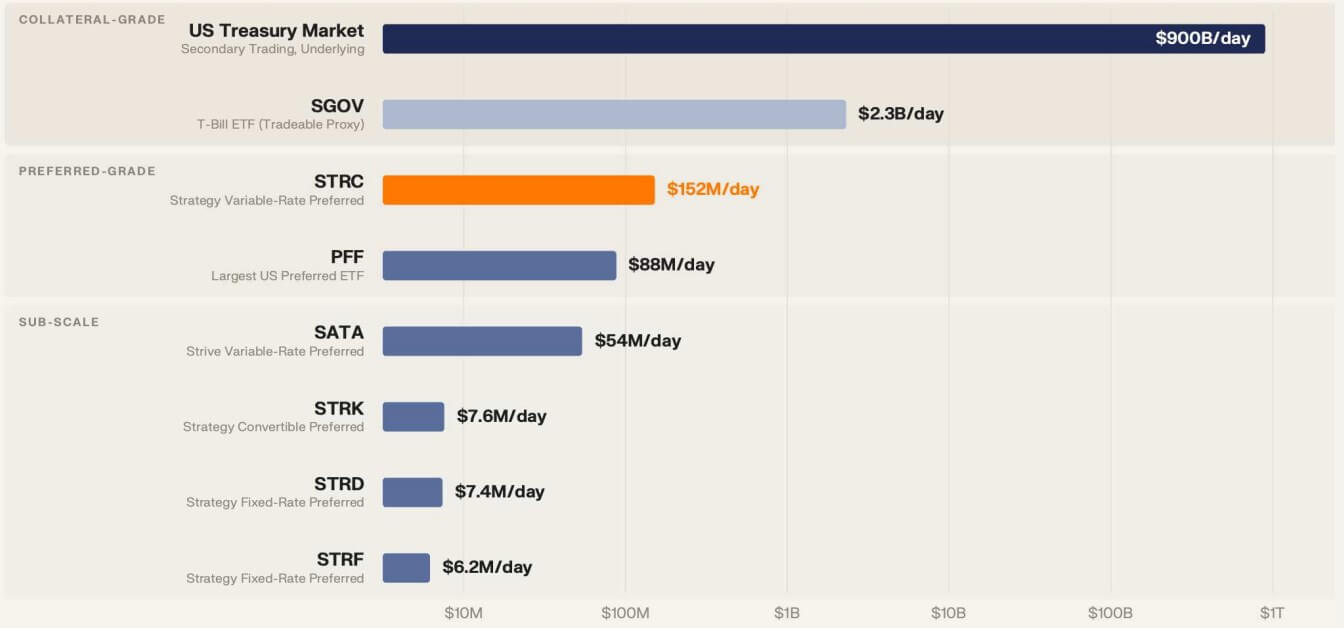
Keyrock found that the instrument can typically absorb about $28 million in trading before its price moves 10 basis points, or 0.1%.
That puts it well ahead of Strive's SATA and Strategy's fixed-rate preferred securities, each with less than $3 million in comparable market depth.
For institutional investors, that difference has practical consequences.
Using an illustrative execution rate equivalent to 20% of daily trading volume, Keyrock estimated that a $50 million STRC position could be liquidated in less than two trading days.
The same transaction would take approximately five days in SATA and six to eight weeks across Strategy's fixed-rate preferred instruments.
However, those estimates become less reassuring once Strategy's repurchases are considered.
Removing the company's buying activity reduces estimated trading capacity to approximately 80% of reported volume, implying that a $50 million exit could take longer than headline turnover suggests.
Keyrock cautioned that the calculation does not establish how much liquidity would disappear if Strategy stopped buying. Other market participants could also change their behavior in response.
A preferred-income manager interviewed for the report suggested that some trading around STRC's $100 reference price comes from arbitrage firms and high-frequency traders responding to the issuer's activity.
Such participants could reduce their involvement if Strategy withdraws, potentially leaving the market more dependent on longer-term investors and opportunistic buyers.
STRC liquidity weakens when prices fall below $100
The risk extends beyond the company's direct contribution to trading volume.
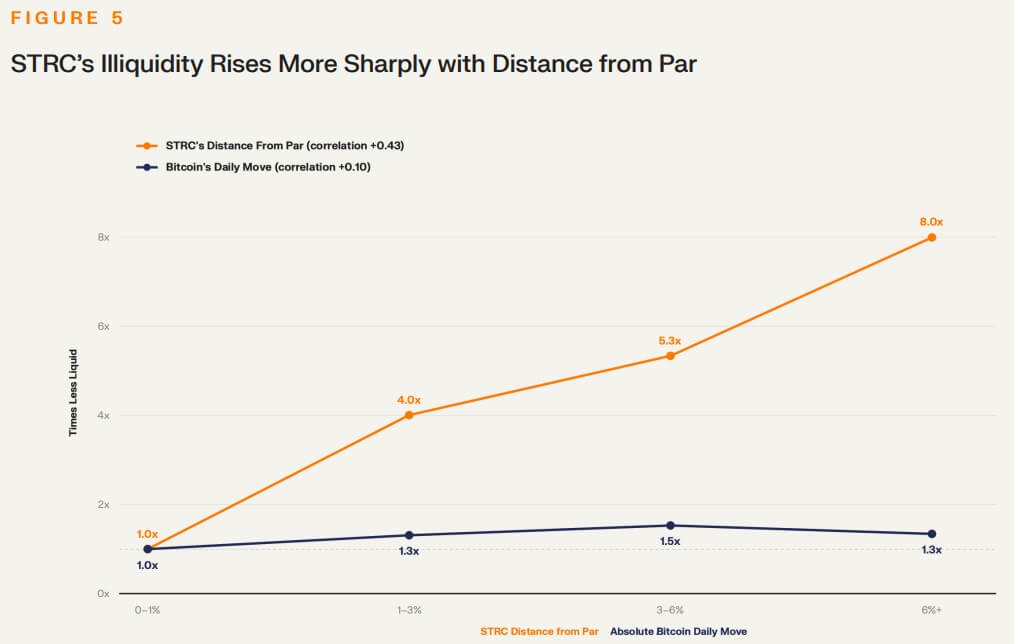
Keyrock found that STRC's market depth deteriorates sharply when the security moves away from its $100 reference price.
On the worst 10% of trading days, estimated depth within a 10-basis-point price move falls from about $28 million to $6.5 million.
The deterioration becomes more pronounced as the price discount widens.
STRC is approximately four times less liquid when trading 1% to 3% away from par and roughly eight times less liquid when the deviation exceeds 6%, according to the report.
That creates a potential problem for investors expecting to exit large positions without accepting significant price discounts.
The relationship between STRC's distance from par and market illiquidity had a correlation of 0.43, compared with 0.10 for the magnitude of Bitcoin's daily price movements.
The findings suggest that STRC's tradability is more closely tied to how far its price has moved from $100 than to Bitcoin's immediate direction.
Keyrock also found that a typical decline from par represented approximately seven months of dividend income, while STRC's June drop toward the mid-$70s amounted to roughly two years of coupon payments.
Those discounts illustrate how quickly capital losses can outweigh the income investors expect to collect from the security.
Still, the research does not establish that Strategy's repurchases caused the observed relationship. Keyrock found a similar pattern before the buyback program began, and STRC remains substantially more liquid than competing preferred securities.
The unresolved concern is whether that advantage can persist under stress without significant support from Strategy.
Strategy faces a new test as its buyback capacity shrinks
The findings come as Strategy increasingly allocates capital to maintain its preferred-stock market.
Between Sept. 28 and Oct. 4, the company repurchased approximately $176.3 million of STRC, including $102.6 million during the final three days of September and $73.7 million in early October.
During the same reporting period, Strategy acquired 334 Bitcoin for approximately $28.7 million.
Of the preferred repurchases, $154.1 million came from the company's cash reserves, compared with $13 million used for Bitcoin purchases.
That allocation highlights growing tension between supporting the securities that finance Strategy's operations and deploying capital directly into Bitcoin.
If the company maintained its recent weekly repurchase pace, its remaining $547.2 million authorization would last approximately three weeks.
However, that is an illustrative estimate rather than a fixed deadline. Strategy previously doubled the authorization in September and could adjust the program again.
The company is also pursuing a separate measure intended to strengthen demand for its preferred securities.
Shareholders are scheduled to vote on Oct. 28 on amendments that would introduce daily dividends across Strategy's US-listed preferred stocks.
If approved and implemented, STRC would begin making payments under the new schedule on Nov. 2.
Strategy argues that more frequent distributions could improve price stability, reduce trading disruptions around dividend dates, and broaden institutional interest without increasing total regular dividend obligations.
However, the experience of Strive's SATA, which already uses a near-continuous payment structure, suggests that dividend frequency alone may not guarantee deeper liquidity.
Keyrock identified family offices, private-bank discretionary accounts and specialist credit funds as the most promising sources of larger allocations.
Those investors can commit tens of millions of dollars without necessarily facing the restrictions that prevent some pension and insurance funds from purchasing unrated perpetual preferred securities with deferrable dividends.
Their participation could determine whether STRC develops enough independent demand to support larger institutional positions.
For Strategy, the next disclosures will provide an indication of whether that transition is occurring.
A sustained decline in the company's share of STRC trading, alongside stable market depth and prices near $100, would suggest that independent investors are absorbing more activity.
If issuer participation remains elevated as the authorization approaches its limit, Strategy would face another capital allocation decision: extend the repurchase program, tolerate a potentially wider discount or redirect resources toward preferred dividends, debt obligations and Bitcoin accumulation.
The Oct. 28 vote and subsequent weekly repurchase disclosures will offer the first evidence of whether changes to STRC's dividend structure can attract sufficient demand to reduce that dependence.
Mentioned in this article



Editorial credits