


Quick Take
- Russia’s crypto exchange and depository entry rules take effect October 5.
- Firms still need individual Bank of Russia decisions before joining the registers.
- Retail trading also awaits separate decisions on eligible assets.


Crypto exchange operators and digital depositories in Russia will be able to apply for entry into official registers from October 5, when new Bank of Russia admission rules take effect. The move gives firms a route into the regulated crypto market envisioned by a law that took effect in September. Each applicant still needs a separate regulator decision.
In a September 24 notice, the Bank of Russia said the rules also cover operators of information systems used to issue digital financial rights. Its Russian regulation sets qualifications for managers and certain officers, lists documents applicants must submit and governs decisions on register entries. A firm seeking admission must document that it meets those requirements before the bank considers its entry. The published rule tells applicants what to provide and how the bank will make its decision. It does not grant a particular applicant the status it is seeking.
How firms enter the market
The bank's exchange-operator guidance says its electronic application form becomes available on October 5. Under the ordinary route, the regulator has 30 working days to decide after receiving the last required document. For a digital depository, that decision window is 60 working days. These are periods for a decision, not promised approvals or dates for customer trading. The clocks begin with a complete set of required documents, rather than with the October 5 effective date itself. Exchange operators and depositories also face different ordinary review windows, so the single start date for the rules cannot be read as a common timetable for admitting firms.
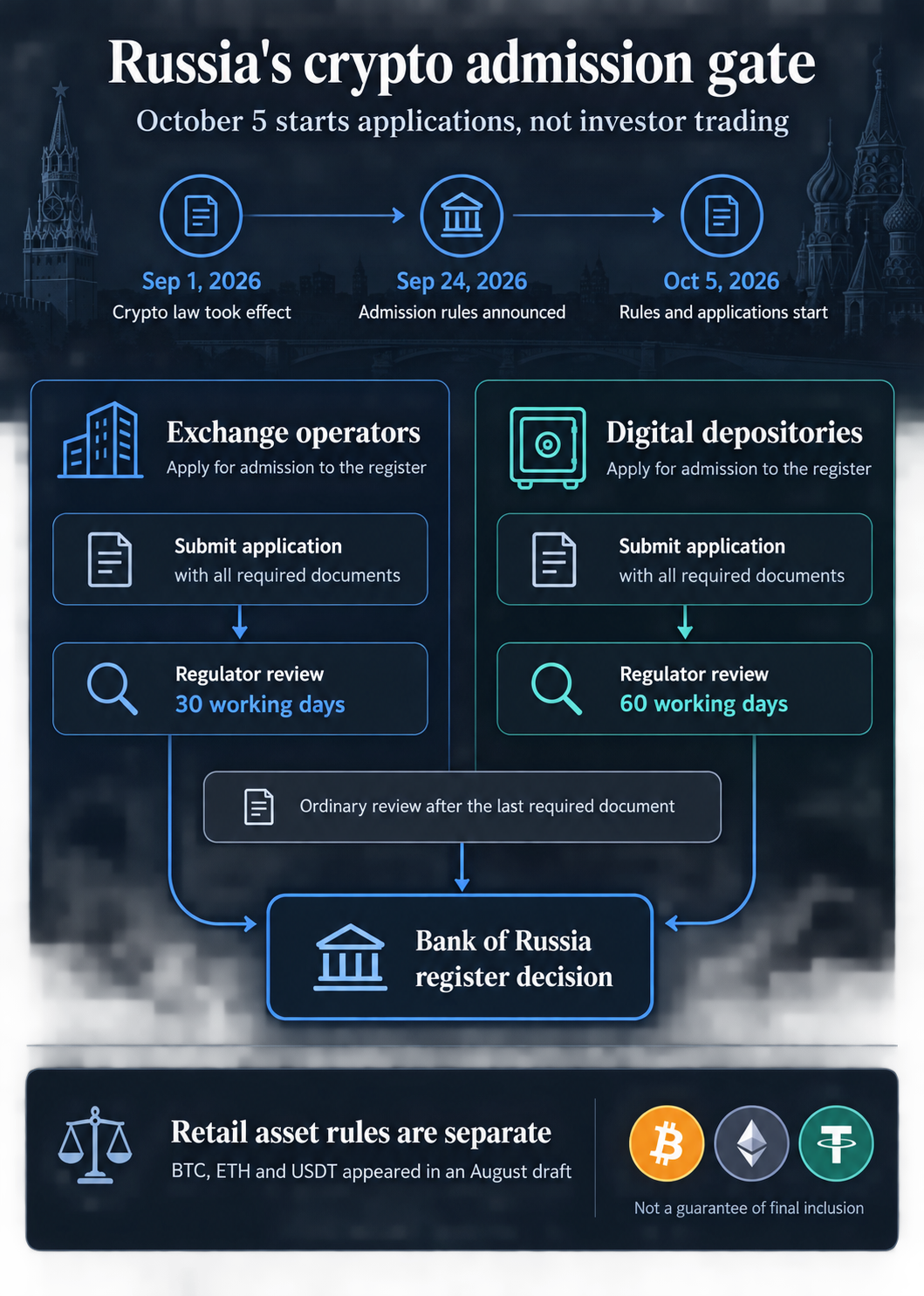
Some existing banks, brokers and participants in an experimental regime can use a faster notification route, with eligibility depending on the role sought. The regulator says qualifying firms must submit documents before September 1, 2027. That route also requires a decision on a register entry.
Russia's crypto law took effect on September 1 and envisages buying and selling through regulated intermediaries. It requires testing for both qualified and non-qualified investors and sets a 300,000-ruble annual purchase limit per intermediary for the latter group. Those terms describe the intended market; the October rules address how firms can enter it.
The assets that non-qualified investors may buy are being handled separately. In August, the central bank named Bitcoin, Ethereum and Tether's USDT for public exchange trading in a draft directive open for comment. The October admission procedure does not finalize that proposed list.
For investors, the next markers are the Bank of Russia's decisions on individual firms and the status of the separate asset rules. An effective admission procedure alone does not establish that regulated retail trading is available.
Mentioned in this article


Editorial credits