



Prop-firm fees are at risk, most participants do not reach a payout, and simulated funding does not necessarily represent live firm capital. This review is informational, not financial advice.
HyroTrader Overview
- Company Name
- HyroTrader
- Registered In
- The service is provided by a UAE free zone company, the funded phase is operated by a British Virgin Islands entity, and European card payments run through a Slovak company.
- Launch Year
- 2022
- Challenge Types
- Zero Step, One Step, Two Step
- Profit Targets
- 5–10%
- Maximum Drawdown
- 5–10%
- Maximum Daily Loss
- 3–5%
- Profit Split
- 80%–90%
- Minimum Trading Days
- 0–5
- Fee Refund
- Program dependent: Returned in full alongside your first funded payout, sent as a separate crypto transaction.
- Maximum Allocation
- USDT 200,000
- Payout Time
- 24 hours
- Website
- hyrotrader.com
HyroTrader Screenshots

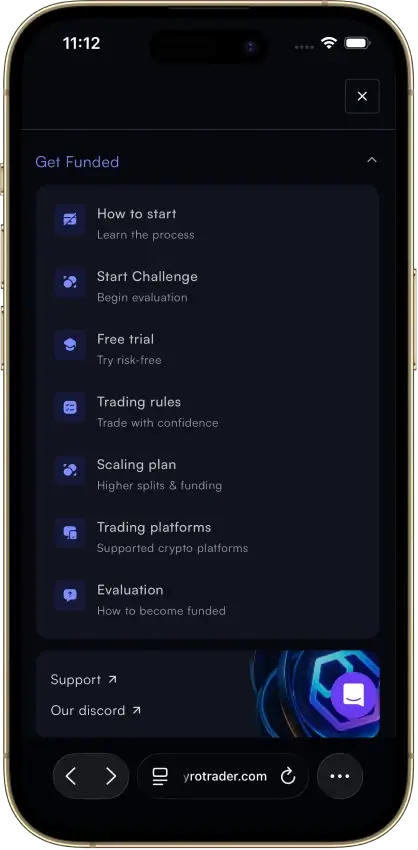
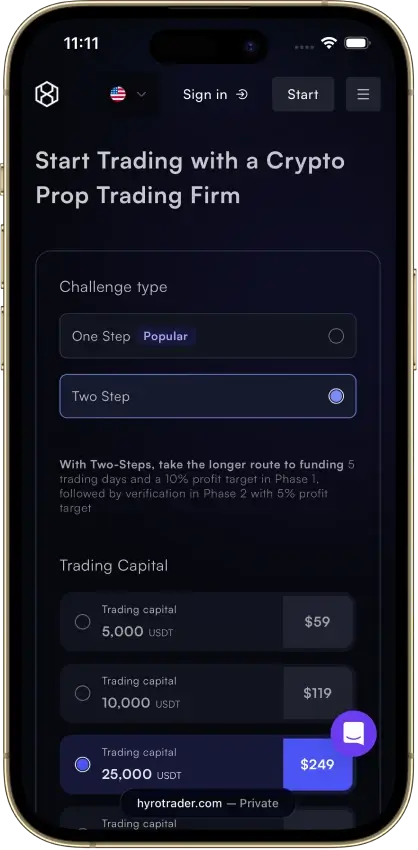
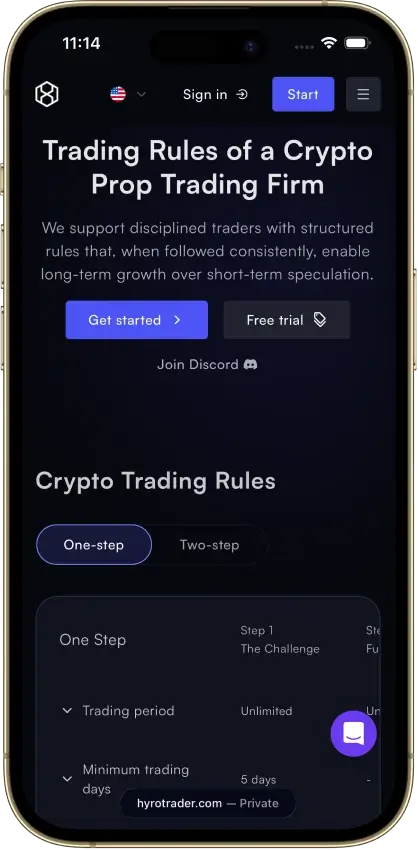

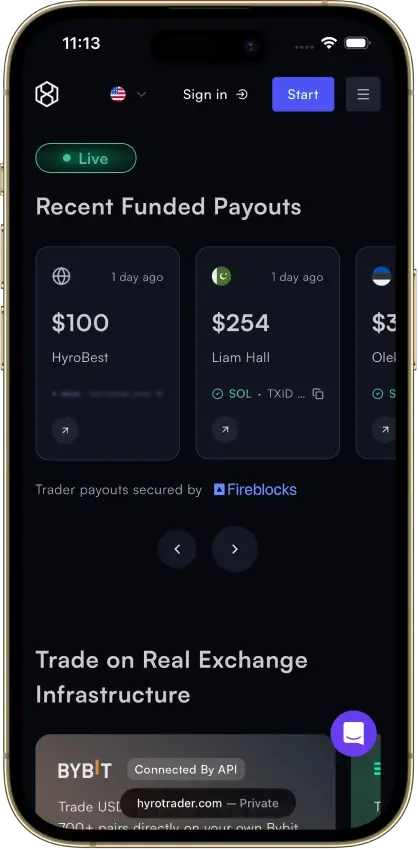
Screenshot 1 of 8
HyroTrader Pros and Cons
Pros
- No time limit on any evaluation phase
- No mandatory stop loss on any trade
- Deposit returned with first payout (One-Step, Two-Step)
- Orders reach a live exchange order book
- Static daily drawdown on every challenge
Cons
- Forced withdrawal at 5%, excess forfeited
- API keys permit prohibited instruments
HyroTrader Discount Code
CRYPTOSLATE10 takes 5% off. It is a CryptoSlate reader code rather than a public promotion, and the name is misleading: HyroTrader’s own checkout returns 5%, not 10%. It applies to every account size on both the One Step and Two Step routes, and it also comes off the paid swing-drawdown upgrade. On a 25,000 USDT Two Step the fee falls from $249 to $236.55. The banner runs a countdown, but that timer restarts for each new visitor and HyroTrader publishes no expiry date.
Your fee is a Refundable Challenge Deposit that returns in full alongside your first funded payout, sent as a separate crypto transaction. On the cheapest account that turns a $59 outlay into a $0 net cost.
Passing alone does not release it. Clear both phases, never request a payout, and the money stays with HyroTrader until an outer limit in the terms is reached, the longest being twelve months from the date you met the objectives.
How the HyroTrader Evaluation Works
The path from purchase to payout runs through four stages.
- Buy a challenge. Pick 1-step or 2-step, pick an account size, pay by card or crypto.
- Set up the account. Choose your drawdown type, choose a platform, connect it with API keys.
- Pass the phases. Hit the profit target inside the risk limits, with no deadline.
- Sign and get funded. Complete KYC, sign a separate funded trader agreement, then request payouts.
One Step
| Phase | Profit target | Daily loss | Maximum drawdown | Minimum days | Time limit | Consistency rule |
|---|---|---|---|---|---|---|
| The Challenge | 10% | 4% | 6% | 5 | None | None |
| Funded Account | — | 4% | 6% | 0 | None | None |
Returned in full alongside your first funded payout, sent as a separate crypto transaction. · 80% at the start, 85% after four months of funded trading, 90% after eight months.
Two Step
| Phase | Profit target | Daily loss | Maximum drawdown | Minimum days | Time limit | Consistency rule |
|---|---|---|---|---|---|---|
| The Challenge | 10% | 5% | 10% | 5 | None | None |
| The Verification | 5% | 5% | 10% | 5 | None | None |
| Funded Account | — | 5% | 10% | 0 | None | None |
Returned in full alongside your first funded payout, sent as a separate crypto transaction. · 80% at the start, 85% after four months of funded trading, 90% after eight months.
A trading day only counts if you put real risk on. The dashboard defines it as a day you open and close at least one trade sized at 5% or more of the initial balance, with a result of at least 1% either way. Scratch trades will not tick the box.
Compliance checks before the funded contract is signed are stated as under one business day for individual registrations, up to three for company registrations.
HyroTrader Rules and Restrictions
Quotes attributed to HyroTrader’s support team below were given by staff in the firm’s public Discord support channel, in response to questions from our own funded-challenge account. This is the section to read twice, because HyroTrader runs two different loss limits measured two different ways, and traders can lose accounts by confusing them.
HyroTrader’s maximum loss is a static drawdown
Your total loss limit does not move. HyroTrader’s dashboard defines it as both realized and unrealized decrease in equity measured against the initial trading capital at the start of the challenge, and the rules panel states that account equity must remain above 90% of the initial balance on a 2-step account.
On our live 5,000 USDT 2-step account, the dashboard shows limits in dollars rather than percentages: drawdown −250, profit target 500 and loss limit −500. The spec line reads “Two step / 5K / USDT / futures / Trailing.” Hovering any metric gives a plain-English definition, and the maximum-loss tooltip states: “Both realized and unrealized decrease in equity compared to the initial trading capital at the start of the challenge.”
On a 5,000 USDT 2-step account:
- Maximum loss is 10%, so $500
- Your absolute floor is $4,500
- That floor stays at $4,500 whether your equity is $4,600 or $9,000
Static drawdown is the friendlier design and plenty of larger firms do not offer it. Profit buys room here: take the account to $6,000 and you have $1,500 of usable buffer instead of $500.
HyroTrader’s daily drawdown is trailing, not static
The daily limit works the opposite way, and this is where the account is most likely to break. The dashboard’s rules tab describes the daily drawdown as a percentage of your initial account balance, which reads like a fixed floor. Hover over the same metric and the tooltip gives the actual mechanic: the difference between the day’s highest equity and the lowest equity reached afterward, both including unrealized profit and loss. The FAQ confirms it in the same words, calling the standard daily drawdown trailing. Both descriptions are true of different things. The size of your allowance is fixed at 5% of your starting capital and never changes. The point it is measured from follows your equity high for that session. Worked example, 5,000 USDT 2-step account: Your allowance is 5% of the initial balance, so $250, permanently. Not 5% of current equity.
- Open at $5,000, trade nowhere. Floor is $4,750.
- Run to $5,200 unrealized. Floor moves to $4,950.
- Give it back to $5,000. You are now $50 from a breach on a day you finished flat.
Touching $200 of unrealized profit cost you $200 of downside room. Gains do not buy space inside the session, they drag the floor up behind you. HyroTrader’s support team confirmed two details that make this stricter than it looks. The peak never comes back down within the session: “Closing one position or allowing the balance or equity to fall below $5,000 does not move that peak back down. The system continues measuring the daily drawdown from the $5,050 peak until the daily reset.” The trail also runs whether or not you are in profit. A trader sitting at $4,900 who rallies to $5,050 on unrealized gains sets a new peak there, making the breach level $4,800 on a 2-step account or $4,850 on a 1-step. Asked whether trailing starts only once an account exceeds its starting balance, the team was blunt: “The statement that trailing begins only after the account exceeds its initial balance is not correct. Every new highest equity point reached during the day, including unrealized equity becomes the new reference point.” The limit resets at 00:00 UTC, so the peak does not carry into the next day. And the maximum loss floor at $4,500 is untouched by any of it. The live daily drawdown figure is visible on the challenge page of your dashboard, so the number is there to watch, and a free trial is available to learn the mechanic without paying. HyroTrader’s FAQ states that violating a trading objective automatically invalidates that account and ends its eligibility, and that there are no discounts on a repeat attempt. A breach of either limit is final.
Daily drawdown on a 5,000 USDT 2-step account
Consistency Rule and Risk Caps
- Profit Distribution Rule. No single trading day may contribute more than 40% of your total net result. Evaluation phases only, funded accounts exempt.
- Low-cap altcoin limit. Assets under $100 million market cap are capped at 5% of your initial balance including leverage. Breach it and you may be reassigned a new challenge, with only 40% of profits from those assets counting toward your target.
- Maximum loss per trade. Realized loss on any single trade must not exceed 3% of the initial balance, on every instrument. On a 5,000 USDT account that is $150.
That third rule carries a disclosure worth quoting in full: “Please note that this rule is currently not monitored by our automated system and is reviewed manually. If you close a trade with a loss exceeding 3% of your initial account balance, or if you are unsure whether your trade may have breached this rule, please contact our support team.” The rule can invalidate an account, the platform will not stop you breaking it, and HyroTrader asks you to report yourself. Publishing that openly is more candid than burying it. Support confirmed how far it reaches. Asked about a trade closing at a 3.25% loss on a liquidity sweep, the team said it counts as a violation even if the account was profitable at the time and later hit the target, and that once reviewed the challenge is failed. A breach in week one can void a pass in week six. Size against the 3% line from your first trade, because nothing in the platform will hold you to it.
Marketing vs. Contract
Marketing language is checked against the terms that govern the selected program.
Tradable Markets and Prohibited Strategies
For a prop firm that describes itself as crypto-specific, the tradable universe is wider than the name suggests. HyroTrader’s FAQ states that it now allows trading all USDT pairs available on Bybit, listing tokenized stocks, oil, and metals alongside cryptocurrencies. Gold trades as the XAUUSDT pair. Bybit’s demo environment sets the practical limit, not HyroTrader’s rulebook. A pair the demo does not support returns an error and does not count as a violation.
This looks like a recent change that has not reached the whole support desk. On one day in August 2026 a trader was told tokenized stocks were not allowed and would not count on review, while another was told gold and SNDK were fine. The FAQ agrees with the second. If you plan to trade outside crypto pairs, get it confirmed in writing.
News and Inactivity Rules
News trading has its own rule, and it is the one place where the paperwork asks you to comply with something you cannot read. The FAQ states that trading solely on news events is not permitted, describing it as a high-risk strategy, while confirming you are not required to close positions during a news event and may keep trading through it. That is clear enough.
The terms still carry a clause that does not match that policy. Section 10.2 prohibits “news-event trading in violation of the news-event window defined in the Trading Rules,” and no such window is published anywhere. Asked directly, HyroTrader confirmed there is no blackout window, called the clause outdated and never implemented, and said it is being removed. That is a straight answer about a clause sitting in the category that can cost a trader a payout.
Two inactivity clocks run at once. Each is a separate rule. A 30-day rule applies to the trading account and is reset only by trading, not by logging in. A 90-day rule in section 20.4 of the terms applies to your HyroTrader platform account and covers prolonged inactivity, with fourteen days of email notice before closure. In practice the 30-day clock is the one that will catch you, and opening the dashboard does not restart it.
Funded accounts drop the profit distribution rule but pick up two exposure limits: total margin across open positions is capped at 25% of the initial balance, and total notional value of open positions at twice the initial balance.
HyroTrader’s Swing Drawdown Upgrade
A checkbox at checkout changes your daily drawdown from trailing to fixed. “Fixed” is doing less work than it appears to.
Swing mode sets your floor at the day’s starting equity minus your allowance and leaves it there until reset. It removes the intraday ratchet without anchoring the floor to your initial balance, so the floor still climbs across a winning run, moving once a day.
On a 5,000 USDT 2-step account with a $250 allowance:
| Day opens at | Swing floor that day |
|---|---|
| $4,900 | $4,650 |
| $5,000 | $4,750 |
| $5,400 | $5,150 |
| $5,800 | $5,550 |
A trader who has built the account to $5,800 can breach the daily rule at $5,550, above the capital they started with. Ordinary behavior for a daily limit, but the label invites a different reading.
Pricing is per model and account size:
| Account size | Two Step | One Step |
|---|---|---|
| 5,000 USDT | $29 | $39 |
| 10,000 USDT | $49 | $59 |
| 25,000 USDT | $89 | $119 |
| 50,000 USDT | $119 | $169 |
| 100,000 USDT | $179 | $229 |
| 200,000 USDT | $299 | $419 |
The surcharge is proportionally heaviest on the smallest accounts, at 57% on top of a 1-step 5,000 and 32% on a 1-step 200,000, so traders with the least capital pay the largest premium for the safer setting.
The upgrade does not loosen your limit. HyroTrader confirmed the percentages are unchanged at 4% for one-step and 5% for two-step, and that swing alters only the calculation. To HyroTrader’s credit this is documented properly, with a dedicated FAQ section publishing the equation, worked examples for both models and a price list matching the checkout. It also states the upgrade can only be taken during setup and cannot be added to a live account, worth knowing before you decline it.
The checkbox is sold on a single claim, that swing rules deliver a 53% lower failure rate compared to default. No sample size, period, or methodology appears anywhere on the site. The sales line is the weaker part.
HyroTrader Pricing and Account Sizes
Both models run across the same six account sizes, priced in US dollars, payable by card or crypto.
We bought the cheapest challenge on the site, a 2-step 5,000 USDT account at $59, and paid in USDC on Arbitrum One. Payment runs through Confirmo, a provider founded in Czechia and registered in Slovakia, with Hyro Finance in Slovakia as beneficiary, and the deposit address is single-use and labeled as such. The crypto route added about two cents. The confirmation email was slower to arrive than at other prop firms we have bought from, though that is one observation, not a pattern.
Two Step
| Account size | Price | With swing upgrade |
|---|---|---|
| 5,000 USDT | $59 | $88 |
| 10,000 USDT | $119 | $168 |
| 25,000 USDT | $249 | $338 |
| 50,000 USDT | $379 | $498 |
| 100,000 USDT | $579 | $758 |
| 200,000 USDT | $969 | $1,268 |
One Step
| Account size | Price | With swing upgrade |
|---|---|---|
| 5,000 USDT | $69 | $108 |
| 10,000 USDT | $129 | $188 |
| 25,000 USDT | $299 | $418 |
| 50,000 USDT | $499 | $668 |
| 100,000 USDT | $749 | $978 |
| 200,000 USDT | $1,299 | $1,718 |
One Step costs between 8% and 34% more than the equivalent Two Step, and it runs tighter risk limits at 4% daily and 6% maximum loss against 5% and 10%. You pay a premium for a shorter route to funding and accept a smaller margin for error in return. That is a defensible trade, though the checkout does not mention it, so a trader choosing 1-step because it sounds simpler may not realize they have bought less room. Traders anchoring on entry price can weigh these fees against evaluations that start well under $59.
Secondary fees:
- No activation fee, no monthly fee, and no platform fee are charged or published
- There is no reset option. A failed account is repurchased at full price, and the FAQ states there are no discounts for repeat attempts
- Bybit’s own trading commissions apply to every order, since you trade on your own sub-account
- Paying in crypto adds a processing fee of roughly one cent on a $59 purchase, which is immaterial
HyroTrader Payouts and Profit Split
Payout Terms
Every funded trader starts at 80% and reaches the 90% ceiling after eight months.
- Split: 80% at funding, 85% at four months, 90% at eight months
- Minimum payout: $100 in profit after the split is applied
- Frequency: on demand from your first trading day, no waiting period
- Currency: USDT or USDC, no withdrawal fee
- Speed: a few hours per the homepage, 12 to 24 hours per the FAQ
- First payout: immediately on clearing the minimum, deposit refunded in the same cycle
- Maximum payout: 5% of the account per payout, and you must withdraw on reaching it
A $100 minimum with on-demand payouts from your first trading day is competitive, and on a 5,000 USDT account at an 80% split you need $125 gross to clear it. The ceiling is the problem. A single payout is capped at 5% of the account, $250 on a 5,000 USDT account, and the FAQ states that a trader who does not withdraw on reaching that level will not be paid the excess. For comparison across the category, CryptoSlate tracks the firms that clear withdrawals fastest.
The published schedule is wrong, and the firm says so. Its FAQ claims 90% arrives “after 16 months,” which does not reconcile with 5% every four months from 80%. Asked about it, support replied: “You’re correct, the 16-month timeline is outdated. We increased the starting profit split from 70% to 80%, but the timeline wasn’t updated at the same time.” That also explains the 70% still sitting in the older challenge terms document. It was the previous rate, not a hidden one.
The minimum, the split ladder and the 5% cap are all published in the FAQ. What is not published is the payout schedule and payment rail, which section 13.2 places in a Funded Trader Agreement signed only after passing, as is common in this industry.
As evidence that payouts happen, HyroTrader publishes a figure of more than $5 million paid to traders against 1,700 funded traders, which works out at roughly $2,900 each across the firm’s life. It cites no source for either number.
Scaling Plan
Scaling is open to traders reaching 20% total profit with a positive balance. The scaling page lists reinvesting profits into further challenges as part of the route and publishes no tier table, allocation figures, or timeline.
Platforms and Trading Conditions
Platform Availability by Jurisdiction
Four routes to the market, presented side by side at setup:
- Bybit: direct API connection to your own sub-account, with country restrictions
- Tealstreet: terminal front-end, connects to Bybit by API, no country restrictions
- Tiger.com: terminal, no country restrictions
- CLEO: proprietary terminal, internal B-book execution priced off Binance data
All list more than 600 USDT perpetual pairs and leverage up to 1:100, and the tradable set now extends to tokenized stocks, oil, and metals, with gold trading as XAUUSDT, wherever Bybit’s demo environment supports the pair. KYC is not required for the demo account itself, though it is required before a funded payout. The advertised leverage ceiling is 1:100. The exchange sub-account sets the effective figure on any given pair, and HyroTrader does not.
On execution, the four routes are not equivalent, and the difference matters more than the marketing suggests. The Bybit route connects to your own exchange sub-account, and Tealstreet is a front-end onto the same connection, which is a difference from firms quoting against an internal feed. CLEO is not that. HyroTrader’s own FAQ describes it as using “its own B-Book execution model, where trades are simulated internally,” using Binance data “as a pricing reference” rather than “connecting to external exchange liquidity.” Two marketing pages call the product real liquidity. That is fair for Bybit and not fair for CLEO, and the balance is simulated on every route.
Bybit API Setup and Restricted Instruments
Connecting Bybit took longer than any other setup step. You create a Bybit account, then a sub-account and a demo account inside it, open the $100,000 demo, confirm that no positions are open, and only then generate the API key and secret. Setup videos are provided and they help. The dashboard also runs a referral scheme, with 15 points unlocking a free 5,000 challenge.
The API keys expire after three months, and the dashboard highlights that.
Bybit issues those keys against a Unified account, which permits spot, options, and USDC pairs. HyroTrader’s prohibited actions list includes trading spot in a futures-type challenge and trading options or USDC pairs. The credentials you are told to create are therefore permissioned for actions that can end your challenge.
HyroTrader confirmed this when asked, acknowledging that running on Bybit’s Unified Trading Account means the account can display products the program does not permit. Its risk systems detect a prohibited instrument automatically and treat the account as breached, though a genuine accidental click reported immediately may be reviewed case by case at its discretion.
Automatic detection is better than a slow manual catch, so the exposure is limited to a mis-click. Read the prohibited list before your first order.
Is HyroTrader Legit and Safe?
Yes, in the sense that matters most to a buyer: the prop firm is trading, is reviewed publicly, and pays. It is not regulated, and it does not claim to be.
- Provider: HYRO TECHNOLOGIES FZ-LLC, a free zone company in Ras Al Khaimah, UAE
- Funded phase and platform IP: HYROTRADER TECHNOLOGIES LTD, British Virgin Islands
- European card payments: Hyro Finance, j. s. a., Bratislava, Slovakia
- Regulation: none. The site states plainly that it is not a broker and does not accept deposits
- Trading since: 2022, per the company, with direct exchange integration from 2023
HyroTrader holds 4.3 out of 5 on Trustpilot from about 250 reviews, an ordinary, unrestricted profile. The company displays its own headline rating of 4.7 out of 5, a Google rating attached to a Prague business listing rather than a Trustpilot score. Both are genuine.
The company rewrote its terms on 7 August 2026 and published a post explaining the changes. A firm maintaining its paperwork is a better sign than one leaving a stale rules page live.
Two cautions. Its self-reported statistics, including more than $5 million paid and 35,000 registered traders, carry no source or methodology. And its own comparison articles put both models at 4% daily and 6% maximum loss, and call the 40% rule a single-trade limit. The live rules page says 5% and 10% for 2-step, measured per trading day. Use the rules page, not the blog.
HyroTrader Alternatives
Two prop firms quoting the same leverage can fill you very differently. Some route orders to a real exchange or broker account in your name. Others simulate every fill internally against a price feed and still describe it as live liquidity. Check which model each firm here uses, and check what leverage you actually receive on the instruments you trade.
The firms scored closest to HyroTrader are ranked here, highest score first.
Advertised leverage describes a ceiling. The figure that applies to your positions is set inside the account or platform you connect to, and on major pairs it is often a fraction of the headline. Confirm the working number on your own instruments before you size anything against the marketing figure.
Prop Firm Pillar Scores
- Payout Reliability and Evidence 25% weight $100 minimum, on demand from day one, no fee, all published. Pulled down hard by a 5% cap per payout with forfeiture of the excess.6.5 / 10
- Rules Fairness and Transparency 20% weight Reasonable rules, marked down where the rule and the screen disagree.7.0 / 10
- Cost and Value 15% weight $59 entry, a real refund path, and no discount theater.7.5 / 10
- Trading Conditions 15% weight Four platforms, unlimited time, no stop-loss obligation. CLEO is the outlier, B-booked internally.7.5 / 10
- Profit Split and Scaling 10% weight 80% is standard and 90% arrives in eight months, quicker than the site claims.7.5 / 10
- Firm Transparency and Stability 10% weight A detailed contract and candid answers, against two admittedly outdated documents and unsourced statistics.6.0 / 10
- Support and Reputation 5% weight Discord replies in six to forty-five minutes, including overnight, with worked arithmetic. Marked down for opposite answers on tokenized stocks the same day.8.0 / 10
Final Verdict
HyroTrader is a crypto prop firm that connects traders to an exchange account through an API key on its main route, with a static maximum loss floor that never moves. The rules themselves are fair. The trouble is that the firm’s own screens do not always agree on what they are, sometimes within the same dashboard.
Prop-firm fees are at risk, most participants do not reach a payout, and simulated funding does not necessarily represent live firm capital. This review is informational, not financial advice.
Disclaimer: CryptoSlate may receive a commission when you click links on our site and make a purchase or complete an action with a third party. This does not influence our editorial independence, reviews, or ratings, and we always aim to provide accurate, transparent information to our readers.
The weights below follow the framework behind every prop firm CryptoSlate rates.
- Payout reliability (6.5): $100 minimum, on demand from day one, no fee, all published. Pulled down hard by a 5% cap per payout with forfeiture of the excess.
- Rules fairness (7.0): reasonable rules, marked down where the rule and the screen disagree.
- Cost and value (7.5): $59 entry, real refund path, no discount theater.
- Trading conditions (7.5): four platforms, unlimited time, no stop-loss obligation. CLEO is the outlier, B-booked internally.
- Profit split (7.5): 80% is standard, 90% in eight months, quicker than the site claims.
- Firm transparency (6.0): detailed contract and candid answers, against two admittedly outdated documents and unsourced statistics.
- Support and reputation (8.0): Discord replies in six to forty-five minutes, including overnight, with worked arithmetic. Marked down for opposite answers on tokenized stocks the same day.
The same rubric sits behind the rest of the firms CryptoSlate has tested.
FAQ
HyroTrader FAQs
Is HyroTrader regulated?
No. The service is provided by a UAE free zone company, the funded phase is operated by a British Virgin Islands entity, and European card payments run through a Slovak company. The site states that it is not a broker and does not accept deposits.
Is the trading real or simulated?
Simulated. Orders on the Bybit route reach your own exchange account, while CLEO is internally B-booked against Binance pricing. Payouts are real.
Does HyroTrader use trailing drawdown?
On the daily limit, yes. It is measured from the day’s highest equity including unrealized profit and loss, and resets at 00:00 UTC. The maximum loss limit is a static drawdown, measured against your initial balance, and never moves.
Does HyroTrader have a time limit on the evaluation?
No. HyroTrader is a prop firm with no time limit: both models have an unlimited trading period. You must trade at least five days per phase, where a qualifying day means opening and closing a trade sized at 5% or more of the initial balance with a result of at least 1%.
When does HyroTrader refund the challenge fee?
With your first funded payout, sent as a separate crypto transaction. Passing the evaluation alone does not release it.
What does the swing drawdown upgrade change?
It switches the daily drawdown from trailing intraday to fixed from the day’s starting equity. The percentages do not change, staying at 4% and 5%, so you buy a different calculation of the same allowance. It costs $29 to $419, published in the FAQ, and can only be taken during setup.
Can I breach a HyroTrader rule without knowing?
Possibly. The 3% maximum loss per trade rule is reviewed manually, and support confirmed a breach fails the challenge even if the account later passes. The API keys created during Bybit setup also permit spot, options and USDC pairs, all prohibited.
Can I withdraw whenever I want?
Up to a point. Payouts are on demand from your first trading day with a $100 minimum after the split, but a single payout is capped at 5% of the account and HyroTrader’s FAQ states that profit above that level is not paid if you do not withdraw on reaching it.