

Quick Take
- MSCI’s new consultation could classify Strategy as a non-operating company and remove it from major equity indexes.
- JPMorgan previously estimated such an exclusion could drive about $2.8 billion in passive selling of MSTR shares.
- Strategy says the rule misreads markets, while MSCI’s final decision arrives by Oct. 16 after feedback closes Sept. 30.


Strategy faces a renewed threat of removal from major MSCI equity indexes under a broader screening proposal that could trigger an estimated $2.8 billion in passive selling.
MSCI opened a consultation this month on rules designed to identify “non-operating companies” through their financial statements.
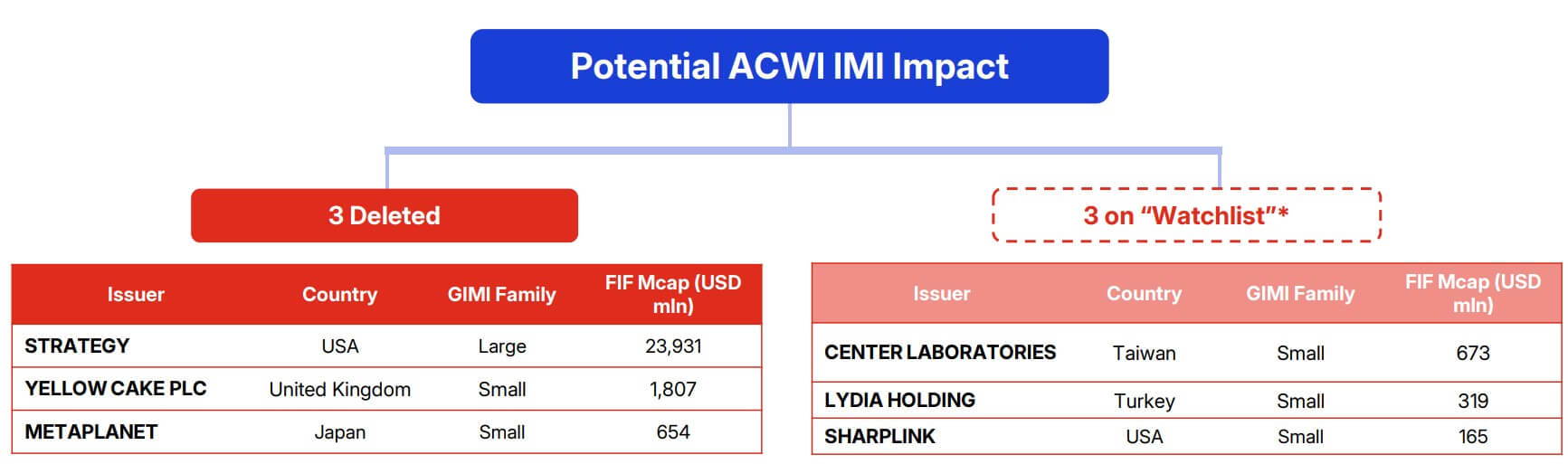
The firm noted that applying the proposed methodology to the MSCI ACWI IMI using May 2026 data would have resulted in three deletions, including Michael Saylor-led Strategy, Tokyo-listed Bitcoin holder Metaplanet, and London-listed uranium investor Yellow Cake.
Strategy pushed back against the premise of MSCI’s proposal, arguing that index providers should reflect markets rather than influence corporate asset allocation.
It said:
“MSCI’s proposal puts it out of step with regulators, markets, and its own customers. Bitcoin doesn’t need MSCI. Neither does Strategy.”
Strategy's MSTR shares fell about 2% in pre-market trading following the news.
MSCI replaces its crypto threshold with a broader financial test
MSCI's latest approach reaches much further than the crypto-only rule it abandoned earlier this year.
The previous consultation focused on companies whose primary business involved Bitcoin or other digital-asset treasury activities and proposed excluding firms when digital assets represented at least 50% of total assets.
MSCI dropped that plan in January, saying digital-asset treasury companies would remain eligible while it studied the wider category of businesses whose activities appeared predominantly investment-oriented.
The August proposal resulted from that broader review.
Under the new methodology, a company first faces a core screen measuring operating assets as a percentage of total assets. A company with operating assets above 50% passes. Those below that level move to a second stage consisting of five financial tests.
Those tests examine operating assets, operating expenses, cash generation, exposure to fair-value movements, and dependence on external capital.
For companies seeking inclusion, MSCI's proposed flags include operating assets below 20% of total assets, operating expenses below 5%, negative operating cash flow and non-operating fair-value changes above 5% of total assets.
The capital-dependence test would flag companies whose financing cash flow exceeds 20% of assets and whose filings show capital raising was used to accumulate assets.
Triggering at least four of the five flags after failing the core screen would make a company ineligible for the index.
Meanwhile, existing index constituents receive more room before deletion. For those companies, operating asset intensity would have to fall below 10% rather than 20%, while capital dependence would have to exceed 30% rather than 20%.
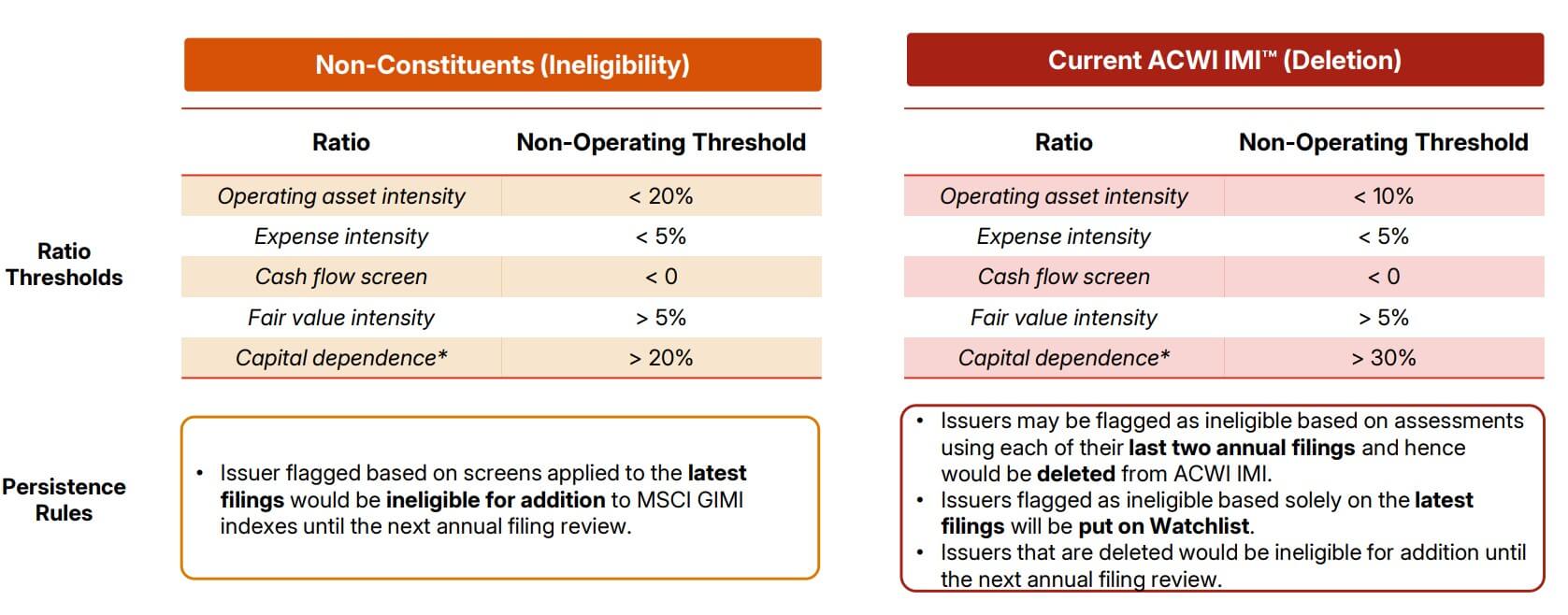
They would also have to fail the test across two consecutive annual reviews before MSCI removed them. Companies that fail only on the latest filing would instead go onto a public watchlist.
That persistence requirement is why the consultation does not translate directly into an immediate Strategy deletion.
Yellow Cake's inclusion also demonstrates how far MSCI has moved beyond its previous approach. The company owns physical uranium, yet its asset-heavy structure brought it into the same screen as Strategy and Metaplanet.
Strategy-focused analyst Adam Livingston said the revised methodology represents a more credible threat than MSCI's earlier crypto-specific effort because it applies a general financial framework rather than singling out Bitcoin treasury companies.
Livingston's own analysis suggests Strategy could be vulnerable on operating asset intensity, expense intensity and fair-value exposure, while positive operating cash flow and financing cash flow of roughly 26% of assets could allow it to avoid two other flags. That would leave it with three failures, one short of MSCI's four-test requirement.
Index pressure arrives as Strategy sells Bitcoin
The renewed MSCI threat comes as Strategy's long-running Bitcoin accumulation cycle has already slowed, with the company selling BTC and directing more capital toward cash reserves and obligations tied to its expanding securities structure.
Strategy has sold more than 6,000 BTC in recent weeks and has not disclosed a new Bitcoin purchase for nearly two months. Its holdings have fallen to roughly 840,447 BTC, while its dollar reserve has climbed to about $4.7 billion.
The sales mark a change from the model that drove Strategy's Bitcoin holdings sharply higher over the past several years. The company has historically issued common stock and other securities, then used much of the proceeds to purchase Bitcoin.
However, that approach has changed more recently, and Bitcoin itself has become a source of liquidity under its wider capital-management model. This framework allows Strategy to raise equity and preferred stock, issue debt, use cash, or sell Bitcoin depending on relative market conditions and its financial obligations.
An MSCI removal could make one of those funding channels less effective.
JPMorgan analysts estimated during MSCI's previous consultation that Strategy could face about $2.8 billion of selling if it were removed from MSCI indexes. The estimate rose substantially if other major index providers followed.
Such selling would occur in MSTR shares held by index-tracking investors. It would not directly remove cash from Strategy or automatically require the company to sell any of its Bitcoin.
The secondary effect could be more important for its accumulation strategy.
Strategy has benefited from periods when MSTR traded at a premium to the value of the Bitcoin underlying each share. Selling common stock at elevated valuations allowed the company to raise capital and buy additional Bitcoin while limiting the dilution required for each dollar raised.
Livingston said a large wave of index-related selling could push MSTR lower and compress that premium, weakening the economics of future equity issuance. At a $95 share price, his $2.8 billion scenario would equate to roughly 29.5 million shares changing hands.
That risk is more pronounced as Strategy tries to balance its Bitcoin ownership against preferred dividends, debt, and its growing cash reserve. An index exclusion would add another source of pressure to a capital structure that has recently shifted from uninterrupted Bitcoin accumulation toward more active liquidity management.
Still, even a large MSCI-driven selloff would leave Strategy holding hundreds of thousands of Bitcoin. Livingston argues that the greater threat is to the speed and efficiency of future accumulation.
October decision approaches as traders price higher removal odds
The uncertainty now moves toward an October deadline, giving Strategy and MSCI less than two months before the proposed framework could move from consultation to index policy.
MSCI will accept feedback through Sept. 30 and expects to announce its decision on or before Oct. 16. Any approved changes are proposed for implementation during the November 2026 Index Review. MSCI also cautioned that the consultation may result in some, all, or none of the proposed changes.
Prediction market traders have become increasingly skeptical that Strategy will survive the year without an MSCI removal.
A Polymarket contract covering whether Strategy will be removed from either the MSCI World or MSCI USA Index by Dec. 31 was pricing the probability at about 73% this week. The signal comes with a significant caveat: only about $5,700 had traded in the year-end contract even though the broader event page showed more than $1.18 million in volume, most of it tied to earlier, already resolved deadlines.
Using the proposed methodology and May filings, Strategy already appeared among the three companies marked for deletion.
The October result will determine whether that simulated outcome remains theoretical or becomes a new constraint on Strategy's capital-markets model.

Bitcoin is -1.26% over the past 24 hours and currently sits at rank #1 by market cap.
Mentioned in this article




Editorial credits