Quick Take
- September's ISM services prices index rose to 74.0, its highest since July 2022, while headline growth slowed.
- Jefferson's October 1 remarks preceded the release and described upside inflation risks after September's quarter-point rate increase.
- The Bitcoin financing channel remains conditional, with perpetual funding distinct from Fed rates and no demonstrated survey-driven reaction.


The US services prices gauge reached a four-year high in September even as growth slowed, a combination that could keep leveraged Bitcoin positions exposed to restrictive financing conditions. The October 5 survey pairs softer activity with more widespread reports of rising input costs.
The Institute for Supply Management's services report, issued on its October 5 release date, put the prices index at 74.0, up from 72.6 in August. That was its highest reading since July 2022, when it reached 74.5.
The headline services PMI eased to 54.9 from 55.4, while business activity dropped to 56.5 from 61.7. Both remained above the 50 expansion threshold. Employment moved the other way, rising from 47.8 to 50.1 and returning to slight expansion after two months of contraction.
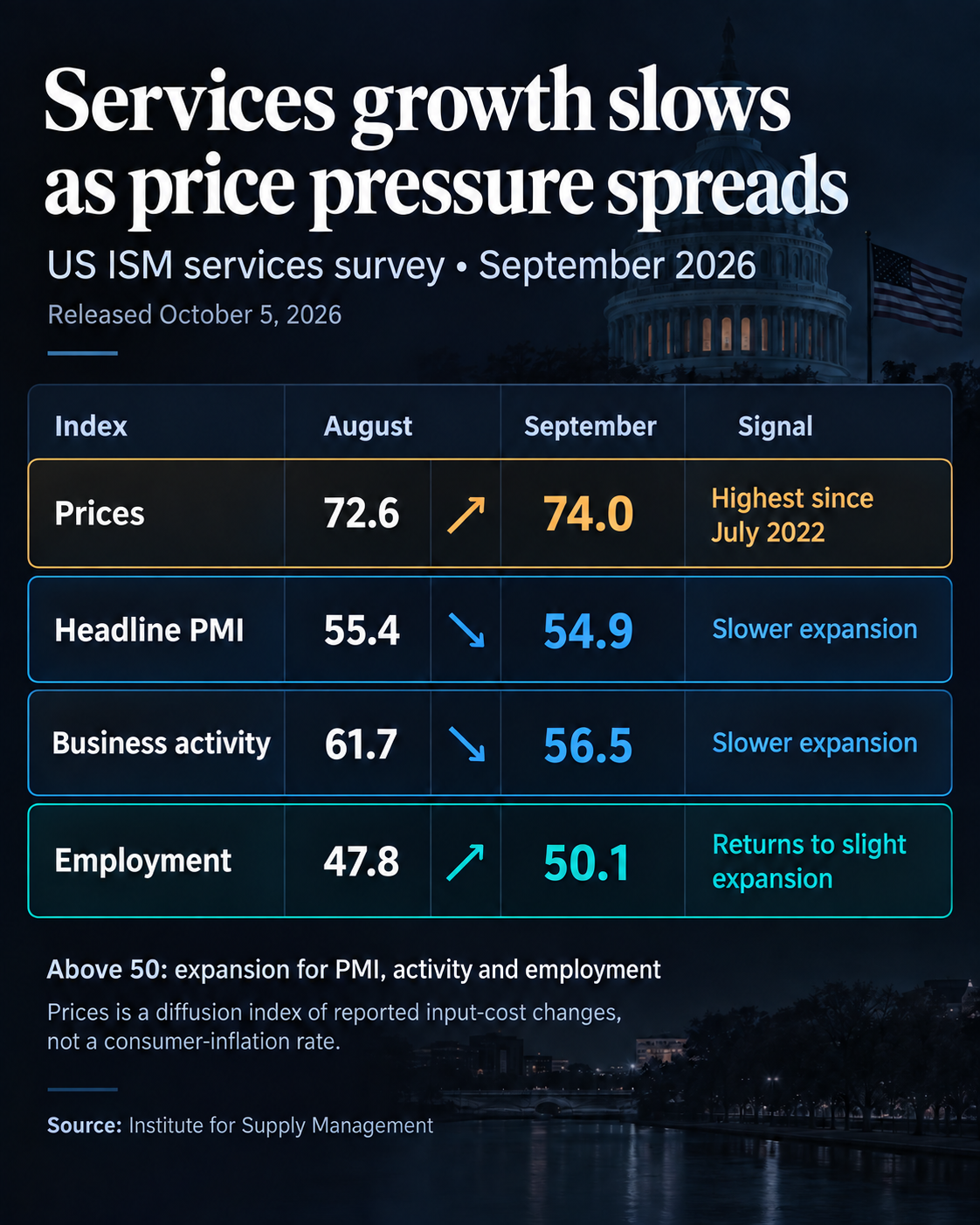
Growth therefore lost momentum while reported input-cost increases became more widespread. ISM's prices gauge is a diffusion index describing the direction and breadth of monthly input-cost changes across survey respondents. Its 74.0 reading provides no estimate of the size of price increases and cannot be read as a consumer-inflation rate.
Why the rates risk persists for Bitcoin
Fed Vice Chair Philip Jefferson said on October 1 that inflation risks tilted upward. He also described September's quarter-point increase in the federal funds target range to 3.75%-4.00% and said future adjustments should depend on the data, outlook and balance of risks.
His remarks preceded the services release. The survey adds cost-pressure evidence to a policy debate already underway. Slower expansion gives investors one part of the picture; rising input-cost pressure keeps the prospect of rate relief uncertain.
For leveraged Bitcoin exposure, the concern is how that uncertainty affects financing and willingness to take risk. If persistent costs make rate relief less likely and investors become more cautious, financing-sensitive positions could face pressure. Leverage would magnify a trader's losses from an adverse price move: the CFTC explains that margined virtual-currency futures traders can be forced to replenish collateral or close positions when markets move against them.
The Fed's policy rate and perpetual-futures funding operate differently. Coinbase's documentation describes funding as payments between long and short positions that help align perpetual prices with spot prices. Bitcoin perpetual funding needs its own market observation; it cannot be inferred from the federal funds target.
Historical evidence also cautions against treating the price connection as automatic. A February 2023 New York Fed study using intraday data found Bitcoin largely disconnected from monetary and macroeconomic news in its sample.
Bitcoin traded near $85,580 on CryptoSlate's October 6 page, down 0.04% over 24 hours. That rolling change cannot identify a reaction to the ISM release.
The funding-risk case would strengthen if adverse policy or yield repricing coincided with weaker leveraged demand. Easing cost pressure, stable rate expectations or stronger buying without leverage would weaken it. Slower services expansion alone offers little assurance of relief for leveraged Bitcoin positions; the effect on their financing still needs evidence from markets.
Mentioned in this article

Editorial credits