
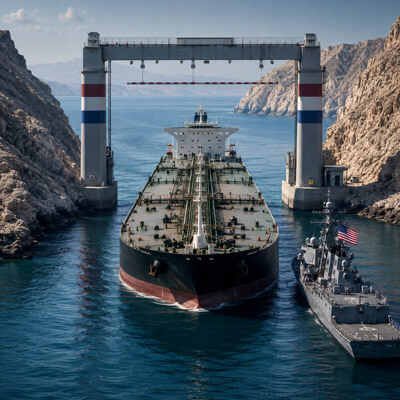
US charges Hormuz fees by…?
Current Odds
Odds Summary
Polymarket reports 4.1% for Yes and 96% for No.
Polymarket · Last synced
Market Analysis
Hormuz fee market weighs Trump threat against maritime law friction

A presidential threat gave the market a real trigger, while the rules demand actual U.S. collection, a much harder threshold. The gap between rhetoric, maritime law, and agency implementation explains why later deadlines carry weight while near-term dates stay thin.

The market’s pricing is best read as a split verdict on power versus process: a U.S. president publicly floated a 20% Strait of Hormuz cargo fee, yet the contract resolves only if the government actually collects money for transit or protection. That distinction matters because political intent can move quickly, while maritime billing, sanctions policy, allied consent, and legal authority usually move through institutions that create delay and expose weak points.
The price starts with a real presidential trigger
The strongest reason this market has any meaningful probability is the July 13 statement reported by AP News, in which Trump said the U.S. would blockade Iran in the Strait of Hormuz and charge ships a 20% fee as reimbursement for protection. For market purposes, that was a concrete catalyst: it named the waterway, the payer base, the fee concept, and the protection rationale that matches the resolution language.
The subsequent walkback within a day helps explain the steep date curve. Near-term outcomes imply little room for the government to convert a presidential statement into a collected payment, while the December 31 outcome leaves space for a new executive order, emergency maritime directive, Treasury framework, or negotiated reimbursement mechanism. The roughly $701,000 in volume shows the market has processed more than a stray headline, yet the low prices across all dates suggest participants are separating announcement risk from administrative completion.
Actual collection is a higher bar than announcing reimbursement
The rule set forces attention onto proof of payment, not policy theater. A public demand, invoice template, naval deployment, or threat against shipping companies would still fall short unless the U.S. government collects money from a shipping company, vessel, foreign government, or another relevant entity. That is why the difference between July 17 at 0.3%, July 31 at 1.4%, August 31 at 4.3%, and December 31 at 10% is informative: each later deadline gives agencies more time to design a collection channel and gives geopolitical pressure more time to intensify.
The hidden assumption behind the later-date pricing is that the White House could find an implementation path that avoids a straightforward transit toll. A reimbursement for U.S. naval protection, a charge tied to convoy participation, or a payment from a foreign government could fit the resolution more easily than a universal Hormuz toll. That matters because the contract language is broad; it includes fees, tolls, and reimbursements for transit or protection, leaving room for a payment architecture that looks different from the original 20% cargo proposal.
Maritime agencies create delay before diplomacy even enters
The Federal Maritime Commission’s March statement is a practical brake on rapid resolution. The FMC said tariff charges related to Strait of Hormuz conditions must comply with the Shipping Act and generally require 30 days’ notice unless special permission is granted. For the market, that notice requirement makes near-term collection difficult even if a carrier or intermediary tried to pass through a Hormuz-related charge.
The International Maritime Organization’s position adds a wider legal constraint. AP reported that the IMO was firmly against charging fees for passage through straits used for international navigation and said there is no legal basis for mandatory tolls simply to transit a strait. That posture does not prevent the U.S. from attempting a protection reimbursement, but it raises the diplomatic cost of anything that resembles a compulsory transit fee. The market’s low aggregate probability appears to price that resistance as a serious obstacle to converting rhetoric into cash receipts.
Iran’s toll demands make the concept legible and escalatory
Treasury and OFAC context explains why the idea did not vanish from market pricing after the walkback. OFAC warned on May 1 that Iran had demanded toll payments for safe passage through the Strait of Hormuz and that such payments could involve fiat currency, digital assets, offsets, or in-kind transfers. Treasury later said Iran’s IRGC was extorting vessels through a so-called Persian Gulf Strait Authority and charging fees for passage.
That background matters in two ways. First, it shows that toll-style payment schemes in Hormuz have already become a sanctions and maritime-security issue, making the U.S. proposal part of an active policy conflict instead of an isolated remark. Second, it raises the escalation threshold: if Washington adopts its own fee structure while accusing Tehran of maritime extortion, opponents would likely frame the move as legitimizing the same behavior the U.S. is sanctioning. The market appears to assign some probability to escalation, while heavily discounting a clean legal rollout.
Repricing would require documents, invoices, or a security shock
The clearest confirming evidence would be operational rather than rhetorical. A Federal Register notice, FMC special permission, Treasury guidance authorizing a protection reimbursement channel, Defense Department convoy-fee procedures, or a public invoice to a carrier or foreign government would matter because each would shorten the distance between proposal and collected payment.
- A formal U.S. collection mechanism tied to Hormuz protection would support later-deadline outcomes.
- A carrier disclosure showing payment to a U.S. entity for Hormuz transit or protection would directly target the resolution threshold.
- An IMO, allied, or congressional challenge could slow implementation by raising legal and diplomatic costs.
- A new attack on shipping, mine incident, or Iranian toll demand could revive the reimbursement argument as an emergency security measure.
The main failure mode is a workaround that never becomes a U.S. fee
The largest counter-signal is that the U.S. may choose pressure tools that avoid the resolution trigger: sanctions on Iranian-linked toll collectors, naval escorts funded through existing appropriations, insurance-market coordination, or allied cost-sharing without a designated Hormuz transit or protection payment. Those paths could answer the same security problem while leaving the market unresolved because no qualifying fee is collected by the U.S. government.
That failure mode explains the current shape of the market. The December deadline carries meaning because a presidential threat, active Iranian toll allegations, and a volatile strait create plausible catalysts. The near-term dates stay compressed because collection requires agencies, counterparties, legal cover, and documentary evidence. Until those pieces appear, the market is pricing Hormuz fees as a possible escalation scenario with a demanding evidentiary threshold.
Sources
What Could Move the Odds?
Market-Implied Thesis
The pricing implies the U.S. is unlikely to collect any qualifying Hormuz transit or shipping-protection payment before the cutoff.
This reflects a world in which rhetoric does not become an actual U.S. collection arrangement. Trump’s reported reversal of a toll proposal and Treasury’s attribution of fee-like coercion to Iran reinforce that view.
What Could Reprice It
A formal U.S. decision creating a payable protection reimbursement or transit-charge mechanism would most directly challenge the current thesis.
No dated post-October 13 decision is supplied. The key repricing category is an official mechanism that results in the U.S. collecting payment, rather than diplomatic discussion or a proposed policy.
Where the Market May Be Weak
The signal may be vulnerable to sparse participation relative to a fast-moving policy event, so low odds may not fully reflect new official developments.
The market’s displayed liquidity, open interest, and trader count show some engagement, but they cannot establish that informed participants would rapidly price a nonpublic or abruptly announced collection arrangement.
Counter-Signal
The thesis could fail because settlement covers U.S. collection of protection reimbursement, not only a conventional Hormuz toll.
Contemporaneous reporting described discussion of reimbursement or protection payments. Even after the reported toll reversal, a differently structured payment from a shipping firm, vessel, or foreign government could still.
Market Details
- Resolution criteria
- This market will resolve "Yes" if the United States government collects a payment from any shipping company, vessel, foreign government, or other relevant entity as a fee, toll, or reimbursement for transit through the Strait of Hormuz, or for the protection of shipping in the Strait of Hormuz, by the listed date, 11:59 PM ET. Otherwise, this market will resolve "No".
- Platform
-


- Category
- Politics › Iran
- Scheduled deadline
- January 1, 2027, 4:59 AM UTC
- Market rules summary
- Binary market. Payout is 1 USDC for a winning outcome, 0 USDC for a losing outcome. View full rules
Frequently Asked Questions
What are the current US charges Hormuz fees by… odds?
Polymarket reports US charges Hormuz fees by… odds with No at 96% and Yes at 4.1%. These probabilities are market-implied and can change as liquidity and trading activity update. The latest market snapshot includes $127.01K volume, $58.87K liquidity, and $33.05K open interest. CryptoSlate last synced this market data at Oct 18, 2026, 15:47 UTC.
What could move the US charges Hormuz fees by… prediction market odds?
The pricing implies the U.S. is unlikely to collect any qualifying Hormuz transit or shipping-protection payment before the cutoff. This reflects a world in which rhetoric does not become an actual U.S. collection arrangement. Trump’s reported reversal of a toll proposal and Treasury’s attribution of fee-like coercion to Iran reinforce that view. Catalysts to watch include Formal U.S. collection mechanism before the cutoff, Official U.S. payment-collection action, and Abrupt official announcement.
How does the US charges Hormuz fees by… prediction market resolve?
This market will resolve "Yes" if the United States government collects a payment from any shipping company, vessel, foreign government, or other relevant entity as a fee, toll, or reimbursement for transit through the Strait of Hormuz, or for the protection of shipping in the Strait of Hormuz, by the listed date, 11:59 PM ET. Otherwise, this market will resolve "No". Binary market. Payout is 1 USDC for a winning outcome, 0 USDC for a losing outcome.
Related Iran Markets
 US announces halt in Iran offensive operations date
 US x Iran Effective Ceasefire date
  Will the U.S. invade Iran before 2027?