

Peru Presidential Election Winner
Final Results
Scheduled deadline: Apr 12, 2026, 00:00 UTC




44 more outcomes Other final results
- Alfonso López ChauNo
- Vladimir CerrónNo
- José LunaNo
- George ForsythNo
- Roberto ChiabraNo
- Enrique ValderramaNo
- José WilliamsNo
- Fiorella MolinelliNo
- Ricardo BelmontNo
- Fernando OliveraNo
- Carlos EspáNo
- Rafael Belaúnde LlosaNo
- Yonhy LescanoNo
- Mesías GuevaraNo
- Marisol Pérez TelloNo
- Jorge NietoNo
- Roberto Sánchez PalominoNo
- OtherNo
- Wolfgang GrozoNo
- Candidate BNo
- Candidate CNo
- Candidate DNo
- Candidate ENo
- Candidate FNo
- Candidate GNo
- Candidate HNo
- Candidate INo
- Candidate JNo
- Candidate KNo
- Candidate LNo
- Candidate MNo
- Candidate NNo
- Candidate ONo
- Candidate PNo
- Candidate QNo
- Candidate RNo
- Candidate SNo
- Candidate TNo
- Candidate UNo
- Candidate VNo
- Candidate WNo
- Candidate XNo
- Candidate YNo
- Candidate ZNo










Market Resolution
Polymarket reports Keiko Fujimori as the winning outcome for the Peru Presidential Election Winner prediction market with a final probability of 100%. Scheduled deadline: Apr 12, 2026, 00:00 UTC. Final reported trading volume was $107.15M.
Polymarket · Final sync
 Brazil Presidential Election

 Next French Presidential Election


 Presidential Election Winner 2028


Market Analysis
Fujimori’s dominant price depends on a fragmented challenger field
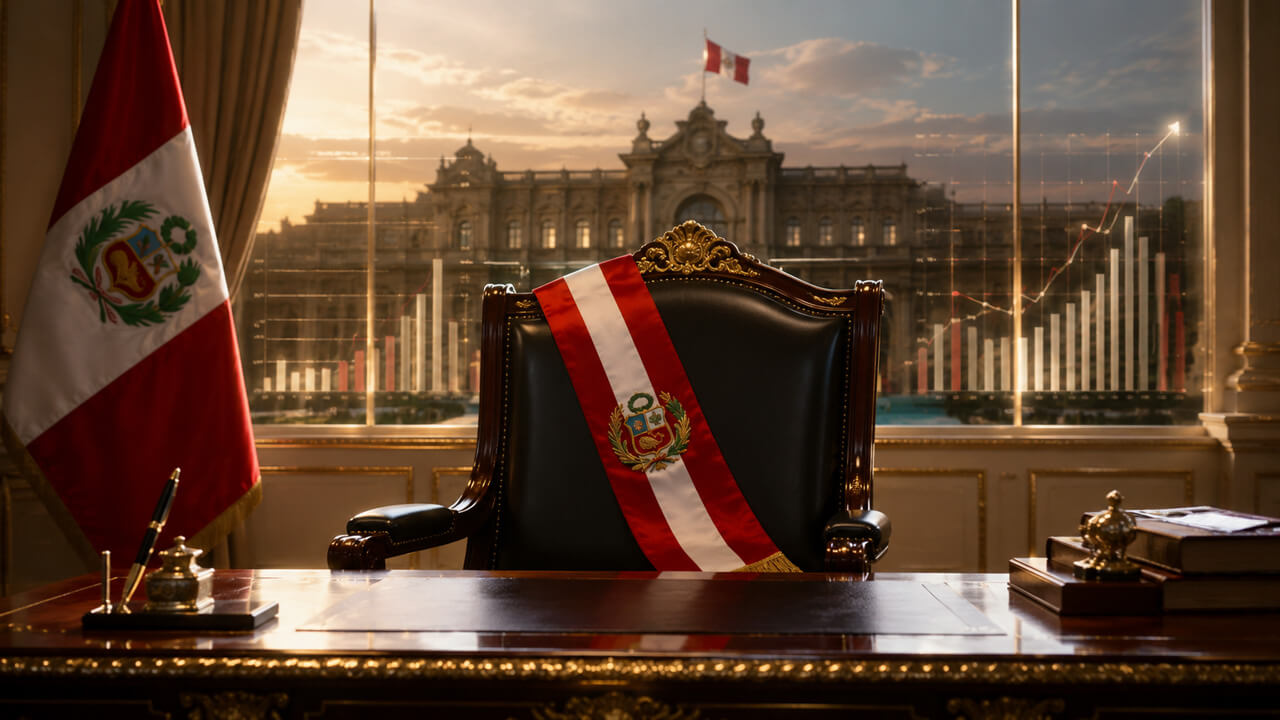
Peru’s 2026 presidential contract has concentrated around one name, yet the concentration depends on assumptions about ballot clarity, official recognition, and rival coordination. The most important shocks may come from the election process itself before campaign narratives alter the favorite’s standing.

The Peru presidential market is telling a concentrated story: Keiko Fujimori has become the dominant outcome, while almost every listed alternative sits near the minimum quoted price. The size of the position set gives that story editorial weight, because $99.44 million in volume and $12.73 million in liquidity make the current pricing harder to dismiss as a stray early print.
One candidate has become the market’s organizing assumption
At 96.4%, Fujimori is priced as the default answer to the event’s resolution question. Roberto Sánchez Palomino is the only other name above noise at 3%, while Rafael López Aliaga sits at 0.2% and the rest cluster around 0.1%. That distribution matters because it implies the market sees fragmentation among alternatives as part of Fujimori’s advantage. A challenger can have a plausible path in isolation, yet remain barely priced if the market has no shared answer about which challenger would inherit anti-Fujimori probability.
Depth makes casual narrative shifts harder to sustain
The depth turns the price into a coordination device. With $8.34 million in open interest, a material pool of capital is already organized around Fujimori as the focal outcome. That can make incremental headlines less powerful unless they directly threaten candidate eligibility, the election timetable, or the identity of the officially recognized winner. The market can absorb routine campaign noise because the current structure prices a broad lead over a fragmented slate; a single rival would need evidence of consolidation to change the basic shape.
Official settlement puts procedural shocks near the center
Polymarket lists ONPE as the settlement source, and the market closes on April 12, 2026, when general elections are scheduled. This places official recognition above campaign coverage for resolution purposes. Anything that changes the official candidate list, the timing of the count, or the way the winner is identified would hit price with unusual force. The market’s concentration assumes the named option remains cleanly mappable to the person ONPE ultimately identifies.
| Market-implied assumption | Evidence that could force repricing |
|---|---|
| Fujimori remains the clear focal candidate | Official developments affecting ballot status or eligibility |
| Alternatives stay fragmented | Polling, alliances, or withdrawals that elevate one rival |
| ONPE resolution is straightforward | Ambiguity around timing, certification, or candidate identity |
| Liquidity continues to support concentration | Open interest migrating into a challenger outcome |
Confirmation would come from public proof of the same map
The current structure would be reinforced by evidence that turns the market’s implicit assumptions into public facts: a stable official calendar, clear inclusion of the leading candidate in the official process, and polling or alliance signals that keep challengers from clustering around one rival. Since the supplied source set excludes polls and party registration detail, those items are hypothetical catalysts in this analysis. Their significance comes from the way the odds are distributed: with most alternatives near 0.1%, even modest consolidation behind one named challenger would challenge the core shape of the market.
The counter-signal is a challenger becoming the shared reference point
Roberto Sánchez Palomino’s 3% share matters because it is the one visible outlet for skepticism within the listed field. The price does not imply a full two-candidate race; it shows where the market has placed the only material alternative marker. A hypothetical poll, endorsement bloc, ballot decision, or withdrawal sequence that makes another name the obvious anti-favorite would force probability to migrate from dormant 0.1% outcomes into an active challenge. The first sign of repricing may therefore be a shift in the second-place cluster before Fujimori’s own price moves dramatically.
That is why the market’s next meaningful move is likely tied to information that resolves identity and coordination questions. Routine campaign volatility can be discounted when the field is priced as atomized. Official developments, credible candidate eligibility changes, or a second contender becoming the shared reference point would speak directly to the assumptions supporting a 96.4% front-runner price. Until those assumptions are tested by sourced election-process data, the market reads as a price on continuity in the candidate map as much as on vote share.
Sources
Market Details
- Resolution criteria
- General elections are scheduled to be held in Peru on April 12, 2026.
- Platform
-


- Category
- Politics › Global Elections
- Scheduled deadline
- April 12, 2026, 12:00 AM UTC
- Settlement source
- onpe.gob.pe
- Market rules summary
- Multi-outcome Polymarket event. Each listed option is represented by its Yes price on the underlying market. View full rules
Frequently Asked Questions
What was the final result of the Peru Presidential Election Winner prediction market?
Polymarket reports Keiko Fujimori as the winning outcome for the Peru Presidential Election Winner prediction market with a final probability of 100%. The final market snapshot includes $107.15M volume and $6.35M open interest. CryptoSlate last synced the final market data at Jul 6, 2026, 13:57 UTC.
How does the Peru Presidential Election Winner prediction market resolve?
General elections are scheduled to be held in Peru on April 12, 2026. Multi-outcome Polymarket event. Each listed option is represented by its Yes price on the underlying market. The settlement source listed for this market is Onpe.
Related Global Elections Markets
 Who will win the 2026 Vancouver mayoral election?


 Who will win the 2026 Toronto mayoral election?


 Next Premier of Quebec