


Quick Take
- Solana's 250ms target kept skip rates low and broadly stable, the Foundation found.
- Validators counted equally lost 1.6360% of vote credits, versus 0.0874% when weighted by stake.
- Vote credits affect staking rewards, but the study did not quantify individual SOL payouts or establish that shorter slots caused the gap.


Solana's faster clock has not, so far, brought a network-wide jump in skipped slots. But a Solana Foundation study published Sept. 28 found a less even result underneath that stable headline: vote latency rose as the network moved through shorter slot targets, and validators with less stake lost a larger share of vote credits than the stake-weighted network average at 250 milliseconds.
That difference matters because vote credits feed into staking rewards. The Foundation reported group credit-loss fractions, not individual SOL payouts. Its findings make the proposed move to 200ms an economic question as well as a speed question, without showing that the 250ms change itself caused the disparity.
The Foundation's analysis says skip rates stayed low and broadly stable as target slot times fell to 250ms. On that measure, the network continued to produce blocks without evidence in the study of a broad consensus problem. The 250ms feature gate was listed as active on Mainnet in the Foundation's September changelog.
Voting told a more uneven story. As the slot target shortened, the study found that votes took more slots to land, with the largest increase among nodes in Asia and South America. Solana's network-average vote latency nevertheless remained well below two slots, and the Foundation said it saw no evidence of consensus instability. Higher latency for some validators therefore sits alongside healthy aggregate consensus performance.
The geographic data have a further limit. The Foundation counted only seven Asia-to-Oceania and 35 Europe-to-Oceania leader handoffs while the 250ms target was in place. It said those small samples were insufficient to rule out a statistical fluke in the apparent regional skip patterns. They do not establish a general skip-rate penalty for validators in those regions, even as the separate vote-latency observation warrants attention.
The reward question sits in vote credits
At the 250ms target, validators counted equally lost 1.6360% of vote credits in the Foundation's table. When the same measure was weighted by stake, the lost fraction was 0.0874%. The lower stake-weighted figure means that larger-staked validators, as a group, lost proportionally fewer credits than the population of validators considered one by one.
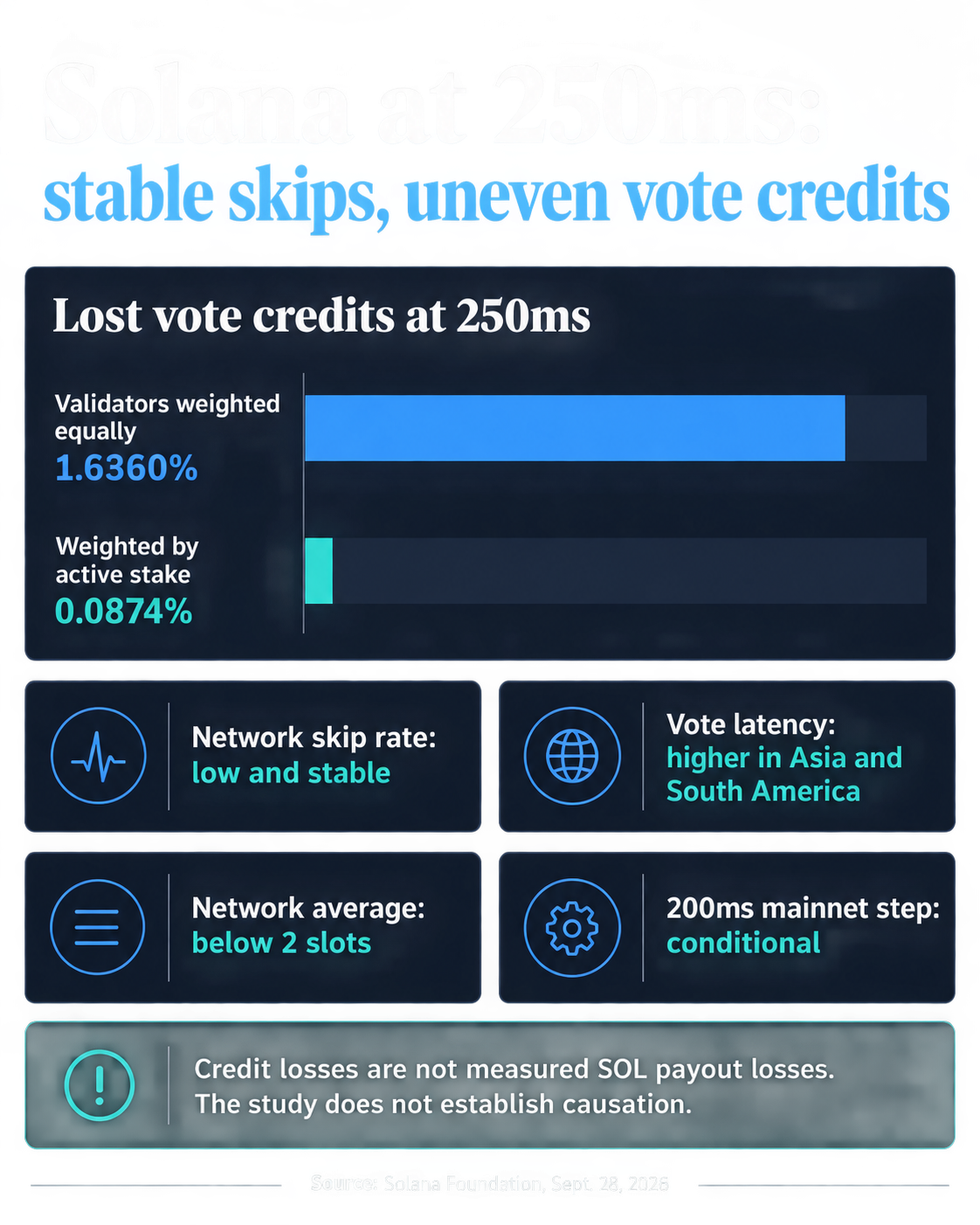
This is the divide that an aggregate uptime figure cannot describe. A stake-weighted average gives greater influence to operators with more delegated SOL. It can remain very low even when some smaller operators lose a greater fraction of credits. The table does not identify a SOL payout loss for any particular operator.
Solana's staking documentation explains the mechanism connecting votes to money: vote credits weighted by stake help determine inflationary rewards issued each epoch to validators and delegators, and validator commissions affect the amount delegators receive. That makes credit performance economically relevant. It does not make 1.6360% or 0.0874% a reward-loss percentage. Actual payouts also depend on the stake delegated, the epoch's reward pool and commissions, so neither table entry can be converted into an operator's lost SOL without account-level reward data.
Nor does the gap alone identify its cause. Stake size, geography and voting performance may be related in the observed sample, but the published group comparison does not isolate the effect of shorter slots from other validator conditions. The result is an observed distributional gap, with its cause and payout size still unresolved.
The Foundation's September study treats 200ms as a possible next target, while the staged slot-time proposal describes it as a separate feature-gated step. The cited Foundation updates report 250ms on Mainnet and discuss 200ms as a possible next target. Any forecast of validator rewards at that faster target is therefore conditional.
There is also a protocol boundary to the comparison. Under today's system, votes are transactions that must land on-chain. The Foundation says the planned Alpenglow design would instead send votes directly between validators and collect proof of voting within eight slots. If that change arrives, the present vote-latency mechanism would not carry over unchanged. The study therefore supports caution about extending today's pattern to a future 200ms network, especially one operating under a different voting design.
For a 200ms decision, the test is broader than whether blocks keep arriving. The Foundation's figures show a functioning network and uneven credit losses across stake sizes. They support scrutiny of reward distribution at the next speed step, without establishing a quantified SOL loss for any validator.
Mentioned in this article

Editorial credits