

What will Anthropic’s valuation hit by December 31?
Current Odds
5 more outcomes Listed by current odds, highest first
Odds Summary
Above $1.5T leads at 92.5% reported probability on Polymarket.
Polymarket · Last synced
Market Analysis
Anthropic’s Trillion-Dollar Ladder Tests AI Demand Against Financing Reality
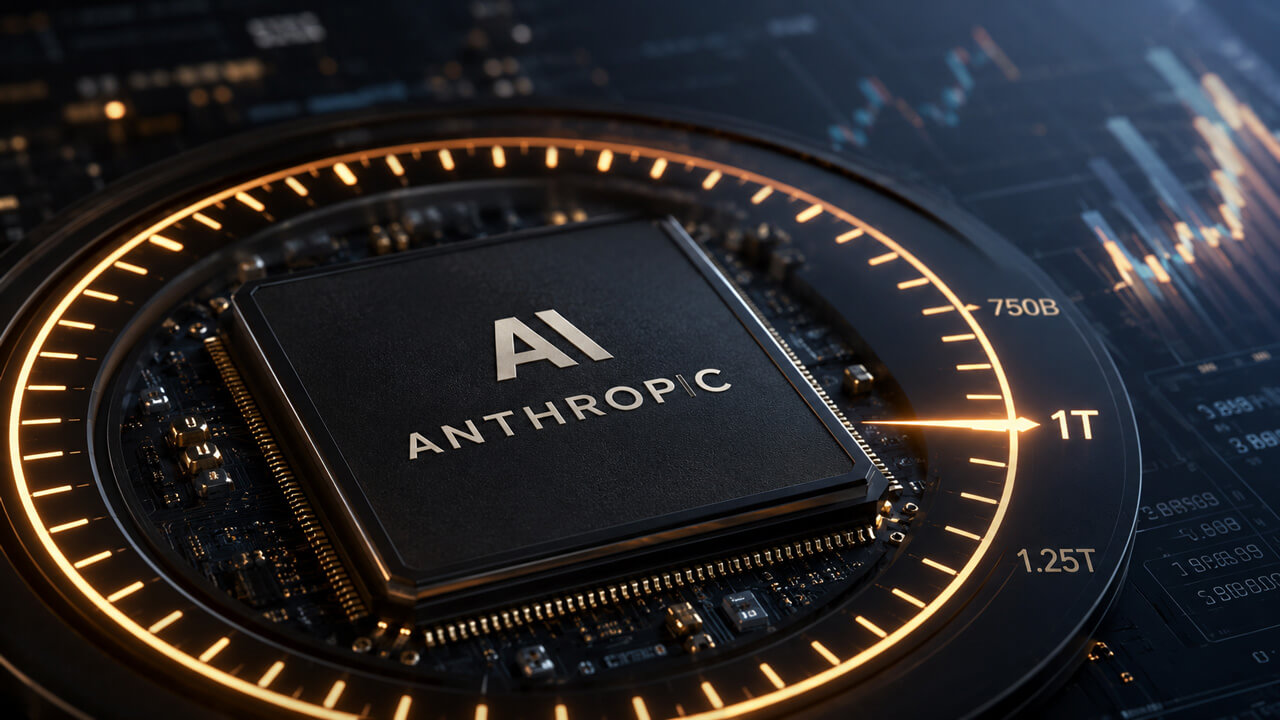
The odds imply a market confident that Anthropic can touch lower trillion-dollar marks before the 2026 cutoff, yet far less willing to carry that confidence into the $3 trillion to $5 trillion bands. The split points to settlement mechanics, round timing, and private-market proof as the pricing battleground.

This market is pricing a high chance that Anthropic records a trillion-plus private-market print by Dec. 31, 2026, while requiring much stronger proof for the extreme bands. That shape matters because resolution turns on the Nasdaq Private Market NPM Price for any date in the window, so one qualifying print can settle a threshold even if valuation sentiment later cools.
The ladder prices a one-print path to the lower trillions
The market-implied story is clearest in the slope. The $1.1T and $1.25T bands sit at 97% and 92.5%, while $1.5T still trades at 73.5% and $1.75T at 61.5%. From those odds, the inferred base case is that a settlement-grade private-market mark reaches the lower trillion range during the market window. The significance is the word during: the contract cares about a high-water mark, which makes timing and transaction visibility as important as any end-of-year view.
| Valuation band | Yes price | What the ladder implies |
|---|---|---|
| $1.1T to $1.25T | 97% to 92.5% | Strong confidence in at least one qualifying print. |
| $1.5T to $2.0T | 73.5% to 47% | Confidence falls as the required mark approaches a larger financing hurdle. |
| $3.0T to $5.0T | 25.5% to 5.5% | The market assigns much lower probability to an extreme private valuation print. |
That steepening matters because it separates belief in AI valuation momentum from belief in an actual transaction that NPM can measure. A narrative can travel quickly; the settlement source still needs a valuation datapoint that reaches the listed level.
The hidden assumption is that official private marks keep pace
The rules make the NPM Price the operative measurement, which creates a hidden assumption behind the high lower-band odds: private-market reporting will capture any valuation jump quickly enough and clearly enough. If a financing headline, secondary sale, or company-related report fails to translate into the NPM figure, it has limited settlement force. That distinction matters because markets often react to public reports before the designated data source updates.
The supplied activity levels add weight without removing fragility. With $1.57 million in volume, $748,810 in open interest, and $283,010 in liquidity, the ladder is large enough to reflect active positioning across thresholds. At the same time, the tails can still react sharply to a single source update because settlement is concentrated around one private-market data feed.
Extreme thresholds need a transaction the source can see
The drop from 47% at $2.0T to 25.5% at $3.0T, then 12.5% at $4.0T and 5.5% at $5.0T, suggests a market that distinguishes incremental valuation growth from a major repricing event. The inference is that higher bands require more than general AI enthusiasm. They likely require a financing round, tender offer, secondary transaction, or comparable private-market event that produces a valuation NPM can report.
That matters because the higher thresholds compress two conditions into one price: Anthropic must be valued at or above the level, and that valuation must be visible through the settlement source before the deadline. A hypothetical strategic investment with disclosed pricing could pressure multiple bands at once. A vague report about investor interest, by contrast, may move sentiment while leaving settlement evidence unresolved.
Repricing would likely start with one settlement-grade datapoint
The most powerful catalysts are those that connect directly to the resolution rule. A broad AI sector move may influence expectations, yet the contract’s decisive evidence is narrower. The odds would have the clearest reason to move if one of these hypothetical or source-driven events emerged:
- An NPM update showing Anthropic’s private-market valuation at or above a listed threshold.
- A hypothetical primary financing round with terms that imply a qualifying valuation.
- A hypothetical tender offer or secondary sale that feeds into the NPM Price.
- A hypothetical strategic investment with pricing terms visible to the settlement source.
- A reported private-market mark below expectations, which could weaken confidence in the higher bands.
The downward-labeled $600B, $700B, and $800B contracts sit around 10.5% to 12.5%, a cluster that matters as a reminder of path dependence and wording risk. Lower-band pricing can reflect hedging, settlement interpretation, or limited attention in a multi-outcome event, especially when the main focus is the upper valuation ladder.
The main counter-signal is a source that lags the story
The strongest counterargument to the cautious pricing of the highest bands is the long window. A single large financing before Dec. 31, 2026 could create a discontinuous jump, and the high-water-mark design means the valuation would only need to touch a threshold once. That possibility keeps even $4T and $5T bands alive in the ladder.
The main failure mode cuts the other way: public excitement, informal marks, or reported demand may fail to appear in NPM’s valuation data. If the settlement source lags, excludes a transaction, or records a lower private-market price, the contract can ignore narratives that feel important elsewhere. For this market, the decisive tension is the gap between AI valuation expectations and the narrower evidence that the rules allow.
Sources
What Could Move the Odds?
Market-Implied Thesis
The $2T threshold price implies a modestly more-likely-than-not view that Nasdaq Private Market will mark Anthropic at $2T or higher by year-end.
The ladder is cumulative, not a forecast of one exact valuation: stronger pricing at lower thresholds indicates the market expects a substantial step-up from Anthropic’s latest official $965B post-money anchor.
What Could Reprice It
Public-market feedback from Anthropic’s confidential S-1 process is the clearest potential repricing catalyst before the measurement window closes.
Anthropic disclosed its draft S-1 submission in June. Any later public filing, disclosed financial detail, or investor-demand signal could reset expectations for its private-market NPM price.
Where the Market May Be Weak
The quoted probability may overstate precision because trading turnover materially exceeds resting liquidity, leaving threshold prices vulnerable to marginal flow.
The market’s displayed activity does not establish that deep capital supports every price level. Its outcome is also tied specifically to an NPM Price, rather than a broadly observed financing or IPO valuation.
Counter-Signal
Anthropic’s latest official $965B post-money valuation leaves the $2T thesis requiring more than a doubling in the NPM mark within the remaining window.
Its reported $47B run-rate revenue supports a high valuation baseline, but the official May financing anchor is still well below $2T; a confidential S-1 submission does not itself establish IPO demand or a higher mark.
Market Details
- Resolution criteria
- This market will resolve to "Yes" if Anthropic's private market valuation, as measured by the NPM Price reported by Nasdaq Private Market, LLC (NPM) for any date between market creation and December 31, 2026, reaches or exceeds the listed amount. Otherwise, this market will resolve to "No".
- Platform
-


- Category
- Finance › AI
- Scheduled deadline
- January 5, 2027, 4:59 AM UTC
- Settlement source
- fe.secondmarket.com
- Market rules summary
- Multi-timeframe Polymarket event. Each listed timeframe is represented by its Yes price on the underlying binary market. View full rules
Frequently Asked Questions
What are the current What will Anthropic’s valuation hit by December 31 odds?
Polymarket reports What will Anthropic’s valuation hit by December 31 odds with ↑$1.5T at 92.5%, ↑$1.75T at 69.5%, ↑$2.0T at 61%, and ↑$2.5T at 23.5%. These probabilities are market-implied and can change as liquidity and trading activity update. The latest market snapshot includes $5.96M volume, $292.44K liquidity, and $1.92M open interest. CryptoSlate last synced this market data at Oct 21, 2026, 08:12 UTC.
What could move the What will Anthropic’s valuation hit by December 31 prediction market odds?
The $2T threshold price implies a modestly more-likely-than-not view that Nasdaq Private Market will mark Anthropic at $2T or higher by year-end. The ladder is cumulative, not a forecast of one exact valuation: stronger pricing at lower thresholds indicates the market expects a substantial step-up from Anthropic’s latest official $965B post-money anchor. Catalysts to watch include NPM valuation marks through December 31, 2026, Potential public S-1 filing or IPO-process feedback, and Changes in available order-book depth.
How does the What will Anthropic’s valuation hit by December 31 prediction market resolve?
This market will resolve to "Yes" if Anthropic's private market valuation, as measured by the NPM Price reported by Nasdaq Private Market, LLC (NPM) for any date between market creation and December 31, 2026, reaches or exceeds the listed amount. Otherwise, this market will resolve to "No". Multi-timeframe Polymarket event. Each listed timeframe is represented by its Yes price on the underlying binary market. The settlement source listed for this market is fe.secondmarket.com.
Related AI Markets
 Which AI model will lead Arena on October 19, 2026?
  Which company will lead Agent Arena in October 2026?


 When will OpenAI announce its paused training has resumed?