

Largest Company end of June?
Final Results
Scheduled deadline: Jun 30, 2026, 00:00 UTC




23 more outcomes Other final results
- Company DNo
- Company FNo
- Company HNo
- Company JNo
- Company LNo
- Company NNo
- Company PNo
- Company RNo
- Company TNo
- MicrosoftNo
- AlphabetNo
- Saudi AramcoNo
- Company ANo
- Company CNo
- Company ENo
- Company GNo
- Company INo
- Company KNo
- Company MNo
- Company ONo
- Company QNo
- Company SNo
- OtherNo


Market Resolution
Polymarket reports NVIDIA as the winning outcome for the Largest Company end of June prediction market with a final probability of 100%. Scheduled deadline: Jun 30, 2026, 00:00 UTC. Final reported trading volume was $24.64M.
Polymarket · Final sync
 Largest IPO by market cap in 2026?


 Tesla and SpaceX merger officially announce date?
  Largest Company 2026
 Market Analysis
Can Nvidia’s Commanding Lead Survive a One-Day Market-Cap Finish?
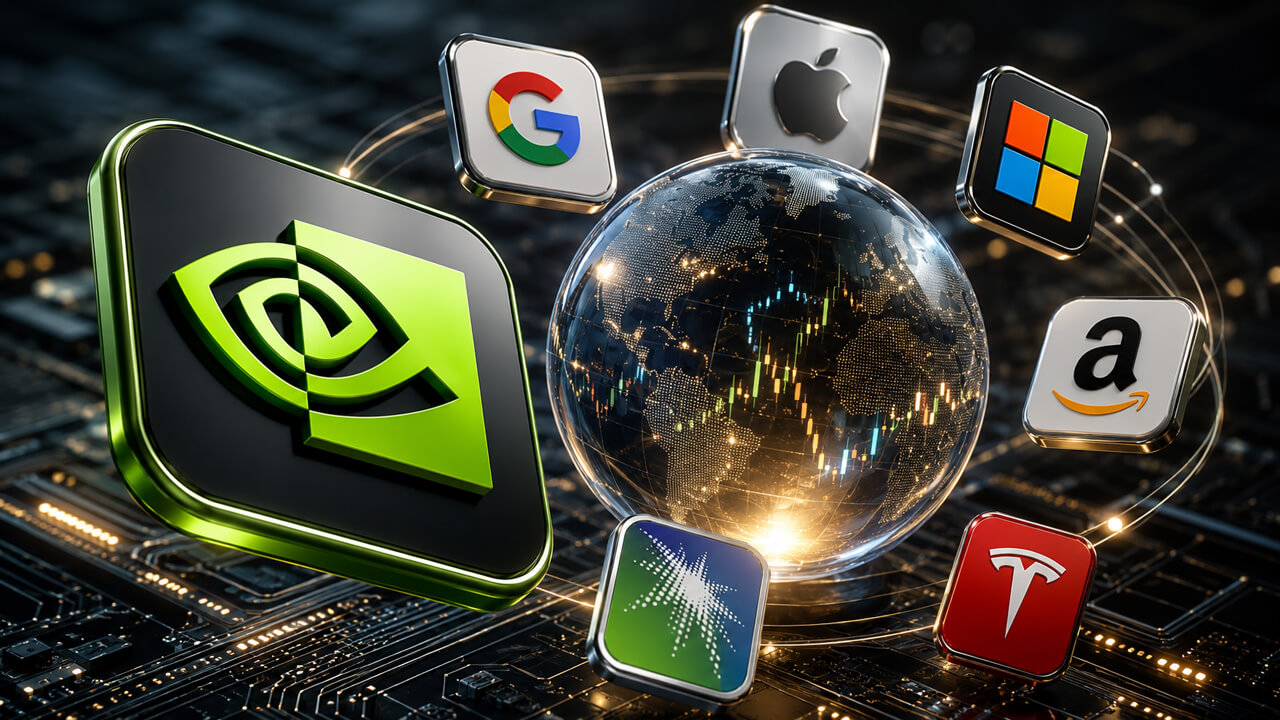
The market is treating June’s finish as a race with one dominant runner and several distant pursuers. That confidence depends on a narrow settlement moment, valuation momentum staying concentrated, and rivals failing to produce a catalyst large enough to compress the gap.

NVIDIA’s 94.9% price turns the June 30 settlement into a test of persistence: the market is assigning more importance to an assumed valuation cushion than to the long calendar of events that could shift the leaderboard. With $22.56 million in volume and $1.54 million in liquidity, that view carries enough depth to make any repricing dependent on visible evidence powerful enough to outweigh routine headline flow.
The price implies a race shaped by inertia as much as fundamentals
The market-implied story is straightforward: NVIDIA is being treated as the company most likely to have the largest market capitalization at the exact end-of-June measurement point. The 94.9% Yes price suggests that the field needs a large, timely change in relative valuation to alter the expected outcome. This matters because the question is comparative. NVIDIA can have mixed news and still resolve favorably if rivals fail to close the market-cap gap by the settlement close.
The distribution across alternatives reinforces that inference. Alphabet at 2.5% and Apple at 1.8% are the only other outcomes with visible probabilities above one percent, while Microsoft, Tesla, Amazon, and Saudi Aramco sit near token levels. That spread implies the market is treating the contest as highly concentrated, with a small set of plausible challengers and several names requiring a scenario shift large enough to change the shape of global equity leadership.
| Outcome | Yes price | Market-implied read |
|---|---|---|
| NVIDIA | 94.9% | Dominant expected finisher at the settlement point |
| Alphabet | 2.5% | Highest-ranked challenger in the listed field |
| Apple | 1.8% | Credible challenger with limited implied path |
| Microsoft | 0.2% | Large-company status receives little probability here |
| Tesla, Amazon, Saudi Aramco | 0.1% each | Scenario-dependent outcomes |
The settlement clock rewards whoever leads on one specific day
The rules resolve to the largest company in the world by market cap on June 30, 2026, as of market close. That single-day test matters because it compresses a broad corporate race into a timestamp. A company can lead for much of the month and still lose the market if a rival is larger at the close used for resolution. The high NVIDIA price therefore implies confidence in durability through the final date, not merely confidence in a favorable business narrative during the month.
This creates a hidden assumption about volatility. The market is implicitly discounting the chance that a short, sharp move around quarter-end changes the ranking. That assumption matters because large-cap valuation races can be sensitive to earnings timing, guidance, macro rate moves, index flows, currency effects, and investor positioning. Since those catalysts are hypothetical from the supplied context, they should be treated as potential repricing scenarios instead of current developments.
Rivals need asymmetric catalysts beyond ordinary strength
Alphabet and Apple carry the only challenger prices large enough to signal a meaningful path, yet their combined probability remains far below NVIDIA’s. The market is therefore implying that normal positive performance from a rival may be insufficient; the challenger likely needs both its own valuation expansion and a relative cooling in NVIDIA. That dual condition matters because the resolution depends on relative market cap, so isolated good news for one company may fail to change the outcome if NVIDIA also rises.
Several hypothetical catalysts could force the market to revisit that assumption:
- A major NVIDIA earnings report, guidance update, or margin signal that changes confidence in its valuation durability.
- A demand or supply-chain narrative around AI infrastructure that materially affects how investors value NVIDIA’s future revenue path.
- A major Apple or Alphabet catalyst, such as product-cycle enthusiasm, advertising or cloud acceleration, cost discipline, or capital-return expectations.
- A broad macro move that changes how investors value high-growth mega-cap technology companies relative to steadier cash-flow profiles.
- An energy-price or policy-driven scenario that brings Saudi Aramco back into global market-cap contention.
Liquidity gives the leader’s narrative weight, while leaving room for abrupt swings
The $1.54 million in liquidity and $1.55 million in open interest make the NVIDIA-heavy pricing harder to treat as a thin-market artifact. That matters for editorial interpretation because the current distribution has absorbed enough activity to represent a developed consensus within this venue. The $22.56 million in volume also suggests the question has attracted repeated disagreement or hedging, so a move away from the current leader would likely require a catalyst with broad visibility.
At the same time, liquidity can create a second-order blind spot. When one outcome trades near 95%, incremental confirming news may have limited visible effect, while adverse news can create a sharper repricing if it changes the perceived size of the valuation cushion. The market’s structure therefore concentrates attention on events that affect relative leadership, especially close to the June 30 cutoff, when the remaining time to recover from a ranking change narrows.
The clearest counter-signal is compression among the top challengers
The strongest challenge to the current market-implied story would be sustained compression in the prices of Alphabet, Apple, or another listed rival alongside a decline in NVIDIA’s share. That would signal that the market is moving from a single-leader narrative toward a contested finish. A brief move in one challenger may matter less than a persistent redistribution across multiple outcomes, because broader compression would imply uncertainty about the entire market-cap hierarchy at the settlement close.
The main failure mode for the dominant outcome is a correlation break: NVIDIA-specific pressure arriving at the same time as a rival-specific re-rating. Either event alone may leave the leader’s implied position intact; together they could change the race quickly. Until that combination becomes visible through sourced corporate updates, macro shocks, or price action in the listed outcomes, the market is pricing June’s largest-company question as a durability test that NVIDIA is expected to pass.
Sources
Market Details
- Resolution criteria
- This market will resolve to the largest company in the world by market cap on June 30, 2026, as of market close.
- Platform
-


- Category
- Tech › Business
- Scheduled deadline
- June 30, 2026, 12:00 AM UTC
- Market rules summary
- Multi-outcome Polymarket event. Each listed option is represented by its Yes price on the underlying market. View full rules
Frequently Asked Questions
What was the final result of the Largest Company end of June prediction market?
Polymarket reports NVIDIA as the winning outcome for the Largest Company end of June prediction market with a final probability of 100%. The final market snapshot includes $24.64M volume and $1.83M open interest. CryptoSlate last synced the final market data at Jun 30, 2026, 23:27 UTC.
How does the Largest Company end of June prediction market resolve?
This market will resolve to the largest company in the world by market cap on June 30, 2026, as of market close. Multi-outcome Polymarket event. Each listed option is represented by its Yes price on the underlying market.
Related Business Markets
Tesla and SpaceX merger officially announce date?  Largest Company end of August? Largest Company 2026