

Paraguay vs. France
Final Results
Scheduled deadline: Jul 4, 2026, 21:00 UTC
Market Resolution
Polymarket reports France as the winning outcome for the Paraguay vs. France prediction market with a final probability of 100%. Scheduled deadline: Jul 4, 2026, 21:00 UTC. Final reported trading volume was $23.38M.
Polymarket · Final sync
Market Analysis
France dominance meets draw friction in Paraguay World Cup market
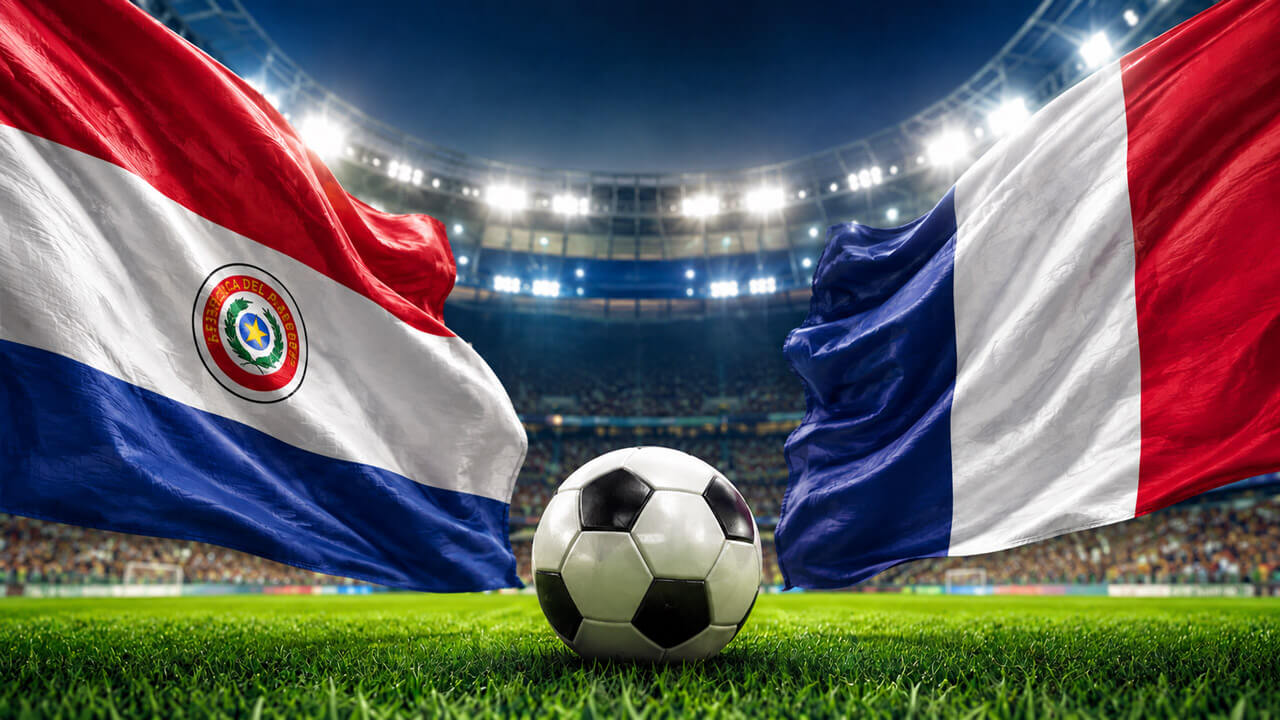
The price tells a story of French control, but the draw leg keeps the market from becoming a simple strength ranking. The tension sits in how much room a low-scoring tournament match leaves for Paraguay to resist without winning outright.

The Paraguay vs. France market is built around a clear hierarchy: France is being treated as the side most likely to turn superiority into a regulation result, while Paraguay is assigned a narrow path to a direct win. The interesting part is the draw at 12.5%, because it shows the market giving meaningful weight to soccer-specific friction even while France sits at 83.5%.
France is priced as the team expected to control the match
With France at $0.835, the implied story is that buyers are treating this fixture as one where the favorite can create enough chances, limit counterattacks, and avoid the kind of game state that keeps an underdog alive. That is an inference from the three-way price, since the supplied market data does not provide team news, rankings, lineups, or venue conditions. The number still carries a strong message: the market is giving far more weight to sustained French pressure than to a single-match upset path.
That matters because a three-way soccer market demands more than a view on which team is stronger. A favorite must win within the relevant match result framework while avoiding the draw outcome. The presence of a separate draw option means the market is carving out room for a stalemate, which prevents the France price from behaving like a pure qualification or advancement probability. The result source is FIFA, so the official match outcome will anchor settlement, making the exact treatment of full time central to how this price should be read.
The draw price is the market’s built-in caution against dominance turning sterile
The draw at 12.5% is the main counterweight to the heavy France lean. It implies that the market sees a meaningful route where Paraguay can survive pressure, slow tempo, and force a result that does not require outscoring France. In tournament soccer, that matters because a favorite can dominate territory and still fail to separate on the scoreboard, especially if the underdog keeps the match level deep into the second half.
The gap between Paraguay at 4.5% and the draw at 12.5% is especially revealing. The market is assigning far more probability to Paraguay denying France than to Paraguay beating France. That creates a specific tactical inference: defensive resistance, low shot volume, and set-piece variance carry more weight than a scenario where Paraguay consistently wins open play. The market is effectively separating two forms of underdog success: avoiding defeat and producing a full upset.
| Outcome | Market price | Implied story |
|---|---|---|
| France | 83.5% | Favorite converts control into the official result |
| Draw | 12.5% | Paraguay resists long enough to prevent separation |
| Paraguay | 4.5% | Underdog needs a direct scoring swing and game-state protection |
Liquidity suggests a formed view, though the information set can still change
The market has $199.76K in volume, $391.88K in liquidity, and $169.89K in open interest, which gives the current distribution more substance than a thin placeholder line. That matters because the price is already organizing around a clear pre-match hierarchy months ahead of the July 4, 2026 close. Still, the same timing creates exposure to information that has not yet arrived in the supplied context.
The hidden assumptions are doing heavy lifting. The France price assumes a match environment where the favorite fields a competitive side, avoids major absences, and has normal incentive to pursue a win. The Paraguay price assumes limited ability to turn isolated chances into a lead. The draw price assumes defensive structure or match tempo can interfere with that hierarchy. None of those assumptions are confirmed by the market snapshot alone, which makes future official information unusually important for a single-match contract.
Team news and incentive changes would force the cleanest repricing
The most direct catalyst would be verified lineup information. If an official team sheet showed France with a first-choice attacking structure, the current favorite-heavy interpretation would receive support because the market’s control-and-conversion thesis would gain evidence. If a hypothetical lineup showed rotation, injuries, suspensions, or a conservative setup, the draw leg could gain importance because the favorite’s path would depend more on late-game execution and bench impact.
Tournament incentives could also matter if context around the match changes before kickoff. A scenario where one side benefits from managing risk, preserving energy, or accepting a low-event game would affect the balance between France and draw more than the balance between France and Paraguay. The reason is structural: incentive shifts often reduce tempo before they create an underdog win path. A red card, early injury, or severe weather scenario would be even more direct because it could change the match from a quality gap question into a game-state management question.
- Official lineups can confirm or weaken the assumed talent and role gap.
- Injuries or suspensions can alter whether France can press the advantage early.
- Game incentives can make a draw more attractive as a tactical outcome.
- Early match events can quickly move probability from hierarchy to volatility.
The main failure mode is a match that refuses to open up
The strongest counter-signal to the current pricing would be evidence that Paraguay can keep the game narrow without needing frequent possession or repeated chances. A compact defensive setup, slow tempo, and limited transition exposure would matter because they attack the weakest link in a heavy favorite price: the need to convert superiority into a win before the draw outcome becomes increasingly live.
For France, the market-implied path depends on turning pressure into a lead early enough to force Paraguay out of a low-risk plan. For Paraguay, the highest-probability resistance path sits closer to denial than domination, which explains why the draw price is almost three times the Paraguay win price. The market’s central tension is therefore simple: France is priced to impose the match, while the draw keeps pricing the chance that control fails to become separation.
Sources
Market Details
- Resolution criteria
- This event is for the upcoming FIFA World Cup game, scheduled for Saturday, July 4, 2026 between Paraguay and France.
- Platform
-


- Category
- Sports
- Scheduled deadline
- July 4, 2026, 9:00 PM UTC
- Settlement source
- fifa.com
- Market rules summary
- Multi-outcome Polymarket event. Each listed option is represented by its Yes price on the underlying market. View full rules
Frequently Asked Questions
What was the final result of the Paraguay vs. France prediction market?
Polymarket reports France as the winning outcome for the Paraguay vs. France prediction market with a final probability of 100%. The final market snapshot includes $23.38M volume and $14.19M open interest. CryptoSlate last synced the final market data at Jul 4, 2026, 23:22 UTC.
How does the Paraguay vs. France prediction market resolve?
This event is for the upcoming FIFA World Cup game, scheduled for Saturday, July 4, 2026 between Paraguay and France. Multi-outcome Polymarket event. Each listed option is represented by its Yes price on the underlying market. The settlement source listed for this market is fifa.com.
Related Markets
 Spain vs. Argentina
 France vs. England
 England vs. Argentina