
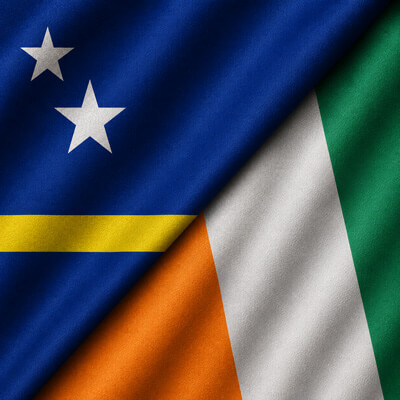
Curaçao vs. Côte d’Ivoire
Ended Jun 25, 2026, 20:00 UTC
Market resolution
Polymarket reports Côte d'Ivoire as the winning outcome for the Curaçao vs. Côte d’Ivoire prediction market with a final probability of 100%. The market closed on Jun 25, 2026, 20:00 UTC. Final reported trading volume was $6.49M.
Final probabilities, volume, and open interest are sourced from Polymarket and were last synced at Jun 25, 2026 11:27 pm.
Heavy Côte d’Ivoire lean leaves little room for match-day ambiguity
The market is treating the World Cup fixture as a clear favorite-versus-outsider setup, with the draw holding a meaningful residual role. The interesting question is which assumptions must survive between now and kickoff for that structure to stay intact.


The current split says the market is treating Curaçao vs. Côte d’Ivoire as a match where the favorite outcome is driven by a perceived quality gap and the alternative outcomes mainly need disruption. Côte d’Ivoire at 85.5%, Curaçao at 4.5%, and the draw at 10.5% tell an important story: the market’s base case is one-sided, while leaving enough space for soccer’s low-scoring variance to matter.
The favorite price depends on a broad strength gap surviving new information
An 85.5% Yes price for Côte d’Ivoire is an inference that the market sees the matchup through structural strength, since the rules provide only a single FIFA World Cup game and do not embed any handicaps or multi-leg adjustment. That matters because the price is doing more than reacting to a fixture listing; it is compressing player quality, tactical expectations, and likely game control into one outcome. With limited listed context, the market is giving heavy weight to prior assumptions about the teams instead of confirmed match-week inputs.
The small Curaçao price also has a function beyond naming the underdog. At 4.5%, the market is assigning Curaçao a path that likely requires several conditions at once: a disciplined defensive setup, inefficient finishing from the favorite, set-piece leverage, or a game state that reaches the final stretch level. Those are hypothetical paths, but they explain why the underdog remains visible at a low price.
The draw price carries match-state risk winner prices cannot absorb
The draw at 10.5% matters because it creates a separate bucket for favorite control without scoreboard separation. In a three-outcome soccer market, a draw can absorb scenarios where Côte d’Ivoire controls territory yet fails to convert, or where Curaçao’s best outcome is to reduce tempo and limit transition risk. This matters for pricing because the draw may respond sharply to information that affects attacking efficiency without fully changing the perceived stronger side.
That makes the draw price a pressure point for late news. A defensive lineup from Curaçao, signs of fatigue or rotation for Côte d’Ivoire, or any match context that rewards caution would likely affect draw assumptions first. These would be hypothetical pre-match developments until confirmed by official team information or FIFA match context, but they show why the draw price sits well above Curaçao’s win price.
Liquidity gives the favorite view weight, while the calendar keeps it fragile
The market has $180.31K in volume, $878.27K in liquidity, and $70.67K in open interest. Those figures matter because the heavy favorite view is backed by enough displayed depth to give the current structure substance. A small, dormant market could be dominated by stale initial pricing; this one has enough capital around it to suggest that the one-sided shape has survived some participation.
The June 25, 2026 close also makes the price vulnerable to new information. The long runway means injuries, squad selection, travel, rest patterns, and official kickoff-day lineups can all arrive after much of the early positioning. Because settlement is tied to the FIFA World Cup game and official FIFA context, information that changes the expected match environment can matter as much as broad team perception.
Repricing would require evidence that changes the assumed script
The strongest catalysts would be those that alter how the game is expected to flow. If new information makes early Côte d’Ivoire pressure more credible, the favorite outcome could gain durability; if it points to a slower, tighter match, the draw and Curaçao paths become easier to explain. The market’s current structure gives these catalysts different channels:
- Confirmed squad absences or returns would matter because the 85.5% price relies on a broad perceived strength gap.
- Official starting lineups would matter because finishing quality, defensive height, and midfield control shape the route between territorial advantage and an actual win.
- Tournament context, if relevant by match day, would matter because teams with different incentives may value risk differently.
- Weather, pitch, or officiating expectations would matter only if supported by reliable pre-match information, since each could alter tempo and set-piece value.
The main counter-signal is a match that rewards caution
The strongest challenge to the current favorite-heavy structure is a game that becomes slower than the price implies. Since the underdog win price is much smaller than the draw, the market is already separating “Curaçao survives” from “Curaçao wins.” That distinction matters because a cautious first half, early cards, or a game-state incentive to protect a point would probably pressure the favorite price through the draw channel before creating a full upset narrative.
There is also a blind spot created by the time horizon. Early prices can encode broad assumptions about team strength while missing details that only exist close to kickoff. If the final match-week evidence confirms clean availability, attacking intent, and an incentive to chase a win, the current distribution has a clear logic. If the evidence instead points to rotated personnel, conservative incentives, or disrupted preparation, the market has several paths for movement without requiring a wholesale change in how it views the teams.
That is why the pricing is best read as a conditional story. It assumes Côte d’Ivoire’s perceived superiority translates into control, control into chances, and chances into a result before variance or incentives reshape the match. The draw is the market’s acknowledgement that the chain can break even when the favorite remains the stronger side in the pre-match model.
Sources
Market details
- Resolution criteria
- This event is for the upcoming FIFA World Cup game, scheduled for Thursday, June 25, 2026 between Curaçao and Côte d'Ivoire.
- Platform
-


- Category
- Sports › World Cup
- Close date
- June 25, 2026, 8:00 PM UTC
- Settlement source
- fifa.com
- Market rules summary
- Multi-outcome Polymarket event. Each listed option is represented by its Yes price on the underlying market. View full rules
Frequently asked questions
What was the final result of the Curaçao vs. Côte d’Ivoire prediction market?
Polymarket reports Côte d'Ivoire as the winning outcome for the Curaçao vs. Côte d’Ivoire prediction market with a final probability of 100%. The final market snapshot includes $6.49M volume and $3.55M open interest. CryptoSlate last synced the final market data at Jun 25, 2026, 22:27 UTC.
How does the Curaçao vs. Côte d’Ivoire prediction market resolve?
This event is for the upcoming FIFA World Cup game, scheduled for Thursday, June 25, 2026 between Curaçao and Côte d'Ivoire. Multi-outcome Polymarket event. Each listed option is represented by its Yes price on the underlying market. The settlement source listed for this market is fifa.com.
Related World Cup markets
 Spain vs. Argentina
 France vs. England
 England vs. Argentina