
Overview
Introduction
Imagine a company with no CEO. No board. No one who can quietly move the money.
Instead, anyone who holds a token can submit a proposal. Everyone votes. The rules are written in code, and the code enforces the outcome.
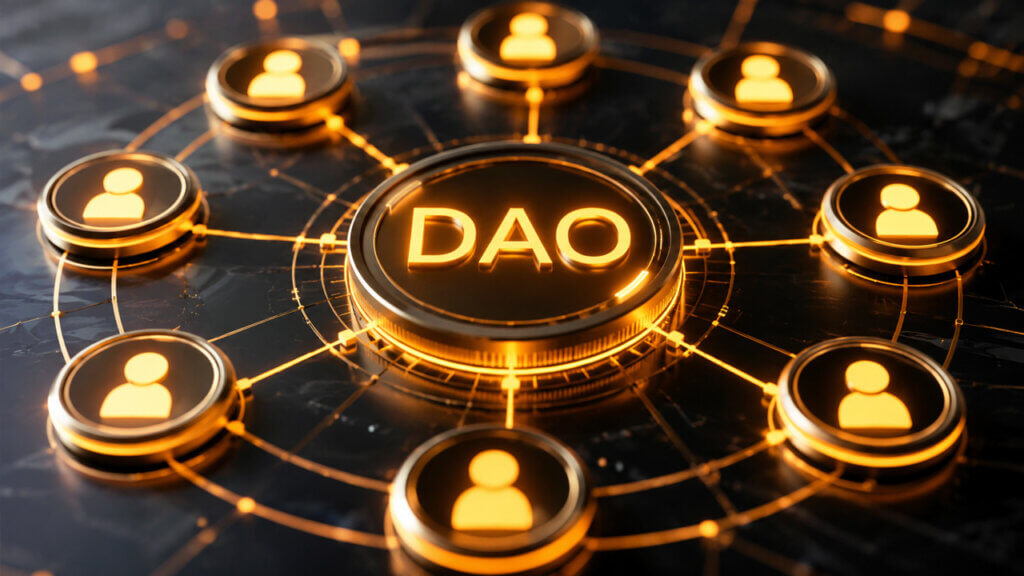
That's the idea behind a DAO, a decentralized autonomous organization. It hands decision-making power to members through tokens, proposals, and public votes.
But there's a catch. A public vote does not automatically mean broad community control. Some projects use DAO branding while a small group of wallets or a founding team decides what actually happens. Before joining a DAO, buying a governance token, or trusting a shared treasury, you need to understand how the governance process actually works, and where it breaks.
Key Takeaways
- What it is. A DAO is a crypto-native organization that coordinates votes, treasury decisions, and software changes through public rules enforced by smart contracts.
- What it changes. Contributors can govern protocols and shared funds through a public proposal and voting process rather than a traditional company structure with officers and directors.
- Main risk. DAO tokens often concentrate power in a small number of wallets, so a public vote does not automatically mean the broader community controls the outcome.
What Is DAO in Crypto?
DAO stands for decentralized autonomous organization. It's the governance layer of blockchain markets, usually built around governance tokens, smart contracts, public proposals, and shared treasuries.
Think of it as the rulebook for how a group makes decisions and spends money, where the rulebook is enforced by code instead of a CEO.
Most DAOs are not fully autonomous. People still write proposals, debate tradeoffs, delegate votes, audit code, and handle day-to-day operations. The “autonomous” part means that certain rules are enforced by code. A smart contract can enforce a voting period or queue a transaction, but it cannot replace the human judgment behind a proposal.
A DAO is also not automatically decentralized just because it uses cryptocurrency. Some projects use DAO branding while a foundation, founding team, venture investor, or small delegate group controls the real outcome. Understanding a DAO accurately means separating the label from the mechanics:
- Who can submit a proposal?
- Who can vote, and how much does each vote weigh?
- How many votes are needed for a proposal to pass?
- Who can spend treasury funds, and under what conditions?
- What happens after a vote passes, and who executes it?
MakerDAO, Uniswap DAO, ENS DAO, Gitcoin, and ConstitutionDAO all used DAO structures, but each had its own rules for membership, voting, funding, and execution. Comparing two DAOs by label alone tells you very little.
How a DAO Works From Proposal to Execution
Here's something that surprises most beginners: a DAO vote doesn't automatically do anything. It's just a signal. The real question is what happens after the vote.
A DAO works by turning community proposals into votes and, when the rules allow it, binding treasury or protocol actions. The process can be simple for a small grants DAO and much more layered for a major DeFi protocol managing millions of dollars.
In many Ethereum-based DAOs, smart contracts define the governance rules and hold treasury funds. A typical governance flow runs through several checkpoints:
A contributor opens a forum post or temperature-check to test community sentiment. Token holders or delegates discuss the idea and surface objections. The proposal reaches a submission threshold, usually a minimum token balance. An off-chain vote, often on Snapshot, measures support without spending gas. An on-chain vote applies quorum and approval rules defined in a smart contract. A timelock delays execution so users can exit or react before the action runs. A Safe, multisig, or smart contract executes the approved action. The result updates a treasury balance, protocol parameter, grant payment, or code setting.
Not every DAO uses every step. Smaller DAOs may rely on a multisig wallet after a Snapshot vote, while more automated ones route successful proposals directly into an execution contract.
One piece of that process deserves special attention: the timelock. It's not bureaucracy. It's the window users have to react before an irreversible on-chain transaction settles. If a proposal turns out to be malicious or rushed, a timelock is what gives the community time to respond. Without it, money can move before anyone notices.
DAO Tokens, Voting Power, and Governance Rights
A DAO token usually represents voting power, proposal access, or delegation rights. Buying one does not guarantee that the holder can direct the organization, and it does not function like equity in a company.
Token-weighted voting is common because it is easy to count on-chain, but it creates a real power imbalance. Large holders such as early investors, exchanges, foundations, or wallets that have simply never moved their tokens can dominate outcomes even when a supermajority of smaller holders disagrees. Delegation can help by letting informed representatives vote on behalf of passive holders, but it can also concentrate authority in a small group of public delegates.
Before assuming a DAO is democratic, separate the main token features:
| Token Feature | What It Actually Means |
|---|---|
| Voting power | More tokens usually mean more votes, unless the DAO uses caps or alternative voting. |
| Proposal threshold | A holder may need a minimum token balance or delegated voting power to submit proposals. |
| Delegation | A holder can assign voting power to another address without transferring the token. |
| Quorum | A vote may fail even with majority support if too few eligible votes participate. |
| Execution rights | Passing a vote may only signal support unless the DAO has a binding execution path. |
Governance tokens require a different reading from ordinary market assets. The market price of a token reflects speculation, liquidity incentives, and trading activity. Governance power depends on token distribution, voter turnout, delegation patterns, and the specific proposal rules the DAO uses.
Price exposure can also work against sound governance. A short-term holder may vote for emissions, token buybacks, or treasury sales that benefit the price in the near term but weaken the protocol over time. A long-term contributor may hold fewer tokens but understand the system far better. Token count and informed judgment are not the same thing, and DAO design rarely accounts for that gap cleanly.
What DAO Treasuries Do and Who Can Spend Them
A DAO treasury holds the assets the organization uses to fund contributors, grants, liquidity programs, security audits, legal work, and protocol operations. The treasury may sit in a smart contract, a multisig wallet, or a mix of on-chain and off-chain accounts. Where it sits determines how much a public vote actually controls.
Spending authority is what gives a vote real force. A DAO can approve a proposal publicly and still depend on a small group of signers to move funds. That setup can be reasonable for early-stage or small organizations, but users should know whether the treasury is controlled by a smart contract with binding execution, a Safe multisig, a foundation, or an operations team with discretion.
The clearest treasury checks are:
- Whether treasury addresses are publicly visible on-chain.
- Which assets the treasury holds and their current value.
- Who the multisig signers are and how many signatures are required.
- Whether a governance vote is binding or advisory.
- Whether a timelock applies before large transfers execute.
- How often grant payments and contributor payouts are reported publicly.
- Whether the treasury contracts have been independently audited.
Transparency here does not remove risk. It provides evidence. If a DAO has a public treasury address but no documented spending process, participants can see the balances but still cannot tell who can act on them.
Treasury design also shapes the contributor experience directly. A grants DAO with clear payout rules can fund builders faster and with less friction than a company approval committee. A protocol DAO with weak treasury controls can lose funds through rushed incentive programs, compromised signers, or a malicious governance proposal that passes before anyone reacts.
Types of DAOs and Real Crypto Examples
DAOs can govern protocols, fund public goods, pool capital for a specific acquisition, or coordinate creative communities. The type of DAO changes the risk profile significantly: a DAO that governs a DeFi protocol has different failure points from a one-time crowdfunding effort or a social club with a shared wallet.
The categories below show how DAOs apply similar voting mechanics for very different purposes:
| DAO Type | Example and What It Governs |
|---|---|
| Protocol DAO | MakerDAO, Uniswap DAO, Compound, Aave, or Lido governance over protocol rules. |
| Grants DAO | Gitcoin-style funding for builders, public goods, or ecosystem work. |
| Collector DAO | ConstitutionDAO-style pooling for a specific acquisition or campaign. |
| Social DAO | Token-gated communities coordinating events, media, or member projects. |
| NFT or Culture DAO | Nouns-style treasury spending tied to a shared brand or creative identity. |
Protocol DAOs are easiest to observe in DeFi because lending, exchange, staking, and liquidity protocols regularly need public parameter changes. Uniswap (UNI) and Compound (COMP) are good examples of tokens that are tied to protocol governance rather than only payments or speculation.
DAO vs Company, DeFi Protocol, and Online Community
A DAO differs from a company, DeFi protocol, and online community in where decision rights and execution authority sit. A company relies on legal roles and management hierarchy. A protocol is software. A community is a group of people. A DAO can overlap with all three without being identical to any of them, and that overlap is where most confusion comes from.
| Comparison | Main Difference |
|---|---|
| DAO vs company | A company relies on legal roles and management authority, while a DAO relies on public governance rules and member votes. |
| DAO vs DeFi protocol | A DeFi protocol is software for financial activity, while a DAO may govern that software. |
| DAO vs token | A token can measure voting power, but the DAO is the process and treasury around that token. |
| DAO vs community | A community can discuss ideas, while a DAO has a defined process for turning decisions into action. |
Many DAO examples sit inside DeFi, which is why governance token categories and DeFi asset categories overlap in practice. That overlap does not mean every DeFi protocol is user-controlled or that every DAO runs a financial application.
Discord servers, Telegram groups, and forums can support a DAO, but they are not a DAO on their own. The organization needs defined rules for proposals, voting, accountability, and treasury execution. Without those pieces, the group is a community with crypto branding, and the distinction matters when real money is involved.
History of DAOs in Crypto
The history of DAOs in crypto runs from early ideas about blockchain-based organizations through Ethereum's launch, the 2016 DAO hack, the DeFi governance expansion, and more recent legal-wrapper experiments. The concept has been reshaped repeatedly because real money, regulatory pressure, and live protocol operations exposed weaknesses in the original design.
Key milestones in that timeline:
- Early 2010s: decentralized autonomous company concepts emerge around projects like BitShares.
- 2015: Ethereum launches as a smart contract platform that makes DAO-style coordination practical at scale.
- 2016: The DAO raises funds on Ethereum and suffers a major exploit.
- July 2016: Ethereum completes a hard fork, moving funds from the exploited contract into a recovery contract.
- 2020 onward: DeFi protocols expand token governance, delegation systems, on-chain treasuries, and grants programs.
- 2024 onward: DAO legal wrappers become more visible, including Wyoming's DUNA model.
The 2016 DAO event remains the central reference point because it showed both the potential and the danger of on-chain organizations simultaneously. The DAO attack drained more than 3.6 million ETH from an insecure contract and led to a fork that moved funds into a recovery contract. The episode also clarified an important boundary: DAO governance and base-layer blockchain governance are different things. A DAO votes on a protocol treasury or parameter. Ethereum itself changes through broader social, technical, and client-layer coordination that no single token controls.
Benefits Crypto DAOs Can Actually Offer
DAOs can deliver transparent coordination when the treasury, voting record, and execution process are all public and auditable. The strongest benefit is not equal power for every member. It is that contributors can inspect how decisions are made and challenge weak governance with visible, on-chain evidence.
Those benefits are clearest when a DAO has active contributors, documented rules, and a treasury that cannot be spent quietly by a small group. In that environment, the open structure creates things a private company cannot easily replicate:
- Public proposals create a searchable audit trail of every decision.
- On-chain votes produce outcomes anyone can verify independently.
- Delegation lets specialists represent passive token holders without requiring every member to follow every vote.
- Treasuries can fund contributors and builders across borders without a corporate payroll structure.
- Smart contracts can reduce reliance on a single operator by enforcing rules in code.
- Open forums can surface dissent and raise objections before money moves.
These advantages are strongest for protocols and communities that genuinely need broad participation. A DAO is less suited to situations that require fast executive decisions, confidential negotiations, regulated customer service, or a single accountable operator.
DAO Risks: Token Control, Low Turnout, Hacks, and Legal Exposure
DAO risk comes from the gap between public voting and real control. A DAO can look open while a few wallets, delegates, signers, or legal entities decide what actually happens. These risks are concrete enough to check before joining, voting, or contributing labor.
| Risk | What to Check |
|---|---|
| Token concentration | Top holder balances, delegate concentration, and founder or investor allocations. |
| Low turnout | Past quorum rates and whether major votes pass with a small share of total supply. |
| Governance attack | Proposal thresholds, vote-buying exposure, timelocks, and emergency veto rules. |
| Smart contract bug | Audit history, upgrade keys, bug bounty scope, and past incident response. |
| Multisig capture | Signer identities, signing threshold, signer rotation, and public execution records. |
| Legal exposure | Whether the DAO has a wrapper, contracts, a tax process, and a jurisdictional plan. |
Legal risk deserves specific attention because a DAO label does not make an organization invisible to regulators. In 2023, the CFTC announced a default judgment against Ooki DAO that included a civil monetary penalty, trading and registration bans, and website shutdown obligations for an illegal trading platform case.
Legal wrappers are one response, but they are not a universal shield. Wyoming's 2024 DUNA legislation created a decentralized unincorporated nonprofit association framework that can hold property, use distributed ledger governance, and define member rights. That gives some DAOs a path to formalize operations, but it does not erase securities, commodities, tax, consumer protection, or sanctions obligations in other jurisdictions.
Security risk is equally practical. If a vote can move funds immediately after passing, a malicious proposal can drain a treasury before participants notice. Timelocks, spending caps, signer transparency, and regular audits are defenses against the irreversibility of on-chain transactions.
What Is a Governance Attack?
A governance attack is when someone uses the voting rules against the community that created them.
It sounds contradictory. How can following the rules be an attack? Here's how it works.
Most DAOs give voting power based on token holdings. If someone buys or borrows enough tokens, they can submit and pass proposals that move treasury funds to themselves, change protocol parameters to their advantage, or lock out other participants entirely. Because it's all on-chain, it looks legitimate. The vote passed. The code ran. The money moved.
The Build Finance DAO case is a clean example. In February 2022, a single user accumulated enough BUILD tokens to pass a motion that let them liquidate the DAO's holdings and mint new tokens. The attack was technically valid under the governance rules. There was no hack. There was no exploit. There was just a set of rules that didn't account for concentrated ownership.
The defenses against governance attacks include:
Higher proposal thresholds. Making it harder to submit proposals without broad delegate support.
Timelocks before execution. Giving the community time to veto or exit before a transaction settles.
Spending caps. Limiting how much a single proposal can move from the treasury.
Emergency veto mechanisms. Allowing a multisig or guardian address to pause suspicious proposals.
Vote delegation. Distributing voting power among informed, active delegates rather than leaving it concentrated in dormant wallets.
None of these are perfect. A sufficiently resourced attacker with enough capital can still overwhelm a poorly designed system. But the presence of these mechanisms, and the transparency of their design, is one of the clearest signals that a DAO was built by people who thought about failure modes.
How to Check a DAO Before Joining or Voting
Checking a DAO means reviewing who controls votes, who controls funds, and whether past proposals were executed as described. The goal is to understand how the DAO operates in practice before connecting a wallet, buying a token, or contributing time and labor.
Start with the public record and look for evidence that governance has actually functioned:
- Read the constitution, charter, or governance documentation.
- Review the last 10 proposals, including any that failed or were contested.
- Compare the forum debate to the final vote outcome.
- Check voter turnout figures and quorum pass rates.
- Identify the top token holders and delegates by wallet balance.
- Locate treasury addresses on-chain and verify the holdings.
- Review multisig signers, required signature thresholds, and rotation history.
- Confirm whether approved votes execute automatically or require a manual step.
- Look for independent audits and active bug bounty programs.
- Review contributor payment records and grant reports.
- Note whether a foundation, company, or legal wrapper sits alongside the DAO.
- Avoid connecting a wallet to any unofficial or unverified link.
A strong DAO does not need to be perfectly decentralized from day one. It should be honest about what is centralized, why that control exists, and what the plan is to change it. Hidden admin keys and undocumented treasury access are more concerning than a transparent transition schedule.
If a governance token trades on a centralized exchange, apply the same safety standards you would use for any other crypto asset. The token may be legitimate while the market, liquidity, or exchange route still introduces its own risk.
How to Get Started With DAO Participation
Start DAO participation by observing before spending money or signing any transactions. Most users learn more from forum threads, past vote records, and delegate activity than from buying a governance token first.
A low-risk onboarding path:
- Read the DAO's documentation, forum, and recent proposals before doing anything else.
- Watch one or two voting cycles without participating to understand how the process actually runs.
- Set up a wallet only when you need to sign a transaction or delegate voting power.
- Acquire a governance token only if the DAO rules require it for participation.
- Start with low-commitment actions such as forum feedback or delegating to an established delegate.
- Avoid approving transactions, bridging funds, or clicking links from unofficial channels.
Some DAOs require a governance token before you can vote or submit proposals. In that case, a regulated on-ramp or exchange may be the starting point.
FAQs
What is a DAO in crypto?
A DAO in crypto is an organization that uses blockchain tools, public proposals, and member voting to coordinate decisions about a treasury, protocol, community, or shared project. The rules are typically enforced by smart contracts rather than a company structure.
What does DAO mean?
DAO stands for decentralized autonomous organization. In crypto, it refers to a group that uses smart contracts, tokens, and governance rules to make decisions without a traditional management hierarchy. How decentralized that process actually is varies widely between projects.
How does a DAO work?
A DAO works by letting members discuss proposals, vote under defined rules, and then execute approved actions through smart contracts, multisig signers, or other treasury controls. The strength of that execution path determines whether governance has real force or is only advisory.
Is a DAO the same as DeFi?
A DAO is separate from DeFi. DeFi is blockchain-based financial software, while a DAO is a governance structure that may control a DeFi protocol, treasury, or community. Many DeFi protocols have a DAO layer, but the two are not interchangeable.
Can a DAO be shut down?
A DAO can lose its website, contributors, legal entity, or treasury access, but smart contracts deployed without an admin key may keep running indefinitely. Whether a DAO can be shut down depends entirely on how it was built: who holds upgrade rights, whether there is a pause function, and whether any legal entity sits behind it.
Do you need a DAO token to vote?
Many DAOs require a governance token to vote, submit proposals, or delegate voting power. Some use NFT membership, contributor reputation, or multisig approval instead. Check the governance documentation of the specific DAO before buying a token to participate.