

Global OKX fits active traders in supported markets. Country-specific product and fiat limits, self-published reserves, and the separate U.S. and Wallet surfaces require careful scope checks.
OKX vs Binance: Fees, Markets and Trading Tools
Binance wins our OKX vs Binance comparison for eligible global traders seeking more spot assets and BNB fee reductions. OKX is cheaper for standard maker orders.

Binance.com combines 0.10% entry spot fees with deep liquidity and extensive trading tools, but access, fiat rails, and products vary by jurisdiction.
Affiliate Disclosure
Some links in this comparison are affiliate links. CryptoSlate may earn a commission if you sign up through these links. Our ratings remain editorially independent.
OKX vs Binance Overview
This OKX vs Binance comparison covers Global OKX and Binance.com for eligible users outside the US.
Winners by Category
Binance wins overall, eligible BNB-discounted spot fees and the dated spot-asset comparison. OKX wins standard spot maker fees. The shared features below have narrowly defined ties.
OKX Binance
Binance wins overall for eligible global traders. OKX is the lower-cost standard maker alternative.
Lower regular spot maker fee
More dated spot assets and optional BNB fee reductions
OKX wins on maker commission. Standard taker rates are equal.
0.08% maker / 0.10% taker
0.10% maker / 0.10% taker
Binance wins this conditional fee comparison when BNB deduction is enabled and funded.
Regular rate: 0.08% maker / 0.10% taker
Eligible BNB-paid fees: 0.075% maker / taker
Binance wins the dated asset count. Local listings and withdrawal networks can differ.
397 base currencies on August 28, 2026
486 base assets on August 29, 2026
Tie on regular entry commissions, before funding and any fee discounts.
0.02% maker / 0.05% taker
0.02% maker / 0.05% taker
Tie on offering these features. Their controls, eligible markets and execution differ.
Margin, futures, options, bots and copy trading
Margin, futures, options, bots and copy trading
Tie on checking that your balance is included in the report. Neither process is a full independent financial audit.
Monthly, user-verifiable zk-STARK reports
Monthly, user-verifiable Merkle/zero-knowledge reports
Tie on published availability. This does not rank response or resolution speed.
24/7 chat and help
24/7 chat
Binance is the overall winner. Choose OKX instead if standard maker commissions are your priority.
Screenshots
OKX screenshots

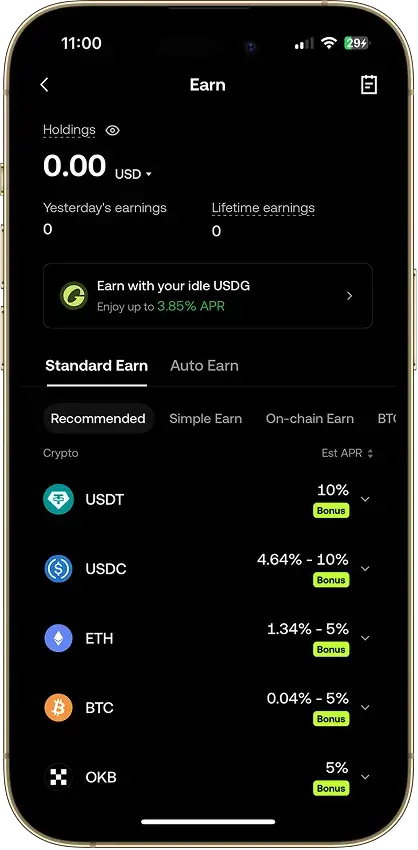
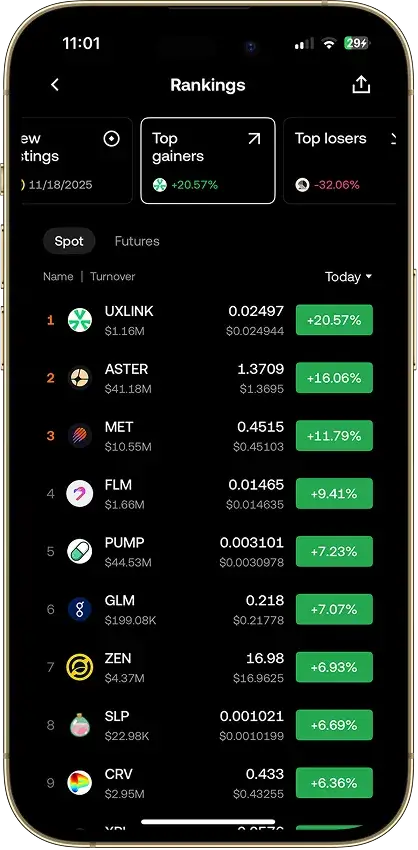
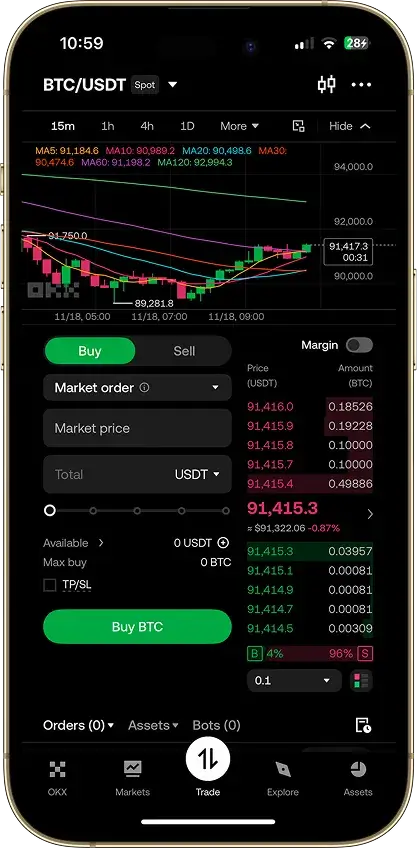
Screenshot 1 of 4
Binance screenshots


Screenshot 1 of 4
Spot and Futures Fees
OKX is cheaper for regular spot maker orders. Paying eligible Binance commissions with BNB reverses that result.
OKX Binance
Regular Spot Maker
OKX wins: $0.20 less per $1,000 maker fill.
0.08% ($0.80 on $1,000)
0.10% ($1 on $1,000)
Regular Spot Taker
Tie on standard taker commission.
0.10% ($1 on $1,000)
0.10% ($1 on $1,000)
Spot Maker With Binance BNB Deduction
Binance wins with the discount: $0.75 versus $0.80 on $1,000.
0.08% regular rate
0.075% with eligible BNB payment
Spot Taker With Binance BNB Deduction
Binance wins with the discount: $0.75 versus $1 on $1,000.
0.10% regular rate
0.075% with eligible BNB payment
Regular Futures Maker / Taker
Tie on the regular schedules. Contract funding is separate.
0.02% / 0.05%
0.02% / 0.05%
Futures With Binance BNB Deduction
Binance wins this discounted commission comparison, subject to BNB eligibility.
0.02% / 0.05% regular rate
Eligible USD-M: 0.018% / 0.045%
Binance requires BNB in the relevant account and the fee-payment setting enabled. A small commission saving comes with BNB price exposure. On a $1,000 maker fill, the discounted Binance saving over regular OKX is only $0.05. Check whether holding the token makes sense for your trading volume.
These examples cover order-book commission only. Buy and Convert quotes, spread, slippage, margin interest, perpetual funding and withdrawals can change the total cost. A limit order that immediately matches an existing order can pay the taker fee.
Higher VIP tiers and special-pair promotions use separate conditions. Consult the OKX fee adjustment notice and Binance spot fee schedule, then check the rate shown for your account.
Crypto Assets and Spot Markets
Binance had more distinct spot assets in the August snapshots. OKX had more trading pairs.
OKX Binance
Distinct Spot Assets
Binance wins the dated asset count by 89.
397 on August 28, 2026
486 on August 29, 2026
Spot Trading Pairs
OKX wins the dated pair count by 25. Multiple pairs can trade the same asset.
1,383 on August 28, 2026
1,358 on August 29, 2026
Binance wins for the larger dated selection of distinct spot assets.
The OKX spot market inventory and Binance asset and pair counts were captured one day apart. They describe those inventories rather than a synchronized live test. A larger asset count is useful when searching for more coins. More pairs can offer additional quote-currency choices for coins already listed.
For a specific trade, check the coin, quote currency and withdrawal network in your own account. Wallet-only tokens and non-crypto contracts are outside these spot counts.
Derivatives, Bots and Copy Trading
Both offer margin, futures and options alongside bots and copy trading. Binance separates spot and futures copy accounts, while OKX also offers RFQ workflows for qualifying accounts.
OKX Binance
Margin and Futures
Tie on product availability, not borrowing limits, collateral or funding costs.
Margin, futures and perpetuals where permitted
Margin, USD-M and COIN-M futures where permitted
Options
Tie on offering options. Available underlyings and contract terms need a separate comparison.
Options for eligible global or regional accounts
European-style, cash-settled options
Trading Bots
Tie on built-in automation. No bot-return advantage is established.
Bots operating under the selected market rules
Grid, DCA, rebalancing and other bots
Copy Trading
Tie on copy-trading access. Trader performance and follower settings determine the result.
Region-dependent trader and follower tools
Separate spot and futures copy accounts
Tie
Tie on the core product set. Contract and strategy details decide the better fit.
Binance separates USD-margined contracts from coin-margined contracts. Its copy accounts offer fixed-amount or fixed-ratio allocation and total stop-loss controls. OKX adds RFQ or OTC workflows for qualifying accounts alongside its exchange order books.
For either exchange, compare the actual contract, collateral and liquidation rules before opening a position. Copy orders can fill at a different price from the lead trader, while bot orders still incur the relevant trading fees. A higher maximum position multiplier increases potential loss as well as exposure.
Liquidity and Order Controls
Binance has dated major-pair depth measurements. They are not a head-to-head execution test against OKX.
Binance’s August 29 liquidity sample measured about $5.78 million of BTC/USDT bids and $6.50 million of asks within 10 basis points of the midpoint. OKX has no equivalent same-time sample in its review. Neither exchange receives an execution-quality award from that one-sided measurement.
OKX supports post-only, FOK, IOC, trigger and scaled instructions among its order controls. Binance supports limit-maker, OCO, OTO, OTOCO and trailing instructions where the symbol permits them. Match the required instruction to your pair, then inspect the live spread and depth for the size you intend to trade.
Earn and Staking
Binance Simple Earn and OKX Earn use asset-specific rates, eligibility and redemption terms.
Binance describes more than 300 Simple Earn assets across flexible and locked products, with the available menu varying by jurisdiction. Global OKX offers formats including Simple Earn, Flash Earn, Stable Rewards, Dual Investment and BTC Yield+ where permitted.
For the same coin and holding period, compare the net return, quota, redemption time and risk of the underlying product. Flexible savings, staking and structured products can expose a balance to different risks. The separate OKX US Auto Earn+ schedule does not set Global OKX returns.
Deposits and Withdrawals
Neither exchange has one worldwide bank-transfer menu. The useful comparison is the route available for your country and currency.
Global OKX offers regional bank and card routes plus local providers and P2P where supported. Binance also combines bank transfers, cards and P2P, with access determined by the account and payment partner.
Before depositing, check that both accounts accept your currency and can send withdrawals to your bank. Compare the displayed deposit fee, withdrawal fee and any hold for that same route. A card purchase may be available even when cashing out to that card is not. If neither has a usable bank withdrawal route, compare other reviewed crypto exchanges.
For crypto transfers, compare the same coin, network and amount on both withdrawal screens. The destination must support the network you choose. Neither a coin listing nor an advertised bank currency guarantees a usable withdrawal route.
KYC and Country Availability
Both global exchanges require identity verification. Product eligibility can be narrower than permission to open an account.
Binance.com does not serve US residents. This page compares it with Global OKX, not with the separate OKX US exchange. Binance.US is also outside the comparison.
OKX asks for government ID, a selfie or facial check and address information. Binance requires identity verification for normal deposits, trading, API use and withdrawals. Either can request further address or source-of-funds documents.
For non-US users, check the terms of the entity serving your country and the specific product you want. Access to spot trading does not automatically permit futures, Earn or P2P. Neither platform offers a universal guarantee for verification time or bank-transfer availability.
Security and Proof of Reserves
Both provide account protections and monthly user-verifiable reserve reporting. That is a tie on these controls, not a claim that their overall risks are identical.
OKX Binance
Account Protection
Tie on these protections. Configure them before depositing.
Two-factor authentication and withdrawal-address allowlisting
Two-factor authentication and withdrawal-address allowlisting
Balance Verification in Monthly Reports
Tie on checking that your balance is included. Covered assets and calculation methods differ.
zk-STARK user-inclusion checks
Merkle-tree and zero-knowledge user-inclusion checks
Tie
Tie on the listed account controls and balance-verification process. No overall safety winner is claimed.
At both exchanges, you can check whether your balance was included in the reserve report. The OKX custody and security assessment describes this as a point-in-time, self-published process. Binance’s reporting has the same fundamental limit: it is not a full independent financial audit. A balance check does not verify every liability or guarantee future withdrawals.
Binance’s SAFU emergency fund is distinct from deposit insurance, as explained in the Binance trust and compliance assessment. Neither an emergency fund nor a reserve ratio makes exchange-held crypto risk-free.
Apps, APIs and Support
Both have mobile apps, trading APIs and 24/7 chat. Binance adds spot FIX connectivity, while OKX provides simulated API trading.
OKX Binance
Web and Mobile Access
Tie on access through these platforms, not app usability.
Web, iOS and Android
Web, iOS and Android
REST and WebSocket
Tie on these protocols. Check the endpoints required by your integration.
Market data, account and trading access
Market data, account and trading access
API Test Environment
Tie on having a test environment. Coverage and simulated fills differ.
Simulated trading and simulated API keys
Spot Testnet
Chat Availability
Tie on stated opening hours. Neither publishes a guaranteed resolution time.
24/7 chat and help
24/7 chat
Tie
Tie on the compared access channels, API protocols, testing option and chat hours.
Binance supports spot trading through FIX for integrations that use that protocol. OKX’s simulation uses separate keys and the x-simulated-trading header. A working test order does not establish live execution speed or regional product access.
OKX has a product-status service, while Binance issues service-specific maintenance notices. Check those before assuming a delayed transfer is an account problem, then use support for holds or verification requests.
Final Verdict
Binance is our overall winner for eligible global traders seeking more spot assets and optional BNB fee reductions. Choose OKX for its lower standard maker fee without holding a fee token.
Affiliate Disclosure
Some links in this comparison are affiliate links. CryptoSlate may earn a commission if you sign up through these links. Our ratings remain editorially independent.
The asset-selection decision uses dated global inventories, and Binance’s fee advantage requires eligible BNB payment. If you mainly place regular maker orders and do not want BNB exposure, OKX is the more economical choice on commission. Confirm your country’s access and bank withdrawal route before choosing either.
OKX vs Binance FAQs
Is OKX better than Binance?
Binance is our overall pick for eligible global traders because of its larger dated spot-asset selection and optional BNB fee reductions. OKX is better for regular spot maker fees without a fee-token holding.
Which has lower fees, OKX or Binance?
Regular spot maker fees favor OKX at 0.08% versus Binance at 0.10%. Standard takers pay 0.10% at both. Eligible Binance spot fees fall to 0.075% with BNB payment, which adds token-price exposure.
Does Binance have more coins than OKX?
The August 29, 2026 Binance snapshot had 486 spot base assets. OKX had 397 on August 28. OKX had more pairs, at 1,383 versus 1,358. These dated global inventories do not guarantee current local access.
Can US residents use these global exchanges?
This comparison excludes US services. Binance.com is unavailable to US residents. Binance.US and OKX US are separate platforms with their own eligibility, fees and products.
Which exchange is safer?
Neither receives an overall safety award here. Both provide two-factor authentication, withdrawal-address controls and user-verifiable reserve snapshots, but neither reserve process is a full independent financial audit.
Which is better for futures trading?
Both offer futures where permitted, with regular entry commissions of 0.02% maker and 0.05% taker. Binance offers eligible BNB-paid USD-M rates of 0.018% and 0.045%. Compare the contract, funding, collateral and liquidation rules as well as commission.


Binance is our overall pick for its larger August spot-asset count and optional BNB fee reductions. The Global OKX exchange review puts its regular maker fee at 0.08%, making it the lower-cost standard-tier choice without a fee-token holding. The Binance.com trading platform review details the eligible BNB discount that lowers its spot rate to 0.075%.
Both global exchanges offer derivatives, trading bots and APIs where permitted. OKX US and Binance.US are separate services and are excluded here.