
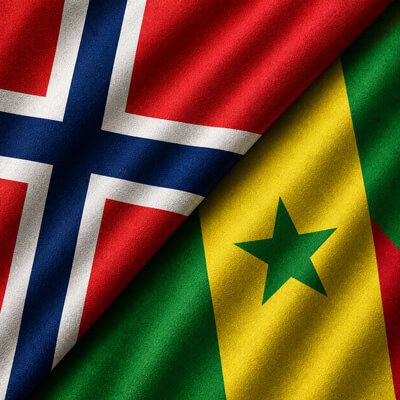
Norway vs. Senegal
Final Results
Scheduled deadline: Jun 23, 2026, 00:00 UTC
Market Resolution
Polymarket reports Norway as the winning outcome for the Norway vs. Senegal prediction market with a final probability of 100%. Scheduled deadline: Jun 23, 2026, 00:00 UTC. Final reported trading volume was $37.71M.
Polymarket · Final sync
Market Analysis
Norway’s Favorite Status Meets Senegal’s Draw-Protected World Cup Resistance

The market gives Norway the lead without granting command, leaving Senegal and the draw as live constraints on the favorite story. The analytical question is which assumption breaks first: team-quality priors, match tempo, or tournament incentives around a late-June World Cup fixture.

The market is pricing a Norway plurality with limited command: 41.5% for Norway, 31.5% for Senegal, and 27.5% for the draw. That shape matters because Norway’s lead has to survive two separate routes against it: a Senegal win and a match state that settles level. The result is a favorite story built on narrow assumptions, with the official FIFA outcome on June 22 carrying settlement weight.
Norway’s lead depends on clearing two obstacles
A 41.5% top price implies the market gives Norway the strongest single lane to victory. The important inference is the split itself: Norway has a lead, while the combined Senegal-and-draw space is about 59% before market frictions. That matters because a three-way football market can punish a favorite through two channels. Norway can play well enough to avoid defeat and still fail to cash the win outcome if the match settles level.
The pricing likely leans on broad pre-match priors: perceived team quality, expected lineup strength, and the assumption that Norway can create enough separation in a one-off World Cup setting. Those priors carry the price because the market has no need to wait for a full tactical dossier before assigning a favorite. The risk to that structure is simple: any development that lowers expected scoring or raises the chance of a cagey match transfers weight toward the draw and away from both win outcomes.
The draw price is carrying the tempo thesis
The 27.5% draw line carries a clear tempo thesis. It implies the market sees enough friction in the matchup to keep a level result close to Senegal’s outright win price. That matters because the draw is the outcome most sensitive to game state. A slow first half, conservative tournament incentives, or lineups built for control can make the favorite’s route narrower without requiring Senegal to dominate.
A hypothetical shift toward a more open match would change that distribution. If pre-match information points to aggressive setups, attacking availability, or group-table incentives that reward taking chances, the draw share could lose support and the win outcomes would absorb the adjustment. If the incentives point toward caution, the draw becomes the market’s pressure valve and Norway’s favorite label carries less explanatory power.
Final-window liquidity can amplify official information
The market has $203,010 in volume, $1.2 million in liquidity, and $134,600 in open interest. The gap between liquidity and open interest matters because a large amount of quoted capacity can still sit around assumptions that have not been tested by final match information. In the final days before a June 23 UTC close, official news can make previously stable prices move quickly as orders adjust to fresher inputs.
The settlement source also matters. FIFA’s match result is the anchor for resolution, so changes that affect the official fixture, kickoff conditions, or final recorded outcome have direct pricing relevance. The market is open close enough to matchday that late information has a cleaner path into price than distant speculation.
Squad and incentive shocks would test the hidden assumptions
The hidden assumption behind Norway’s lead is that the broad pre-match story survives the final team context. Several hypothetical catalysts could challenge that assumption because each one changes the balance between Norway win, Senegal win, and draw rather than affecting a single side in isolation.
- Official lineup news that changes expected chance creation or defensive stability.
- Fitness, suspension, or squad-availability information that alters either side’s starting quality.
- Group-table incentives that make a draw strategically acceptable or a win unusually valuable.
- Weather, venue, or officiating conditions that point toward slower tempo or more transitional play.
- Any FIFA schedule or match-status update that affects settlement timing or official reporting.
These catalysts matter because the current split leaves no outcome with a majority share. A small change in the assumed tempo can lift the draw without proving Senegal superior, while a change in expected finishing quality can move weight directly between the two win outcomes.
Senegal’s counterpath needs only a narrow opening
The strongest counter-signal to Norway’s lead is structural: Senegal does not need a market-wide reassessment to pressure the favorite price. At 31.5%, Senegal is already close enough that a single credible improvement in its expected lineup, match fitness, or tactical path could tighten the spread. The draw price adds another layer because Senegal can benefit from conditions that suppress Norway’s scoring route even if those conditions do not clearly point to a Senegal win.
That is the tension the market has to resolve before kickoff. Norway’s price depends on converting a plurality into a match win, Senegal’s price depends on turning competitiveness into a decisive result, and the draw depends on the game staying compressed. The next meaningful move is likely to come from information that tells the market which of those three stories best fits the actual match conditions.
Sources
Market Details
- Resolution criteria
- This event is for the upcoming FIFA World Cup game, scheduled for Monday, June 22, 2026 between Norway and Senegal.
- Platform
-


- Category
- Sports
- Scheduled deadline
- June 23, 2026, 12:00 AM UTC
- Settlement source
- fifa.com
- Market rules summary
- Multi-outcome Polymarket event. Each listed option is represented by its Yes price on the underlying market. View full rules
Frequently Asked Questions
What was the final result of the Norway vs. Senegal prediction market?
Polymarket reports Norway as the winning outcome for the Norway vs. Senegal prediction market with a final probability of 100%. The final market snapshot includes $37.71M volume and $22.64M open interest. CryptoSlate last synced the final market data at Jun 23, 2026, 02:22 UTC.
How does the Norway vs. Senegal prediction market resolve?
This event is for the upcoming FIFA World Cup game, scheduled for Monday, June 22, 2026 between Norway and Senegal. Multi-outcome Polymarket event. Each listed option is represented by its Yes price on the underlying market. The settlement source listed for this market is fifa.com.
Related Markets
 Spain vs. Argentina
 France vs. England
 England vs. Argentina