Quick Take
- Upbit BTC volume rose to 8,724 on July 14 after KOSPI’s 8.22% drop and trading halt.
- The move suggests some crypto interest during stock-market stress, but activity stayed below recent norms and the 30-sample average.
- A lasting rotation would need sustained higher volume after the shock; for now, the increase looks temporary and unconfirmed.


Crypto and tokenized assets appear to be finding their way into all aspects of finance at the moment.
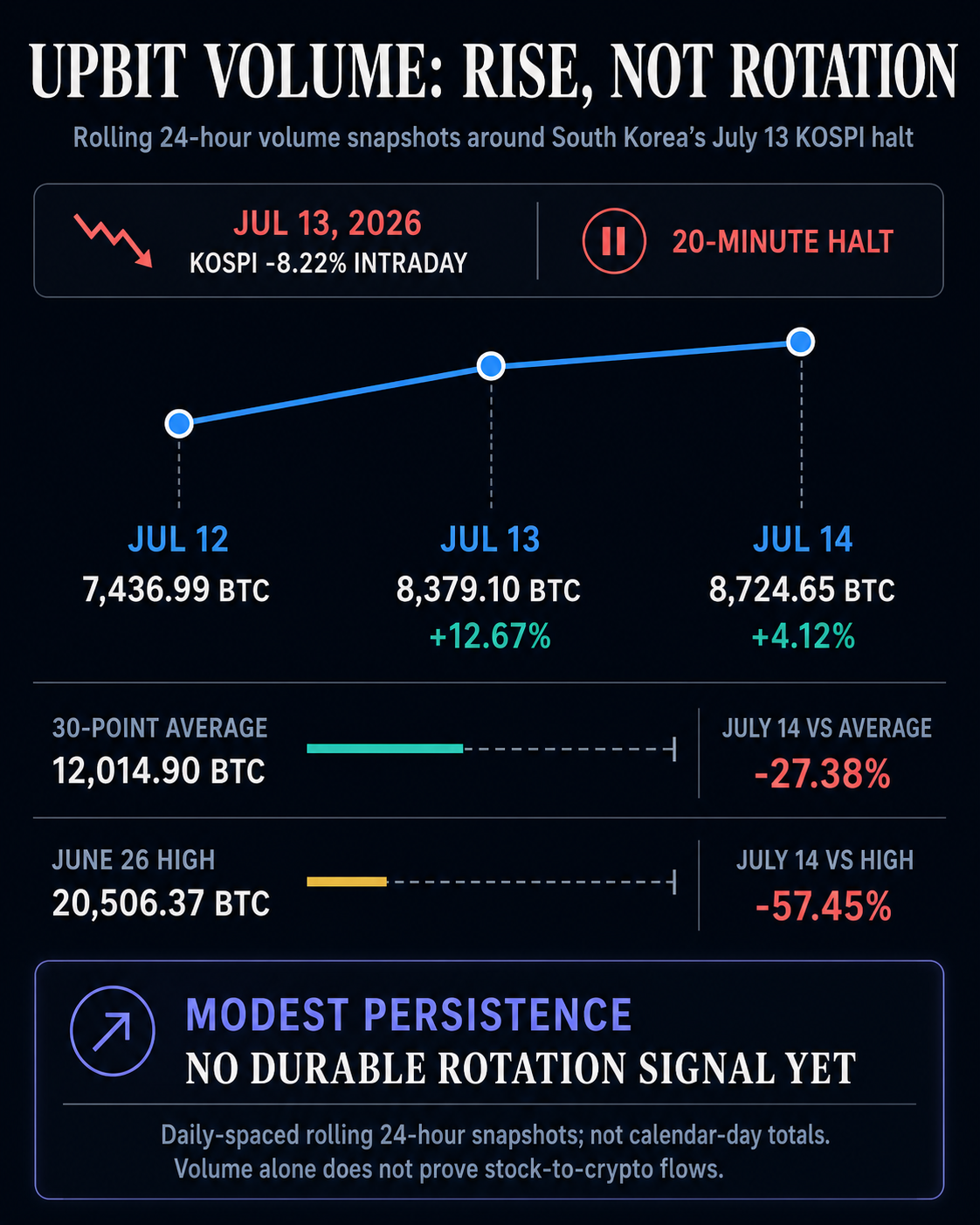
However, when South Korea's KOSPI fell as much as 8.22%, triggering a 20-minute halt on July 13, trading volume on Korean crypto exchange Upbit rose modestly, leaving little evidence that traders made a durable shift from legacy stock trading platforms to crypto exchanges.
KBS World reported the intraday equity decline and circuit breaker. The sell-off came as renewed tensions in the Middle East pushed oil prices higher, while steep losses in Samsung Electronics and SK Hynix amplified the decline across Korea’s chip-heavy benchmark.
Upbit volume rose from 7,436 BTC at 06:10 UTC on July 12 to 8,379 BTC on July 13, then to 8,724 BTC on July 14. That marked a 12.67% jump, followed by another 4.12% increase.
Today's number is still 27.38% below the 12,014 BTC average of the 30 observations and 57% below the series high of 20,506 BTC on June 26. Activity remains higher, but from a low base and without breaking above recent conditions.
Why the rolling window matters
Under Korea Exchange rules, a phase-one breaker activates if the KOSPI falls by 8% or more from its previous close within 1 minute, pausing the market for 20 minutes. It freezes trading during acute stress; it does not redirect investor funds.
The shock also landed in a highly leveraged market. KOFIA data reported by Yonhap showed that the combined average daily balance of margin loans and stock-backed loans reached a record 61.98 trillion won in the second quarter, up from 57.42 trillion won in the first quarter.
Evidence of a rotation would include Upbit's rolling volume remaining elevated across several observations after the event window has cleared and moving above, rather than merely toward, its recent baseline. Exchange-level volume would still need corroboration before it could be tied to Korean stock investors.
For now, Upbit activity neither vanished immediately nor broke into a new range. It rose modestly while remaining well below recent norms. So we got a brief increase in activity rather than evidence of lasting crypto demand.
Mentioned in this article


Editorial credits